Interview (Written): Alfonso Cuarón
A conversation with the writer-director of the movie Roma.
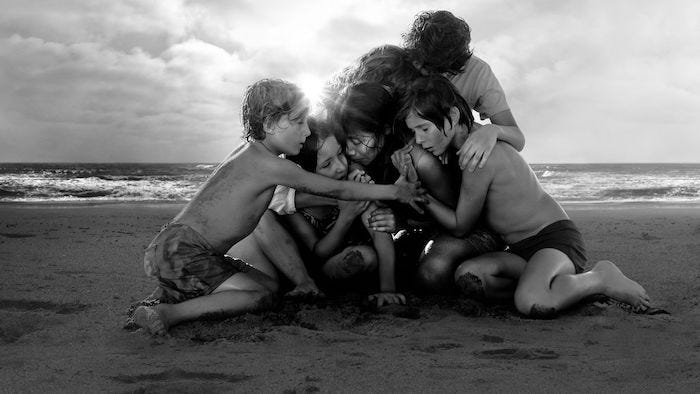
A conversation with the writer-director of the movie Roma.
Roma is a masterpiece, an incredible work of cinema. Deadline has an interview with its writer-director Alfonso Cuarón whose other movie credits include Y Tu Mamá También, Children of Men, and Gravity.
How close is this to your own story?
Ninety percent of the scenes that you see in the film come out of my memory. I’m not saying everything in this is linear, but what I did was compress around three years of memory into a narrative of 10 months. But almost every single scene is something I remember, complemented with the real-life Cleo [played in the film by Yalitza Aparicio]. I would talk to her about what she remembered.
And then there’s subtle elements of fiction because I wanted to include thematic elements that I found relevant both to character but also to this sort of broader story. What we tried to do is balance between character and a social context as well. Because we’re talking about personal scars. That is definitely a period that scarred me, probably for life. I can assume that it scarred the characters that play in the film. But also the social events that were portrayed are one of the most important and deep scars in the Mexican psyche. In the collective consciousness.
— —
You didn’t give anyone the script. You made this film as challenging as possible to shoot. Why?
Nobody had the script, and I shot in absolute continuity. That meant that I had talked to each of the actors about their character, about who they are. I talked to them about what they know, that not necessarily other people know. They had to keep it like this; they could not share that information with the other cast. I also talked to them about secrets they shared with one another. But they didn’t know the story, so every day they were playing out the story and learning their circumstances. And in that way, it was like life and it was playing with their own expectations.
Sometimes those expectations get fulfilled, sometimes it’s just boring and nothing happens. And sometimes everything goes against your expectations; that’s the unpredictable film.
Also, everybody you see in the film around the main characters, they’re real-life whatever they are. So we see real doctors and nurses. As we stage everything, I was just following their instructions, because they were the experts.
But, without wanting to give anything away, it was in so many organic moments that you realized this approach worked and paid off. There were many moments.
Here is a clip from the movie Roma:
For the rest of the interview with Cuarón, go here.
For 100s more interviews with screenwriters and filmmakers, go here.