Interview: Samantha Buck and Marie Schlingmann
An in-depth conversation with the co-writers and co-directors of the movie Sister Aimee which premiered at the 2019 Sundance Film Festival.
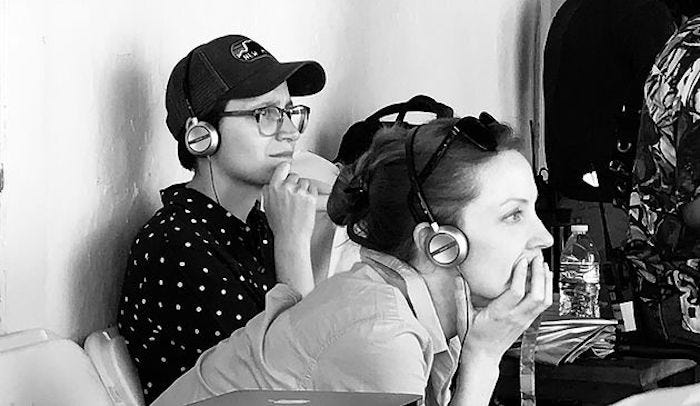
An in-depth conversation with the co-writers and co-directors of the movie Sister Aimee which premiered at the 2019 Sundance Film Festival.
The very first movie I saw at this year’s Sundance Film Festival was Sister Aimee. It was a 9:30AM screening on a Monday morning. I am not a morning person, so the fact I was so taken by this film should tell you something about how entertaining it is.
In watching the post-screening Q&A with the film’s co-writers and co-directors Samantha Buck and Marie Schlingmann, I was so struck by the story behind the story of how this project came to be, I decided I needed to interview the pair. I got in touch with their manager Lee Stobby which led to a 45-minute conversation which I am happy to share with readers.
Scott Myers: First of all, congratulations on the movie Sister Aimee and also, too, I see recently where you’ve signed with ICM Partners, is that right?
Samantha Buck: Yes.
Scott: Was that after the festival?
Samantha: After the festival, yes.
Scott: Very good. Let’s talk about your respective backgrounds. Now, Sam, a part of your interest has been documentary filmmaking. In fact, you directed the Peabody Award‑winning doc Best Kept Secret and that’s a recipient of a Sundance Institute’s Documentary Fund grant. How did you get into documentaries and then start moving into scripted filmmaking?
Samantha: It started with acting. I’ve been a professional actor for many, many years. I was on a television show (Big Apple) with a wonderful showrunner and writer, David Milch. He made everybody take his writing course. He did these writing workshops.
I did that, and Milch called me in his office a few months later. He’s like, “Listen. You should be behind the camera. You should be writing.” I was a young actor who wasn’t confident enough at the time.
There weren’t many examples at that point of actresses that were moving from in front of the camera to behind the camera. There’s Jodie Foster, basically, that was it, who’s a great example. I think I wasn’t confident enough to go for it at that point.
Then a few years after that show, I finally had financial stability and so, I had this opportunity to go down to DC to the March for Women’s Lives because my mother was friends with Ann Richards and Molly Ivins and all these incredible women. Instinctively, I thought, “Oh, I should bring a camera.”
Going behind the camera, that move did happen organically. Very quickly once I was into documentary film making, the desire to want to write and to work with actors, it was always there. How I was approaching doc film making was very verite, Frederick Wiseman‑esque approach where you were basically writing in the edit room with 100 hours of footage.
You’re outlining and writing the screenplay of the film with the footage. I applied to Columbia Film School. I got in when I was working on Best Kept Secret. I’m very happy that I did, because I walked into Screenwriting One, and I met Marie Schlingmann.
Scott: Marie, let’s talk about your background. Photography, gender and sexuality studies, political campaign ads, and I think you’re based out of Germany.
Marie Schlingmann: Yes, I am German. I grew up in Germany. I’ve always had a knack for writing. I’ve always loved films. I didn’t go into it immediately. I did my undergrad in Berlin, which was gender studies and cultural studies and then later American studies.
During that time, I very quickly was more interested in doing photography on the side. I interned and then later worked at a very good production company in Berlin who did international co‑productions. I was much more interested in that.
Funnily enough, I think English is working better with my creative brain, my writer’s brain. I never wrote screenplays, maybe a few short stories, but that’s it, in German. I only wrote them in English.
It was very clear to me that at some point after my undergrad studies and working in this production company that I wanted to do this, and I wanted to do it in the States. I applied to film schools, and I ended up at Columbia, which was good.
Samantha: Fortuitous.
Scott: Were you both screenwriting concentration there?
Marie: Basically, directing, screenwriting is very mixed. I think I came in officially as a screenwriter, and I think you came in…
Samantha: I came in as a director.
Marie: …as a director. You can focus on one thing, but you don’t have to. Both of us chose Columbia because it gives you the opportunity to do writing and directing in equal measures.
Scott: Did you start working together on projects when you’re at Columbia?
Samantha: Yeah. Very early on. I’m not joking, Screenwriting One. Remember, you brought something in. I knew I want to work with this woman. I need to know her. We started meeting right away outside of class and shared each other’s work. We gave each other notes.
Again, it happened organically, where I was interested in what she was doing. She was interested in what I was doing. We both recognize that when we came together, it felt like something even more potent was happening in that combination. We started co‑writing and working on each other’s short films and collaborating from the get‑go.
Marie: I think that a little bit into Columbia, we started to actually write together. Then obviously, while you’re in a film school setting, you have to be on your own a little bit because that’s how they grade you in things. After Columbia, we’ve only written together.
Scott: You’re a couple.
Samantha: Yeah, and we’re married.
Scott: How does that work for you in terms of division of labor? Just strictly about screenwriting, how do you go about working that as a couple?
Marie: It is the one thing that we always say is, every couple has their issues. Ours is we have to sometimes remind ourselves not to let the work seep into everything we do. Obviously, as a screenwriter and as a writer and a director, it’s always on your mind. You’re always thinking about something and talking about it.
That’s our bag to carry as a couple. As partners for the writing process, it’s great. It’s wonderful. We have a pretty set process at this point that usually starts with us brainstorming together for quite some time and then going into our corners or wherever and doing our own research, coming back together.
Then once we’re ready to lay it out, we work for a few weeks, depending on the project, together in front of our board, put it all up there and really structure the screenplays. We’ll talk it all out as much as we possibly can. Then Sam, she’s a very fast writer.
Samantha: I vomit, basically. [laughs]
Marie: I am not a fast writer, so that’s good. She’s very fast. She usually goes in first. She lays it down and moves as fast as she can. I come in behind her and fill it out.
The good thing about it is that by the time Sam stumbles upon a problem, because obviously, there’s always problems the second you start putting it on the page. No matter how long you’ve structured it. She can say, “Whoa, whoa, whoa. We have to stop. We have to look at this. We have to figure it out.” We stop. We do it. Then we go back to our respective places.
In the same way, I can point to things that might have worked when it was a very fast‑written scene with XXX here kind of stuff and can say, “No, when you build it up, this isn’t working.” She can come back. We figure it out. By the time we’re through an entire screenplay, it is almost two passes of a script.
Samantha: I’m sure, if our cat could speak, it would be like, “No, let me give you the inside scoop. They drive me nuts when they’re working.” I think it’s part of the DNA in terms of our relationship, working‑wise, creative‑wise, and romantic‑wise.
I don’t know how people who aren’t married…I don’t know how they do it. You know how it is. It can be so all‑consuming in moment. We get an idea at 3:00 AM. We’re right there to wake the other person up and not let them sleep either.
Scott: Let’s talk about your movie Sister Aimee which debuted the 2019 Sundance Film Festival. It’s also going to be playing at South by Southwest, nominated for their Gamechanger Award. Here’s a plot summary.
“In 1926, America’s most famous evangelist is a woman and she’s looking for her way out. Fed up with her own success, she gets swept up in her lover’s daydreams about Mexico and finds herself on a wild road trip towards the border, based on true events, mostly made up.”
I actually have a theological background. I’m familiar with Aimee Semple McPherson, how popular she was in Los Angeles. She was almost a cult figure there, involvement as a Pentecostal faith healer in that church, Angelus Temple, which is still around near Echo Park in East Los Angeles.
How did you discover this character, which sends you into this journey of writing and directing Sister Aimee?
Samantha: We have Anna Margaret Hollyman, actually, to blame and credit for so much of this. We had made a short film with Anna Margaret a few years ago. We just had such a wonderful time with her. She’s an incredible collaborator.
After that short film, she said, “There’s this woman, Sister Aimee Semple McPherson. She’s the kind of character you two would really be into, the kind of character you guys like to write. You should look her up.”
We went into a Google black hole. She was right. Aimee is totally fascinating. By the time we got around to thinking about writing the screenplay, what interested us was that span of time of when she went missing and when she came back.
That is the truth in the film, that in 1926, Sister Aimee Semple McPherson did vanish for a chunk of time. We were interested in this question of, what would make a woman, mostly from that time at the height of her popularity, her power, what would make her run away from all of that and what would make her come back?
It was just very convenient that nobody really knows what happened. That gave us an opportunity to make stuff up and…
Marie: I think that what we wanted to do and what we hoped we’ve done is, take some truth about the character, about what kind of powerful performer and witty personality she was and say something about women’s ambitions and how easy it is to usurp female narratives but do it in a way that is not factual, that is more existential truth than factual truth.
Scott: I think you said it was five and a half percent true…
Marie: Yes.
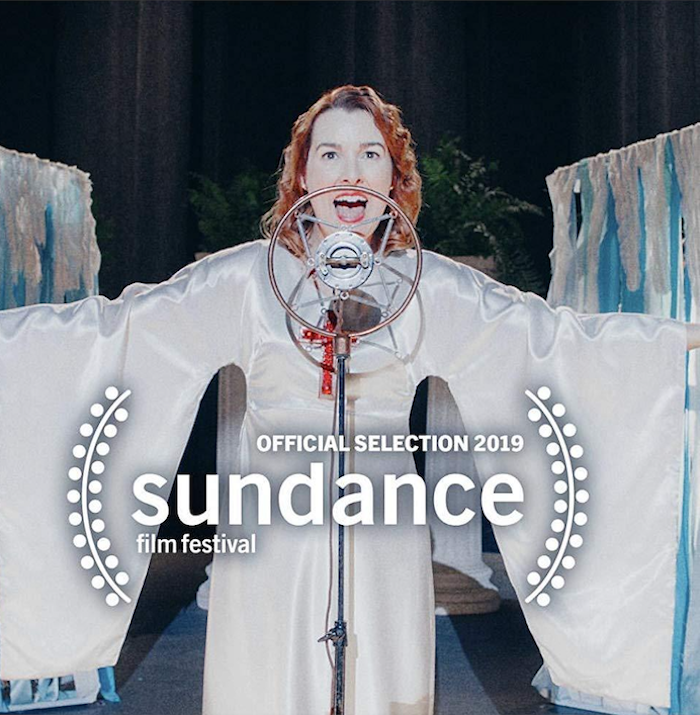
Scott: Stepping back and looking at this as a storyteller, that’s just great because it’s a pre‑branded content, if you will, because she’s a personality. Historical stories seem to be quite popular right now. You got that gap, five weeks, of when she disappears, in which you could just tell whatever story it is you want.
Let’s talk about the tone of this film because it’s this really vibrant mashing of genres. You’ve got a mystery, drama, comedy, fantasy. A Western feel to it. Road picture. There’s even a musical component. Did you know the tone of the story you were going for upfront or did this wonderful meshing of styles emerge over time?
Marie: It did emerge over time. We were pretty clear from the get‑go that we wanted it to be kind of a wild ride because we felt that was appropriate for her character. We knew very early on that that would be some genre mash‑up in this story.
Also, she was a pioneer of radio, of media. We also wanted to add that feel of the 1920s radio, play to it. The idea of something that was very unorthodox in terms of genre and genre boundaries. That was pretty clear from the get‑go.
I think that developing it and then also working with actors, working with Anna Margaret very early on, during the writing process, the specificity of the tone revealed itself.
Scott: By the way, her performance is terrific, Anna Margaret Hollyman.
Samantha: Isn’t she wonderful?
Scott: She really is. There’s a great scene where she first meets Kenny and they get rather delicately close to each other. That’s a long scene, to be sitting like that in a slip on his lap. I’m just thinking, as an actor, “That’s interesting. How would you handle that?” She did such a great job.
Marie: A little behind the scenes tidbit about that scene. That is a very long scene, a very long dialogue scene. She is basically straddling him the entire time. We shot that on a day that was 110 degrees in Texas. We blasted air conditioner into this room, but it wasn’t really doing anything. Real kudos to those two actors…
Samantha: Michael and Anna Margaret.
Marie: For sticking with us.
Scott: Let’s talk about your story’s protagonist Sister Aimee. You start the story in media res, she’s in the middle of a faith healing ceremony at the height of her fame. There’s this woman in a wheelchair she’s supposed to heal, but Aimee just walks away. It’s almost like you’re introducing us to her in the midst of a midlife crisis.
Samantha: That’s exactly right. One thing about Aimee that…We did a lot of research about her. There’s people that are like, “She was a charlatan. Did she heal or didn’t she heal?”
There’s all of these narratives around her, but something that was always pretty consistent or is consistent is how people talk about what a great entertainer she was. Charlie Chaplin would go see her shows at the Angelus Temple.
Betty Davis is quoted, “She’s the best play performer she ever saw.” We wanted to approach her in her midlife crisis from that perspective of what happens when you can no longer perform. In Aimee’s case, and in her art form, part of her performance in stage performance is healing people.
We thought, “Well, if you’re unable to perform any more, a writer who cannot write has writer’s block.” That lends itself to a midlife identity crisis and that kind of pressure would make you want to run away.
Marie: It opens up a space in your life where something else can come in. In this case, it’s this lovely, radio engineer Kenny, who has the kind of passion for something that she is lacking at that moment.
She sees, in him and in the story that he tells her, something that she feels is missing from her life in that moment.
Samantha: Aimee is the type of woman who loves a good storyteller, because she is a good storyteller.
Scott: Interesting. I know that chopping away to the end of the movie, at one point she has to claim. She says, “I’m an entertainer.” She is trying to do that in order to save her skin, and so when you introduce her, you’ve got a great line of scene description in the script. You say, “She is Carole Lombard with a dose of Christian righteousness.”
I thought that was interesting, because he didn’t say, “She is Christian righteousness with a dose of Carole Lombard.”
[laughter]
Scott: You had that sense that the proportions there, more Carole Lombard than Christian righteousness. From the beginning, you had that understanding of her character.
Marie: Yes, I think that was for us. This wasn’t as much a predominantly religious story for us. She was a very religious, very devout person, but for us, the aspect in her that we could really tap into was the performance, the entertainment aspect, so we wanted to push that very early on.
Samantha: Anna Margaret also, when we act we work with her in that story, so much of our Aimee, so much of it is Anna Margaret, too. When we worked with her and a sort of the main capture after experience, we both thought, “She is Doris Day. She is Carole Lombard.” She should have been doing…
Marie: …comedies in the 1930s. [laughs]
Scott: I was struck by your comment just previously, about how she is in this crisis point like a writer’s block or psychologically just not connected to what she is doing. It reminded me of the “Hero’s Journey,” how Joseph Campbell talks about the heroine at the beginning of the story, that they’re just making it through, they need to change. That seems like a fair appraisal of her situation at the beginning. Yes?
Samantha: Yeah.
Marie: Yes, for sure.
Scott: Then the call to adventure. She runs into this guy Kenny. How would you describe his character?
Marie: To a certain degree, it’s not as much as him, but the story that he tells her that is really the thing that pulls her away, that gives her this call to adventure and this idea of, “Oh, there’s something so exciting somewhere else and you know what? I can be a nobody.”
Because this guy really wants to make it in Mexico as a writer and I can be his muse. He sweeps her off her feet, in that moment, genuinely, but what she pretty quickly learns is that Kenny is not as talented as she thought. He is a radio engineer. He is not a storyteller on the radio.
Scott: Yeah, he’s got a pretty inflated sense of himself as a writer, and fashions himself after that, like someone like Jack Reed…
Samantha: Yeah.
Scott: You talk about this story that he shares with Aimee, while they are in that interesting position of straddling, in a way that really catches our imagination, “The Hero With No Name.” Is that an actual folktale or is that something you all made up?
Samantha: It is.
Marie: It is totally made up.
Samantha: We certainly looked into especially female fighters during the Mexican Revolution and afterwards, but this is not as any specific tale that we’ve taken.
Scott: It takes on quite a bit of significance in the movie. There is a mystery element to it and as I said, it inspires Aimee to take off to Mexico with Kenny.
As I’m watching the film, it also plays to a central theme I find running in your movie. That’s this, the stories we tell ourselves about ourselves. Like Aimee has told herself a story about being a faith healer and spiritual leader. Kenny has told himself a story about being a great writer of the common people. There’s a story, A Hero with No Name, which at other points other characters claim to be the unnamed hero.
There’s all these stories you drop in throughout the movie where people are telling stories about Aimee’s life over the years to these LA detectives. There was a story that Aimee insist Kenny tell when she sends him back to LA to clear up the gossip which has sprung up.
Then there’s that story she ends up telling the musical version of it to the Mexican police. I’d like to get your thoughts on that, because this is a possible theme in the movie, “the stories we tell ourselves about ourselves.” How the stories can help to define who we are, but also trap us due to the confines of the narratives or free us by telling new stories. Did any of that resonate with you?
Marie: Yeah. Yeah, absolutely. Really, for us, this was very early on it. “Oh, we’re making it.” This is a story about storytelling and about the power of storytelling, the privilege of storytelling. There’s also the idea that Aimee, in the beginning of the movie, is a person who actually has the power to tell her story, to tell it in the way that she wants it told, and she gives that power up.
The moment that she runs away from it, which opens up this space for other people to tap in and say, “No, no, no, no. Let me tell the story of this woman,” her gradual awareness of her lack of that power and then her reclaiming it is part of the narrative.
Samantha: Then the same things about the character Greg was this guy that they end up hiring to help them cross the border, because Aimee is in all the papers.
You have this other woman who ‑‑ again when we were doing research about Mexico and what’s happening in Mexico at the time and all these artists going to Mexico City, and it’s like hang out with Diego Rivera ‑‑ we researched these women who were fighters in the Mexican Revolution.
Some of these women, what happened to them afterwards and how their image was transformed and morphed into these sexual paintings. Just completely false for a lot of them.
We thought it would be interesting if you have this other character who is a lot like Aimee in terms of wanting immortality and ambition, and really good at what she does, but she has never had the ability to control her narrative. Her story has been taken by everybody, and no one will ever believe that she is who she says she is, her story is what she claims it is.
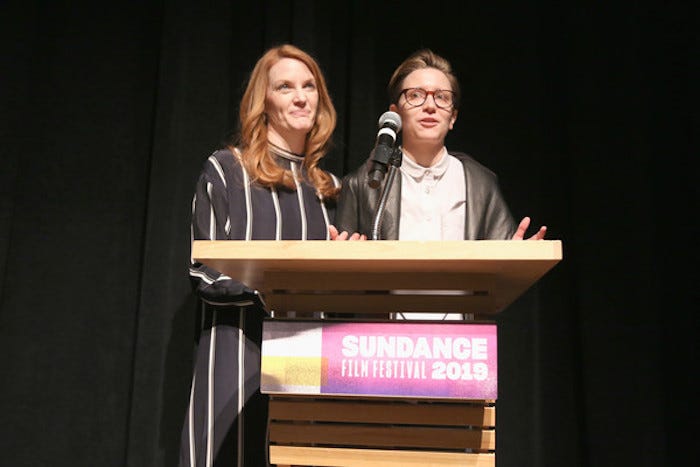
Samantha Buck and Marie Schlingmann at the premiere of ‘Sister Aimee’ at the 2019 Sundance Film Festival
Scott: I wanted to get to Rey because she is a really terrific character in the movie and has a profound influence on Aimee. They develop a very special connection. Rey is basically going to help them get to Mexico because she is familiar with the area, she speaks Spanish.
Over time, Aimee’s affection shifts from Kenny to Rey. I saw in an interview with you at Sundance where you said, “We thought that it would be an opportunity to fictionalize and talk about female identity.” Could you talk a bit about that and how it plays out with Aimee and her relationship with Rey?
Samantha: Yeah, we’ve always though of these two women as soul mates in their quest. In life, they’re both really good at what they’re doing and they’re very subtle. In a way, they’re both in very male‑dominated worlds. If it’s just thinking, “Where’s a guide?” or “She’s a fighter” and Aimee is an evangelist. They share this identity, but they’re also very definite. There’s also elements of misunderstanding in their relationship.
There is an element of fetishization from Aimee’s part that Rey has to call out. It was this relationship, which is really, at the end of the day, that’s the romantic relationship of the movie and more so than Aimee and Kenny.
It gave us an opportunity to explore where identity can overlap and what the limits of that are, and how important it is to be able to claim an identity. If you can’t, then that is the one thing that becomes overwhelming in your life. You want to claim it or you want to reclaim it.
Scott: Aimee is absolutely dealing with the question of “who am I,” right?
Samantha: Yes, absolutely. Because, in the beginning, she is the image that everybody else has of her. She is this larger than life thing that she created and she’s lost her connection to it.
From the whole movie, it’s her running away from it. Being, quite literally, identity‑less in moments, she is not the person pulling the strings in every part of the movie. She is being put into the back seat of that car and that’s where she has been, pretty much without an identity.
On her way back, she has to go all the way where…There’s this moment in Mexico when she looks into the papers and the papers have been tracking what the people in LA say about her. She’s very angry about what people have been saying.
Then there’s this moment when she’s in Mexico and looks into the newspaper, and she’s nowhere in the newspaper. That is even worse. She has to go all the way away from her identity in order to claim it back and fully. That’s why we put the title in the end of the song.
Marie: They are both creating narratives around themselves or want to. They’re closer than maybe you would think if you’d just look at their lives.
Samantha: Yeah. I think quite the nature of Rey’s life in terms of she should be a larger‑than‑life, famous personality. She’s just not given the privilege of being able to be identified for all of the things that she’s done. She was a great warrior in the Mexican Revolution. She is other things that we can’t say they don’t know it, anyway.
Her life experience is not getting credit for the things that she’s done versus Aimee. She’s fought for her position of power, and for her fame, and her fortune, and her audience, no doubt, but…
Marie: She’s also given that away on her own account.
Samantha: Yeah. She’s able to give something away. At some point, she’s able to get credit for the things that she does versus Rey has never been given credit.
Scott: I’d like to talk about that final sequence where Aimee has to convince these Mexican figures, these authority figures that she’s just an entertainer, basically. At that time, they were persecuting religious people, right? That scene is so much fun and so fanciful. It’s a musical at that point. How soon did you hit on that as like, “We want to have the big, culminating thing be that”?
Samantha: Actually, pretty early on when we were writing the first draft. We knew that in Mexico, at the time, it was the brink and the beginning of the Cristero wars. Aimee, factually, was found walking from Mexico into Arizona. We were like, “Oh, that’s interesting, that she was there when this whole religious war was brewing.”
We knew that somebody would have to find one of her costumes. What would she do, knowing that the whole journey is about her trying to like her identity, embracing herself? It was very clear that they would have to find the costume.
She would have to convince them that she’s an entertainer and the musical aspect of it also early on, because of how her shows were described at the Angelus Temple. They sounded like they were Broadway shows.
We thought, “Well, what better way to end this journey for Aimee than for her fully embracing this character, and this persona, and who she is and for the audience to be able to see full‑out what a great performer she is?” Since meeting her in the very beginning of the movie, at the time where she could no longer perform, we knew we had to put on a show at the end.
Scott: That’s great, really enjoyed the movie. Let’s talk about the process of how it got made. You write the script. Did you have any financial backing or, at that point, your interest, or was this entirely on spec and then based on the script, you got things moving forward?
Marie: Yes, we had nothing in place. It came in a moment in our lives too when we were in development on a lot of things that we didn’t know if they were ever going to happen. We felt like we have to write something that is doable on an independent level.
Obviously, we were still ambitious by making it a period piece and a road trip. There’s musical number and violence and all of these things, but we were very confident that we could write it in a way that would allow us to do it for not that much money.
We wrote it in a month. We went away. We stayed with Sam’s mom and just wrote it in a month, which was April 2017. Then we had a producer that we were working on something else with. We felt like she also wanted to make something and make something quick.
We gave it to her. She really went with it. Basically, a year after we wrote the first draft, we were in pre‑production. All of that came after the first or second and third draft, really.
Scott: I can imagine. I’m sure you just stretched that budget dollar. It really feels like a substantially larger‑budget type of a thing. You had that in mind when you were scripting it, stretch the dollars?
Samantha: We did. We definitely did. Also, we talked to our DP. Before we wrote the first draft, we met our DP, Carlos, for a drink and said, “We’re going to go away and write this. You were going to shoot this.”
Again, he’s super talented photographer who also needed a feature under his belt, and our production designer as well who we’ve worked with on two other short films. We’re like, “We’re going to go away and write something, and we’re going to send it to you.”
We started talking about visual language and talking about production design limitations, all of those, all of that stuff from the very beginning. As we were going through drafts, we were addressing things that we knew could bite us in the ass later on.
Then we got also lucky with the community down in Austin, Texas and being able to get really great locations for good price and people pitching in in the right way. I would say the directing and the writing were going hand in hand from the very first draft. We knew we wanted to shoot it.
Scott: How long was the shoot?
Marie: 20 days.
Scott: 20 days, wow. I remember that when I saw it at the screen, it’s Sunday. I said Anna Margaret talked about how together and in sync you all were and the production was extremely smooth, at least in terms of how you knew what you wanted to get. Maybe talk about that process, the 20 days of making the movie.
Marie: Yeah. You know that that’s going to be super intense. You don’t feel like it’s enough for sure, but you also know that. Again, we had started so early on to pull the heads of departments into the process that we felt everyone would be really prepared by the time we were starting, including our first AD who’s a dear friend of ours. He was living in Hong Kong.
We said like, “OK, guys, we know who it is that can help make this movie in 20 days.” He was really well‑prepared. We actually started shooting…It gave us a heart attack, but it was very wise from our first AD.
We started with the musical number. It was the first thing we shot. Two days, it was 54 shots. Two days, it was insane. We knew it was going to set the tone. Also, it would allow the actors to be prepped because in that kind of schedule, there’s no time in between to go and rehearse a musical number once you’re off and running.
It was a very fitting beginning to a really intense shoot, but we were so aware that we would lose…You’ve read the script. There’s not a lot of fab in there.
Scott: No, not at all.
Marie: We knew there was not like, “Oh, you know what? If we don’t shoot these four scenes, we’ll be fine anyway. We can figure something out.” We knew that if we’re losing whole scenes, we’re losing the movie. We also knew that there were very little chance that we were able to do any kind of reshoots. We were very disciplined in order to get everything.
Samantha: I do think having Hugo, our first AD, there and Carlos, our DP…You always have to be prepared to cut shots, but we preemptively, even before we started day one, the four of us, we were on the same page. Hugo and Carlos really understood what we wanted creatively.
We went in earlier than sometimes you have to or want to and got real practical in terms of what’s possible and what’s not possible. We still were met with challenges. The crew was hired also in New Mexico. We had five days to do all these exteriors. It was monsoon season.
Every day, two o’clock, production is being halted because of a monsoon. We can’t go into over time, so there’s parts of the movie where you understood like, “OK, we have to figure out how are we going to get this into a shot, have the film have the same integrity. We either get this scene or we don’t have a movie.” We can’t be precious. We got to figure out how to do it with no pillow time.
Scott: The project is with Endeavor Content. Have you got a distribution set in place at this point or no?
Marie: It’s all still ongoing.
Samantha: There’s talking.
Scott: You got another movie project in the works called “The Big D.” Can you tell us something about that?
Marie: Yes, we are working with our same producer, Bettina Barrow, and her producing partner, Lily Rabe, who’s a wonderful actress. She’s attached to one of the parts. It’s another period piece, but this time, it’s set in 1980 Dallas, Texas during the presidential election. It was also a massive heat wave in that city.
It’s the story of three women who…We’re staying true to our passion for themes. They’re all going through an identity crisis and are all bound together by this strangely cinematic time and place.
Scott: Lily Rabe was in the movie by someone I know very well, Julia Hart. She wrote and directed this movie with Stevens?
Samantha: Yes. She’s wonderful in it.
Scott: Yeah, it was great. Excellent. Good to hear. One last question for you. I was to ask the filmmakers this because people will read this on my blog. Most of them are trying to break into the business. What advice can you offer to aspiring screenwriters and filmmakers about learning the craft and breaking into the business?
Marie: Patience.
[laughter]
Samantha: I think it’s two different things. In terms of screenwriting, it’s cliche that people say, “You just keep writing. Keep doing it every day.” That’s very true. You have to keep that muscle going. Then that muscle will expand and get better. Your voice will develop and be bold.
We watch tons of movies. We break down tons of scripts by other people. Then we try to find our own voice within it. We’re still developing that. Just keep writing, and going with your gut, and learning. In terms of the business…
Marie: I just want to add one thing. It’s stealing from one of our professors and a good friend, Tom Kalin. He always specifically about your first bigger project, your first feature that, “Flawed, it can be. Bold, it must be.” That is a really good thing to live and work by.
Samantha: I agree. In terms of the business ‑‑ I say this particularly to women a lot of the times ‑‑ Anna Margaret is always like, “Don’t be too precious, and put yourself out there. Put your work out there.”
A very early draft of our Dallas scripts that we’re hoping to make next, that’s the first thing we collaborated on. We had a super early draft. We put it in the Nicholl Fellowship. That’s how we found Lee. That’s how we found our manager.
There was part of us that went to this place of, “It’s not ready. I don’t know. Should somebody…?” You have to just get rid of that a little bit and be willing to put yourself out there. Know that there’s a lot of doors that will slam and a lot of people that will say no, but be confident. Don’t be too precious.
Scott: That’s funny you say that. I met a mentor and a workshop leader for every single Black List Feature Writers Lab. They’ve had 12 of them, including one they did in conjunction with the women in film.
I was with six women writers. We had a special session with Aline Brosh McKenna. She said exactly the same thing. She said, “Women, oftentimes, they think they have to find permission to do things.” She said that, “I think we should be more like guys.”
She spread her legs and slap her legs, imitating a guy like, “OK, I got it right here,” that braggadocio, that bravado, that sense of entitlement. It was a very enlightening moment for me as a guy with my own sort of blinders. I think that message is an important one. Don’t be so precious with it, right?
Marie: Yeah, for sure.
Samantha: Yeah, just put it out there.
Scott: Put it out there.
Marie: Nobody’s going to read it if you don’t put it out there.
Here is a short video featuring Marie and Sam at the 2019 Sundance Film Festival:
I hope the movie lands a decent distribution deal including a theatrical run. If so, I highly recommend the film. Why wouldn’t you want to watch a drama-comedy-fantasy biopic-western-road picture-musical?
For more exclusive Go Into The Story interviews with screenwriters and filmmakers, go here.