Interview: Phil Hay, Matt Manfredi, and Karyn Kusama
A conversation with the co-writers and director of the movie Destroyer.
A conversation with the co-writers and director of the movie Destroyer.
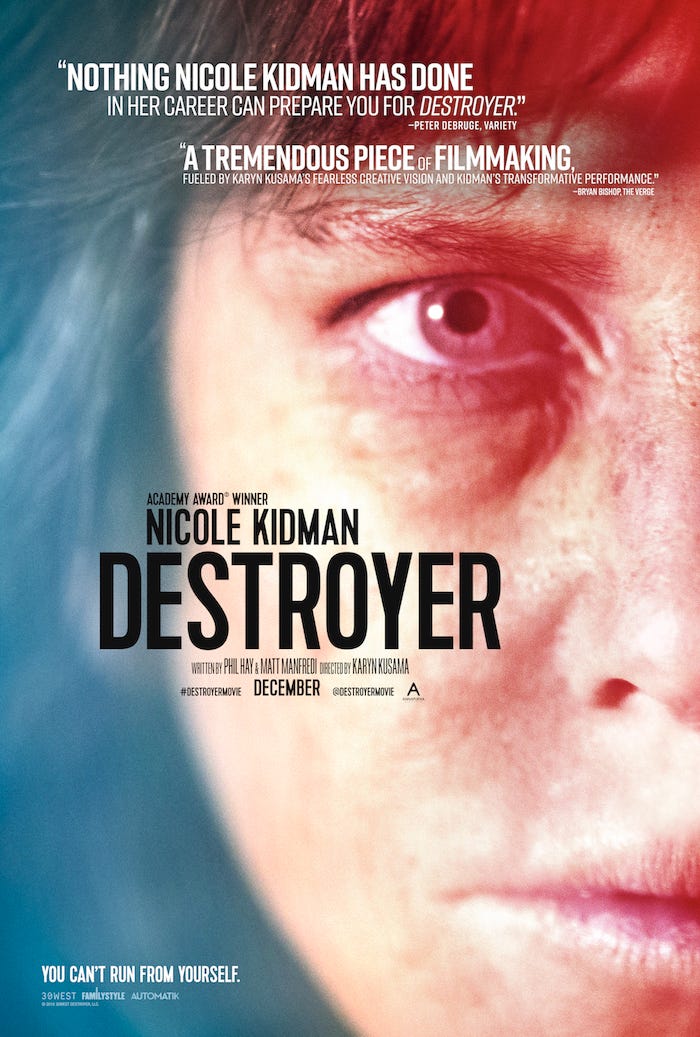
The movie Destroyer, which stars Nicole Kidman, screened at Fantastic Fest in October 2018. While there, the film’s screenwriters Phil Hay and Matt Manfredi, and the movie’s director Karyn Kusama sat down Deirdre Crimmins for a Rue Morgue interview. Hay and Manfredi’s screenwriting credits include Ride Along, Ride Along 2, and excellent 2015 thriller The Invitation, which was also directed by Kusama. Some interview excerpts:
Where did the idea for DESTROYER come from?
Matt Manfredi: Like a lot of the scripts that Phil and I write, we marinate on the idea for a long, long time.
How long is “long”?
Manfredi: This one we started talking about ten years ago.
Phil Hay: Yeah, it was ten years ago.
Manfredi: We had this idea for a cop movie with the structure you have seen. It was complicated enough that it took a bit of tinkering, and going back and forth, and thinking about. We would pick it up, put it down, come back to it, over the course of other projects we were working on. Then we hit on the character of Erin Bell. That clarified it for us. That’s when we felt that we could sit down and write it.
Hay: At that moment, the three of us said “ok, let’s approach this as a movie we want to make.” It really was about finding that character.
How does the process of writing work between the three of you?
Hay: Matt and I cook on it for a long time. Then–we were really hopeful Karyn would be interested–we talk to her about the general idea. About the general world. In this case, we started talking about the character. Karyn would see some stuff while we were writing.
Manfredi: In this case, Karyn was instrumental in figuring out who this character was. That she had to be a woman. That she had to be this specific woman. Before we really started writing we walked Karyn through the story. We wanted her to know, from the beginning, the ins and outs, and also to get her thoughts. She had some adjustments and ideas. While we were writing, Karyn was immediately in the visual process.
Karyn Kusama: I collect a lot of visual material before I start actually directing. In this case, from the story that they were outlining, I had a sense of the visual. I knew the direction I wanted to take the landscape and language. As you guys write, we collectively listen to quite a bit of music that drives the creative process. Once I see a script, we start talking through, scene to scene, transitions and sequences. At that point, when we get to a place where we are happy with where the story is, we share the script with our composer (Theodore Shapiro), who I’ve worked with in nearly all my films. He actually starts writing the score before we even start shooting. A lot of tonal elements start getting clarified, even if we aren’t sure who is going to be in it, or how much money we have.
Hay: We see the images Karyn is starting to put together as she is writing, and that is inspiring.
— —
You mentioned it was important that the main character is female. Why?
Manfredi: Our goal is creating these relationships, especially her relationship with her daughter, but also her relationship with her estranged ex, and he relationship with the other cops. Our hope was always that she would not just be one thing. To try to make a story where she could be…
Kusama: Dimensional.
Manfredi; Dimensional. She could be many things. These things could contradict one another. That’s our goal with the story, but then Karyn and Nicole [Kidman] come in and bring those depths. They create this 360-degree look at a character, which is tricky. There is a way to do this story where it is a man, and they are relentless, and they don’t have any attachments. All of these things we actually want to interrogate, as unhealthy things
Hay: What we didn’t want to do is just swap out a woman for a man, in a cliche detective role. We were aiming for someone who was wholly rounded.
Manfredi: And then hopefully the energy of the movie would be a female energy. It would be questioning the specific “maleness” of that story.
Kusama: Well, also the idea of what happens to any of us when we have a badge or a uniform or a title, that assigns us a certain amount of power. Inevitably that power then gets abused. No matter how much we want to see ourselves on the right side of the law, a lot of the stories we see in movies are about the transgression of power. We wanted to also explore what that is like for an audience to see, though a female perspective and experience. It gives us a window into the flaws of power itself.
Here is a description of the movie put out by the film’s distributor Annapurna Pictures: “Destroyer follows the moral and existential odyssey of LAPD detective Erin Bell who, as a young cop, was placed undercover with a gang in the California desert with tragic results. When the leader of that gang re-emerges many years later, she must work her way back through the remaining members and into her own history with them to finally reckon with the demons that destroyed her past.”
The movie’s trailer:
Here is an Academy Conversations post-screening Q&A with the filmmakers and Nicole Kidman:
For the rest of the Rue Morgue interview, go here.
For my 2016 interview with Hay and Manfredi about their movie The Invitation, go here.
Twitter: @phillycarly, @MattRManfredi, @DestroyerMovie.