Interview (Part 6): Wenonah Wilms
My interview with the 2018 Nicholl Fellowships in Screenwriting winner.
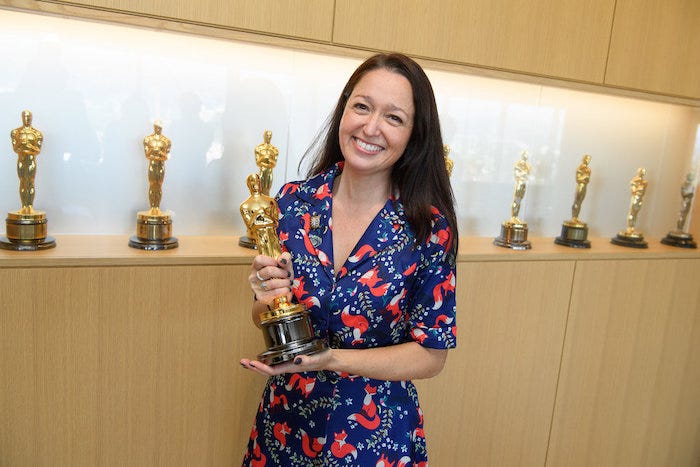
My interview with the 2018 Nicholl Fellowships in Screenwriting winner.
Wenonah Wilms wrote the original screenplay “Horsehead Girls” which won a 2018 Nicholl Fellowship in Screenwriting. Recently, I had the opportunity to chat with Wenonah about her background, her award-winning script, the craft of screenwriting, and what winning the Nicholl has meant to her.
Today in Part 6 of a 6 part series, Wenonah talks about what the Nicholl experience has meant to her and offers advice to aspiring screenwriters.
Scott: How about theme? Are you one of those people that starts off with a theme or some themes in mind? Do they emerge as you’re writing the story?
Wenonah: I think the second way. It goes backwards. I think I go back through and think about what I’m trying to say and then see how I can incorporate that in each scene or plot point or theme. For some reason, I never think about it in the beginning. I don’t know.
Scott: Most writers I have interviewed, the same thing. Stuff emerges as you go through the process. What about when you’re writing a scene? Do you have some specific goals in mind?
Wenonah: Conflict. I know that’s trite but it’s always in the back of my head. Ramp it up, ramp it up. My husband will read my pages. He’ll hand it back and he’ll be like, “You’ve got to throw more shit at them. More conflict, more conflict.” Each scene, I always tell other writers, “You cannot have enough. [laughs] More, more, more.”
Scott: The convention was to write, put the protagonist through hell and back. Boy, you really did that in the whole… including one moment. She’s out in the middle of South Dakota. There’s a buffalo stampede.
Wenonah: I honestly didn’t know if that was too much. I handed this to somebody. I said, “There’s this buffalo scene. I might have gone too far.” I was like, “I kind of love it. Why not?” [laughs]
Scott: Why not? Movies are visual cinematic experience. It’s great. She sees these things thundering by. You get that with the first draft out for you. I just turned it to the Nicholl to win. Most people, they got to rewrite the script. I’m sure you have rewritten. You talked about rewriting that first script.
Wenonah: Yes.
Scott: What’s your rewrite process like?
Wenonah: I’m pretty lazy, which is why I don’t like to rewrite. I tend to rewrite as I go. I’ll open up whatever I did yesterday and reread it, tighten it up. Then I’ll write my pages for the day. Then I do what I call bread crumbs. I will write like two or three sentences of what I want to add on tomorrow.
I always try to leave my writing for the day on a cliff hanger so that I’m eager to pick it back up again. I hate rewriting. I hate opening it up and having all those red marks all over it.
I’m a very fast writer and I’m a very fast rewriter because I think I just don’t want to deal with it anymore. Once I fade out I’m sure everyone is the same — At that point it looks more like a job. When I’m doing rewriting it feels a lot more like a job than my passion.
Scott: How do you go about your actual writing process? Do you write everyday or do you spread like bust? Do you go work in private? Do you go to coffee shops? Do you listen to music? Does it have to be quite? How do you write?
Wenonah: All of it. To me a fivepage day is a minimum, doable amount without going crazy. 10 pages is a good day for me. I’ve had a couple 20page days in my time, but not often. If you think 10 pages a day for 10 days is a script, so 5 pages in 20, I like to massage the numbers quite a bit. I like the goal. I like the end.
Like I said, I’m quick. I spend a lot less time on the writing, I think, than on the planning, and then the whole rest of the thing. I don’t write every day. I’m not a journaler or a diary keeper. I’m not precious about it. I just drink a lot of coffee.
Scott: Coffee, yeah. Do you know there’s a software or an app, it replicates the sound of a coffee shop? You can add chatter. You can add the barista doing the…If you like to write in coffee shops and you can’t be in one you could…
Wenonah: That’s awesome. It’s funny because I started writing when my children were very small and I was used to being constantly distracted, having “Mom?” and cartoons and things going on around me all the time.
Then once they started going to school fulltime I was like, “It’s too quite.” I need something to drown out, to have a background to…you know what I mean. It was a transition for me to have more quiet time to write. That makes me sound like a bad mom…I promise I didn’t ignore my kids to write. Maybe I did a little.
Scott: You’ve had, I think you said, six short films produced, including this most recent one. How important do you think it is for screenwriters to be doing that, to be writing and producing short films? What can writers learn from the experience of being on set and seeing how what’s on the page gets translated onto the screen?
Wenonah: So important. To me that was a huge turning point to start writing things that got produced. I have short films. I did a web series last summer. The first couple of times…I have a lot of anxiety about hearing my dialogue out loud, watching actors perform it. It’s kind of hard to do. You have to force yourself to stay there and listen and take your notes.
There’s two parts of that. One is the whole performance and having it filmed and being in that space and what that’s like writing things on a piece of paper that you know will translate in space. It’s very practical to be able to see things get made, because it really influences your writing.
On the other side of that is being around filmmakers. Like I said, for me, not having access to directors and producers and ADs and everything like that it was a whole different thing to have this be my community. Instead of having a writer community, I have a filmmaker community, and they are essential to getting stuff made.
You need that. You need to find your people and make films. Then people start coming back to you if they see what you’ve done and say, “Hey, I have this other idea. Would you be interested in writing this?”
You start building up your reputation, especially when you’re local. They’re small communities like I live in. You become known as a screenwriter in town. That’s to me how you develop your career. It’s all networking.
Every time I hear about writers that hang out with other writers, that’s really frustrating for me, because you have to be around filmmakers to be successful. Writers will help you be better writers but filmmakers will get your pages on a screen.
Scott: This is a question that comes up quite a bit with me. People say, “Is it possible to be a screenwriter and not live in Los Angeles?” How are you approaching that?
Wenonah: I am a screenwriter not in Los Angeles. Like I said, I’m known in Minneapolis, as a screenwriter. I think to do the kind of things that I want to do and be taken seriously and show that I can do it at a higher level with studios and television shows, I know that I need to be in a different place.
It’s much harder for me, I think. That’s the question everybody asks during the Nicholl and everything, is “When are you moving?” I do have the luxury of all my children being grown and my husband’s company has an LA branch that he could easily move back and forth. I just got lucky that everything happened for me at a time when I will have more freedom and I can travel and be somewhere. I’m [laughs] a little older than I’d like to be starting my career in Hollywood, but it’s just what it is. I want to go to LA and prove that I belong there. It’s terrifying. I love Minnesota and will never give it up for good but I have to give it a shot so I won’t have any regrets as an old lady.
Scott: Yeah, having lived there 15 years and I’ve written 30 commissioned projects out there, you just get used to it. There are regular working people.
Wenonah: Right. It’s your job.
Scott: It’s your job.
Wenonah: It’s what you do. I want that job.
Scott: I know that Nick Shank “Gran Torino.” I don’t know if he still lives in the Twin Cities, but I believe that…
Wenonah: There are definitely some local people that are known as Hollywood-type writers, but I know that they established themselves and then came back, which I would love to do. I love it here, but I know that if I get staffed on a show, it would be a totally different thing.
Scott: If you want on TV, you have to be in LA. This is a question I’m sure you’re going to be asked now a lot, so we’ll end with this. What advice can you offer to aspiring screenwriters about learning the craft and breaking into Hollywood?
Wenonah: I think it’s important to have a thick skin, or at least be able to take people’s opinions and criticisms and stand by your voice and know what you do right and do well. Then, be open because you’re going to change a lot as a writer throughout your career.
Hopefully, you’re going to improve and you can’t do that in a bubble. You have to have people around you helping you, mentoring you, guiding you and telling you when things are not working and why.
That, to me is a big deal for writers. I also think that being part of a film community and getting films made is huge. Short films or whatever, that will definitely help you write. You don’t know the medium you’re writing for unless you take it all the way. That’s a couple of things.
Get some good sleep. Don’t drink too much. [laughs], it’s not cute, and don’t stop writing. If this is what you love doing, don’t stop because it hurts to stop.
For Part 1 of the interview, go here.
Part 2, here.
Part 3, here.
Part 4, here.
Part 5, here.
You can learn more about Wenonah at her website here.
Wenonah is repped by UTA.
For my interviews with every Nicholl Fellowships in Screenwriting winner since 2012, go here.
For my interviews with 53 Black List writers, go here.