Interview (Part 6): Walker McKnight
My interview with the 2019 Nicholl Fellowships in Screenwriting winner.
My interview with the 2019 Nicholl Fellowships in Screenwriting winner.
Walker McKnight wrote the original screenplay “Street Rat Allie Punches Her Ticket” which won a 2019 Nicholl Fellowship in Screenwriting. Recently, I had the opportunity to chat with Walker about his background, his award-winning script, the craft of screenwriting, and what winning the Nicholl has meant to him.
Today in Part 6, Walker shares his thoughts on what the Nicholl experience has meant to him and offers advice to aspiring screenwriters.
Scott: You’ve still got a day job. How do you work your writing life into that?
Walker: There are pros and cons to my day job, but it’s a freelance kind of education-technical writing, which gives me some flexibility. I work from home and I work from coffee shops, and I mostly make my own hours. It helps me choose when I want to write. I can choose to start at 8 AM with the day job and write on a screenplay in the evening, or I can start and do my first two hours of the morning with screenwriting.
I know I have friends with very demanding all‑day office jobs who are still able to write. I don’t know if my trajectory would have been the same if I had the same.
Although I do write some every day, weekends are big for me. I will spend generally at least four hours a day, usually the mornings, on whatever the screenwriting or fiction‑writing thing is that I’m working on.
Scott: That’s right, because you’re also a novelist too, right?
Walker: Nothing published yet, but yep that’s a big goal too. I love both mediums. I’m rewriting a novel draft currently.
Scott: What about the Nicholl experience? How was that whole thing, where you get the call and then you’re going to LA…
Walker: I was naïve about what a big deal it was. It’s not like I didn’t know the Nicholl Fellowship was really important, but I was unprepared for everything that went into it after winning.
Maybe it’s just a consequence of having written for 14 or 15 years without anything happening, but seriously, my aim going into this competition was just to make semifinalist again.
I’d had a couple of semifinalist finishes before, and I knew if you make semifinalist, you will reliably get ten or so requests for reads from various producers and managers. I thought “that would be nice. Just let me get semifinalist.”
Then I made finalist and I was like, “This is nuts.” And even though that’s down to just twelve people, the idea of being one of the winners still seemed ludicrous to me.
I was so sure I wasn’t going to get it that waiting for the announcement didn’t stress me out. I’d just assumed that was it, and I was happy. I was like “Finalist ‑‑ that’s huge. I’ll take it and go along my merry way.”
Once we reached the finalist level, they put us all in touch with each other. We’re still in touch. Everybody’s super‑cool. We all chatted constantly until the announcement of the winners. Then you have to get on Skype and be told that you won. The Skype call is wonderful but nerve‑wracking. A good chunk of the committee stands there in your little Skype screen ‑‑ four in the front and five in the back, staring down at you. All incredibly nice, but still intimidating.
Then it was just getting ready for the Fellowship week in LA. They did so much for us, Joan and Chris and Melissa, I’m so grateful. Meeting previous winners was really helpful too. It’s great that you put up these interviews on your blog, because I was able to read some from previous winners I knew I would meet.
We had some workshops where they laid down their experiences working for a few years. Lots of advice. “Oh, this is what it’s like when you go do a general meeting, and this is how you should act. If you get chosen for a job, here’s our recommendations for that.”
We had a big lunch with the members. Julia Chasman and Dan Petrie introduced me at the ceremony, both were so wonderful. I spoke with them at length at the lunch and got to geek out with them over films I love that they wrote or directed or produced. It was just a week of that, and then of course the ceremony itself was just absolutely nutty.
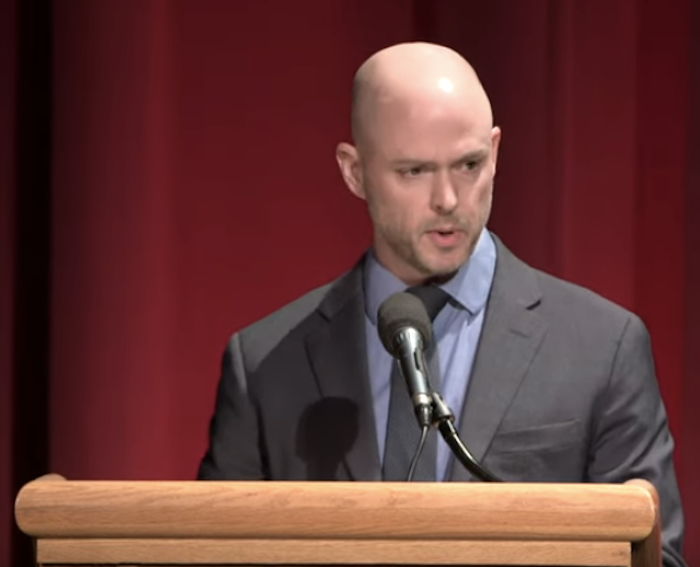
I made those jokes at the beginning of the speech about a panic attack, but I wasn’t kidding. That was the first time I’d ever given a public speech. Even the first time I’d spoken into a microphone my whole life, and I had to do it in front of a thousand people. It was wild.
Scott: Let’s wrap it up here with a question that you will doubtless be asked many, many times over hopefully a long and fruitful career. What advice can you offer to aspiring screenwriters about learning the craft?
Walker: I would say to always remember ‑‑ this will sound very in-the-clouds romantic, but just always remember why you’re doing it. I think writing should always be, at its core, because you want to make somebody feel something. You want to give them a wonderful experience.
Whether it’s sitting down in front of their TV or going to the movies, you hope to be part of the chain that got them there, and that they had a good time, and got excited, felt something meaningful.
There can be many moments of frustration in writing, like you’re on your tenth draft and still rewriting and getting back notes and the whole thing starts to feel more like a math problem than an actual story…but it’s all worth it if your heart is in the right place and you’re actually trying to bring something to somebody.
As for learning the actual craft, I just say find great teachers if you can. Get through a lot of teachers, hear all their insights, get all their feedback. Off the top of my head I can think of at least seven I’ve had.
And find great readers! One of the biggest challenges for me has been finding and making the relationships with people who can read my scripts and give great notes. It’s so essential.
So I do recommend classes. I never did an MFA, so I can’t speak specifically to the value of it, but I made many valuable relationships through the UCLA program and the GSU MA program in Atlanta, plus the various workshops I took.
It’s easy to let those relationships fade, so avoid that if possible. Keep emailing with these people, and don’t just use them for notes. Make personal relationships. Reach out to them even when you don’t need them. Offer to read and give notes on their stuff even when you don’t have anything you need from them.
I’m probably rambling at this point. I think that’s all I got. Read a lot! Scripts, but books too. Find and watch movies you love. See stuff that inspires you!
For Part 1 of the interview, go here.
Part 2, here.
Part 3, here.
Part 4, here.
Part 5, here.
For my interviews with every Nicholl Fellowships in Screenwriting winner since 2012, go here.
For my interviews with 53 Black List writers, go here.