Interview (Part 6): Stefan Jaworski
My interview with 2021 Black List writers for his script Mercury.
My interview with 2021 Black List writers for his script Mercury.
Stefan Jaworski wrote the original screenplay “Mercury” which landed on the 2021 Black List. Recently, I had the opportunity to chat with Stefan about his creative background, his script, the craft of screenwriting, and what making the annual Black List has meant to him.
Today in Part 6 of a 6-part series to run each day through Sunday, Stefan provides advice for writers learning the craft and attempting to break into the business.
Scott: You mentioned your work in TV, and you mentioned outlining. I’m assuming that that’s pretty key part of you for your prep process. How comprehensive is that? Do you get to a scene‑by‑scene outline?
Stefan: The more I write, the less I outline before I move to script. Possibly because I trust my craft more over the years, but also because I find that there are discoveries to make at every stage of the writing process, and I want to find the perfect balance between pre-writing enough to be able to dive into the story with confidence. And at the same time keeping enough choices open to be able to explore and let the story speak to me organically on a scene-by-scene level.
What I do need before I start the actual writing, is to know what the story is. I need to know what it is thematically. I need to know the main characters and what drives and limits them. And what they need to overcome. I need to know what the final choices are. I need to know where it begins and ends. I always know the structural tent-poles and turning-points before I start, but I think if the process is up to me alone, then I have scaled a little bit back over the years in how specific I am in scene‑by‑scene outlining, and left it somewhat more open, because that breathing room…
I always find that when you go to script… as much outline that you might have done, there are always gifts and discoveries made when you go to script. To me, if I’ve outlined too strongly, to specifically, I find that I don’t allow myself to embrace those discoveries that I make when I do make them.
So. It’s all about trying to find the balance between having the characters and structure in place, having the premise, the thematic argument ‑‑ the closing, the start, the character arc is there ‑‑ but leaving some breathing room open. That opens your mind to new ideas along the way that allows you to elevate the outline, instead of just writing the outline.
Scott: That’s also true. It leaves room for the characters to speak to you or do something different.
Speaking of characters, how do you go about developing your characters? Is there a specific process, or do you have any ‑‑ I don’t know ‑‑ exercises or things that you do to unlock them?
Stefan: Apart from always looking for relationships that embody the theme and create an exciting tension and potential for mutual growth…
One of the things that I do work with, I think… is always make a distinction between back‑story and deep back‑story, which is… well… Back‑story is the thing that happened in the immediate past, which created the wound that every feature is trying to mend. Not rarely do movies open with this wound being inflicted on the main character.
One of the things about working with feature scripts, as opposed to longer stories on television, is this often beautiful simplicity there is to mending a wound in 100 minutes [laughs] which is what every movie does or tries to do. Something happened. That hurt our hero. Who will now spend the next 100 minutes solving an outer problem, in the ultimate hopes of mending the emotional wound. The end.
Then, there’s ‘deep back‑story’, which is the fundamental reason why these characters are the way they are. Usually childhood stuff, parents, upbringing. This is often a constant. Not something a feature story changes. But which deeply shapes character, patterns, actions.
Then, I try to think of their level of consciousness ‑‑ how conscious are they about who they are, and what needs to be done? Most of us are not conscious at all. Most of us are blind as hell when it comes to what has defined us and what we truly need. We have false explanations and struggle with false solutions, and toying with those blind angles is an important aspect of character work.
Especially when creating antagonists. No one gets up in the morning and consciously decides to be “the villain”. We all try to do good from whatever perspective we see the world, and that’s why I am reluctant to ever calling anyone “the villain” of any story, but always think of them as the antagonist to the protagonist. With a world view that contradicts and challenges what the protagonist believes. The clash between the two becomes the movie’s core questions, and for any story to be strong, both ‘arguments’ should have equal weight and merit.
You asked, “Do I have a process?” when it comes to character. I think it’s the same as with every scene. You always look for tension. You look for the tension between who they believe they are, who they try to be, and what is actually holding them back. You look for what they’re hiding or not acknowledging. Every character carries and embodies an inherent tension. And the more clearly you can convey that, the more engaging they will be.
When you feel that, when you know that, what their tension is, what drives and limits them, then I think it feeds naturally and organically into the scenes. It feeds into the dialogue, the way they stand and move and engage with people. It’s really that, and then you can give them all sorts of different characteristics after that. Which, to me, is much less important than character.
That’s another thing you should be conscious about. Same as ‘true’ versus ‘real’. The distinction between ‘character’ and ‘characteristics’. A lot of teachings on character is really focused on characteristics. Where was she born, where did she grow up, go to school. Where did she move to, educate herself, where did she work. Is her family large or small, are her parents still alive, what are their names, professions, incomes. This… is all characteristics. You can write a hundred pages of it for each character. And it helps you nowhere when you’re writing actual scenes and story.
Character is simple. What does she want? Why can’t she have it? What’s her inner and outer obstacles? What does she need to overcome in this story? What would fulfill her? It’s stuff like that, that makes characters relatable and hopefully engaging.
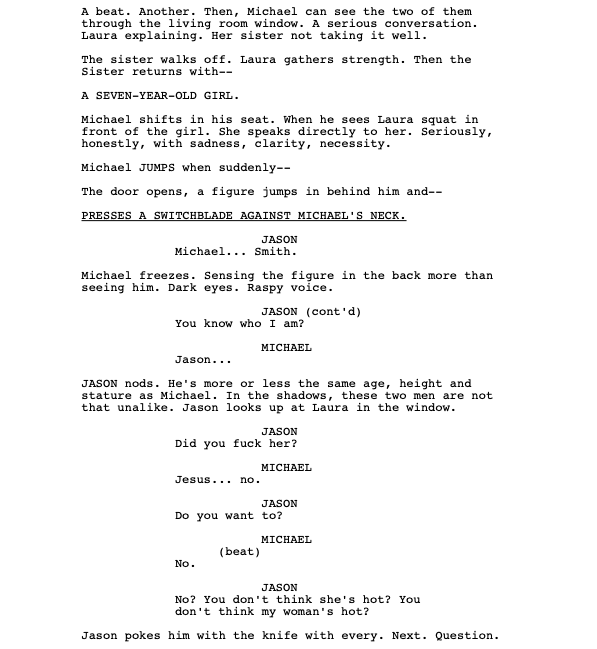
Scott: Actually, I think it works quite well with a character like Michael because there’s a void. You feel like he doesn’t need something to…He’s got the wound, obviously, but his life is pretty empty. It’s even reflected in the fact that he doesn’t have that many people. Burke tells him that. He’s looking at his phone and sees he don’t have a lot of friends.
Stefan: Yeah.
Scott: Let me ask you one last question here: What advice can you offer an aspiring screenwriter to learning the craft and breaking into the business?
Stefan: Well. First of all, understand that you’re not in competition with the world, because every story has already been told, and there are always writers out there who are better and more successful than you. You’re only in competition with yourself. Making what you write resonate as strongly as possible is all you should care about. You need to write the movie that you want to see, and write it as well as you possibly can. Such clichés, but all true.
Finally, don’t “write what you know”. Write what you love, and then “love your darlings”. Don’t kill them. Isolate them, nurse and cherish them, bring them front and center, because your darlings are what you are passionate about in your story. If they don’t connect to your plot, then fix that. If they don’t completely fit your character, dive deeper until you understand where they come from and how they could. But protect and love your darlings at all cost. They are the whole reason for doing this. And if you treat them accordingly, your audience will hopefully love them too.
For Part 1 of the interview, go here.
Part 2, here.
Part 3, here.
Part 4, here.
Part 5, here.
Stefan is repped by Lit Entertainment Group.
For my interviews with dozens of other Black List writers, go here.