Interview (Part 6): Scott Derrickson
My interview with the co-writer and director of the hit Marvel movie Doctor Strange as well as horror movies The Exorcism of Emily Rose and…
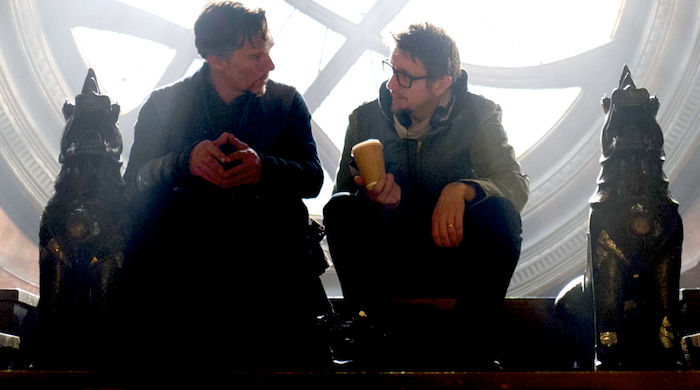
My interview with the co-writer and director of the hit Marvel movie Doctor Strange as well as horror movies The Exorcism of Emily Rose and Sinister.
I started following filmmaker Scott Derrickson years ago on Twitter (@scottderrickson) because I enjoyed his movies, plus, he’s a huge fan of Flannery O’Connor and Bob Dylan, two of my very favorite creatives. So I reached to Scott for an interview and was especially pleased when he said yes.
Recently, we enjoyed an hour-long conversation which was wide-ranging in nature covering three of his movies: The Exorcism of Emily Rose, Sinister, and Doctor Strange, as well as his thoughts on storytelling in general and the horror genre specifically.
Today in Part 6, Scott discusses what he drew him thematically to the movie Doctor Strange:
Scott Myers: Wow! That really is an insight into Ellison’s character because he’s a writer who had had success just several years before. Now he and his wife have this argument where he says, “This is bigger than In Cold Blood. This is my shot.” This unfolding mystery, the obsession with trying to get back to the mountaintop.
Scott Derrickson: Exactly. Something else I so love about Sinister is how collaborative it was. That line you just quoted “This is my shot!” was an improv line by Ethan. The In Cold Blood reference was in the script. It’s a big speech in a single, long take, and Ethan just threw that in there. It’s so great. He was just so inspired in that particular take. It all just flowed out of him, and it becomes a defining moment for his character.
To me, what Sinister is really about is a guy who’s profoundly afraid of losing his own status and identity as a successful writer, along with his financial security. He’s so afraid of that his fear even drives him to ignore the horrific things that are happening around him. [laughs] It drives him to ignore the fact that he should turn these films over to the police.
That was when he makes his deal with the devil — when he decides, “I’m not gonna call the sheriff. I’m not gonna tell them about this. I’m gonna use this.” He’s lying to his wife already about living in the crime scene house. As things escalate, and his kids start acting weird and doing terrifying things, and he’s getting really scared because he knows something’s going on in the house — it still doesn’t scare him as much as losing his position in the world. That scares him more. Fear‑driven ambition is what that movie is really about.
Scott Myers: At this point, your children are probably similar ages to the two kids in the movie. How much of your identification with the character is about that, too?
Ellison really is in danger of forsaking the primary function of being a parent, which is your family’s safety. At one point, he says, “Writing is what gives my life meaning.” Tracy, his wife, says, “Writing isn’t the meaning of your life. Your kids are your legacy.”
Scott Derrickson: Yes, that’s his legacy and the legacy of any parent. By the way, I should probably just throw this out — if I had to pick a favorite scene from all the things that I’ve ever made, I think that argument between Ellison and his wife played by Juliet Rylance is probably my favorite scene. There’s just so much to it. You rarely get scenes like that in horror movies.
I do think that making Sinister was an emotional and spiritual and relational purge for me. In making that movie, I managed, again, to experience this kind of reckoning with evil. The things that that the character was wrestling with, I was genuinely wrestling with. I felt that same fear. But not anymore. And not because Sinister was successful. Before it was even released I felt like I had gotten rid of this diseased tendency to find my identity in being a successful director. The anxieties that I felt before making it had gone away.
And that has remained. If it hadn’t, I don’t think I would have dealt very well with the critical and box office success of Doctor Strange, nor the critical and financial failure of the movie I made before that, Deliver Us From Evil. What matters to me about both of those films is that I made what I intended to make. I hit my target. Neither the success of one nor the failure of the other had much of an emotional impact on me. And that’s because before those two movies, I’d made Sinister. And it changed me.
I don’t know if that makes sense, but I think it’s true. I just grew through that experience. I never again want the meaning or satisfaction of my life to rise and fall with the success or failure of my movies. “My kids are my legacy.”
Scott Myers: I was reminded of two things. One, another Biblical verse, that verse in the gospels, “For what will it profit a man if he gains the world, but forfeits his soul.”
Scott Derrickson: Some of the greatest words ever spoken. Every time I hear that particular verse quoted, it hits me in the chest. Maybe the greatest warning ever for someone working in Hollywood.
Scott Myers: The other thing is, are you much a fan of Carl Jung? Have you studied him at all?
Scott Derrickson: Yes, definitely, particularly his writings on dreams and his theories of synchronicity.
Scott Myers: Here’s my take on this. The Jungian take on Sinister and your experience there, because of what you described to me. I think he would say, “That very clearly was a case of individuation.” The concept of the shadow which is in rather simplistic terms, the dark negative aspects of an individual psyche.
We typically try to repress them or deny them, but his thing is that you’ve got to explore them. You’ve got to open them up to the light. You’ve got to bring them into the light of consciousness, or else they will hold power over you.
We see in a lot of these movies, and not just horror movies, that for the protagonist, the nemesis character is the physicalization of that shadow dynamic. You’ve got this Mr. Boogie character, the eater of children. As I’m watching this movie, I’m thinking, “This father, he’s literally putting his children in harm’s way.”
His obsession with writing success is eating away at the time with his children, his parental responsibility. My unique theory is Mr. Boogie a projection of Ellison’s shadow?
Scott Derrickson: Yes. That’s very astute. I can’t say that I thought of it in those literal terms. Boy, do I like that read! [laughs] It certainly sounds right to me.
Scott Myers: Feel free to use it.
Scott Derrickson: Yeah. I’ll take credit for it, thanks. It’s definitely on point. Ellison conjured this child-eating monster into his life, he really did. It’s on him.
Scott Myers: Jumping to Doctor Strange, it’s my favorite of the Marvel movies. I’m not saying that to blow smoke, I just thought it was so well told because of the mysticism, the spirituality, and stuff like that.
The fundamental thing about Stephen Strange that I resonated with is that he doesn’t get an atomic heart. He’s not bitten by a spider. He isn’t born with superhero strength. He’s just a flawed human being on this journey. That ability for Doctor Strange to become who he is, he has to go inside and discover that stuff.
It’s not a superhero story so much as a hero’s journey story. Do you see it like that?
Scott Derrickson: I do. It makes him much more vulnerable in many ways than any other superhero. You stab him with a knife, you’re going to kill him. For me, Doctor Strange was always about two things, the secondary one being the mind‑bending visuals and the mysticism inspired by the comics.
But the primary thing is Strange’s human journey of personal growth. While shooting, I had written on the front of my script, a quote by Thomas a Kempis: “Who has a harder fight than he who is striving to overcome himself?”
Both in the comics and in the movie, Strange isn’t trying to overcome a villain or trying to utilize power for victory. He’s really just wrestling with himself the whole time. And when he finally grows enough to make a clever, but very self-sacrificial decision, that’s what’s heroic to me. Growing into selflessness.
Scott Myers: Yeah, like Campbell said, “A hero is someone who gives himself over to something bigger than himself.”
Scott Derrickson: That’s it. That’s what the movie is about.
For Part 1 of the interview, go here.
Part 2, here.
Part 3, here.
Part 4, here.
Part 5, here.
Scott is repped by WME and Brillstein Entertainment Partners.
Twitter: @scottderrickson