Interview (Part 6): Scott Beck and Bryan Woods
The co-writers of A Quiet Place go deep into their background, creative process, and the evolution of their hit horror movie.
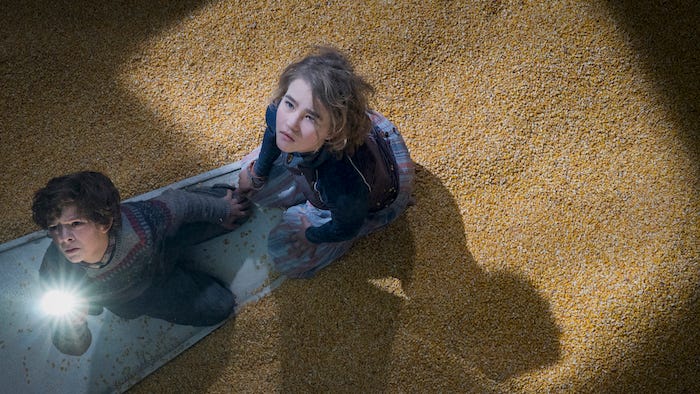
The co-writers of A Quiet Place go deep into their background, creative process, and the evolution of their hit horror movie.
As of today, the Paramount movie A Quiet Place has grossed $242M in worldwide box office revenues. Given the movie’s reported $17M production budget, that represents a ginormous ROI, but the movie is not only a success financially because critics have given the film an enthusiastic thumbs-up: Rotten Tomatoes (95%), Metacritic (82%), IMDb (8.1). Thus, it’s no surprise Paramount has announced a sequel is in the works.
Where did this movie come from? Who came up with the central conceit of the story? Who wrote the original screenplay which sold as a spec script?
The answer is longtime friends and filmmakers: Scott Beck and Bryan Woods. As it turns out, the two have been Go Into The Story followers for several years and with thanks to Joshua Caldwell, I ended up grabbing an hour of the writing duo’s time for an in-depth interview. It turned out to be not only a fascinating conversation, but also an inspiration for anyone who aspires to cinematic storytelling who resides far outside of Hollywood’s pearly gates.
Today in Part 6, Bryan and Scott offer advice for aspiring screenwriters and filmmakers:
Scott Myers: Continuing with some craft questions, when you’re breaking story, how do you spend your time in prep writing? Brainstorming? Character development? Plotting? Research outlining?
Bryan: Playing video games usually.
[laughter]
Scott Beck: No, we each keep our own word document. I use Microsoft One Note, where I have hundreds and hundreds and hundreds of pages that are just basically scraps of ideas for different projects. That can be character sketches. It could be a line of dialogue.
When we’re honing in on a single project, we start having our own brainstorm meetings where we talk about, “Oh, this is what the first act could be. This is what the character is feeling in the beginning of the story, and this is where we need to see them end up.”
We have these conversations that then allow us the ability to finally sit down and start opening final draft and crafting scenes. Bryan may write one scene and then he passes it to me. I do a pass on that and then write the second scene. We go back and forth.
The process changes, I would say, somewhat project‑to‑project. We always love having our conversations first and foremost so that we’re not staring at the blank page, not knowing where it’s going to go.
Scott Myers: What about dialogue? How do you go about finding your characters’ voices?
Bryan: Just the same way exactly as Scott said. We’ll write a scene. I might be writing the characters and dialogue. Then, I’ll send it over to him and he does a pass on the dialogue.
It’s weird thinking about it. You asking that question is making me wonder, “How does it work?” and I can only chalk it up to the alchemy of screenwriting and just putting the characters on a page and getting them talking.
It’s kind of a bizarre thing that I have not thought about and maybe shouldn’t think about because it works all right for us.
Scott Myers: You were talking about the theme of communication in A Quiet Place. How important is theme to you in your writing? Do you begin with the themes of your story or do they emerge over time?
Bryan: Yeah, both. With A Quiet Place, we weren’t comfortable writing the script until we knew that the theme was going to be about communication. We liked how that paralleled the idea of a world and a story that’s scary because the characters can’t talk and they can’t make noise.
We didn’t feel good about the story until we were like, “OK, we are comfortable with this theme.” One of the interesting things about theme is that you can start off with one thing in your head, and then the ultimate movie teaches you what it’s really about.
While I think that theme of communication that we started with is very much prevalent in the finished film, I think another theme emerged, which is the theme of, what would you do to protect your children and how hard is it to protect your children?
I think that theme is maybe an obvious one that we didn’t intellectualize but comes through very boldly in the finished film. I think that’s the best way to do it. I think you should be thinking about making sure your story has layers and that it can resonate on a deeper level.
At the same time, you’ve got to let it teach you what it wants to be and not be so constricted that you’re forcing it into a certain box.
Scott Beck: I will say like any time that we’ve gone off and written things where we haven’t really honed in on any theme whatsoever, that’s where you start getting into the weeds and you start losing your sight. It’s always important to hone in on some certain ideas that can at least be the starting point.
Scott Myers: What do you think about when you’re writing a scene? You talk about writing scenes and switching off and reading them. Do you have any specific goals in mind?
Scott Beck: It’s like the core lessons of come into a scene late and leave it early. Also trying to figure out the arc of each scene. It still needs to have a certain beginning, middle, and end. Those are the core concepts that we always go into. Then, of course, just make it interesting.
I know in plenty of our early screenplays that we wrote in high school and even throughout college, we’d look back at those now, and there would be so many scenes that are maybe only conveying character, but it’s not conveying any story. Yet there’s another scene that conveys only story and not character.
Really, what we should have done is just cinch those two together and be more economical in the storytelling.
Bryan: Another thing we love about writing is discovery. We talk a lot about how there’s nothing more exciting for us than getting bored with our own story, or our own scene, or our own characters because then it’s an opportunity to take a left turn instead of a right turn, and reinvigorate not only the story, but also ourselves as writers. That’s a big part of our process as well.
Scott Myers: I can’t think of better people to ask this question than you all because of the script, A Quiet Place, where you had to write essentially all scene description. What keys do you have to writing entertaining scene descriptions?
Scott Beck: I think, for us, it was very much visualizing what that final film would look like and what it would sound like, and then choosing our words very carefully. Bryan and I take time even drafting our emails to producers just to make sure that things are being communicated as succinctly as possible.
Also, on the page ‑‑ when it comes to the page ‑‑ as interesting as possible. That may be something as using alliteration. It might be something dig into a Thesaurus and figuring out a better word or making sure we’re not repeating a word multiple times on the page so that it doesn’t catch a reader’s eye in terms of being repetitive.
There’s all these little tricks that we use, but, really, it just comes down to doing the work and not getting lazy, which is something that it’s nice to have a writing partner because we challenge ourselves to do our best work possible.
Scott Myers: How about this? When you finish a first draft, now you got to rewrite, is there a process that you have, a specific process that you go through or any techniques that you use to move the thing forward?
Scott Beck: I would say for those first drafts we really rely on our close circle of friends and family. We will send the draft out to maybe four confidants that have been reading our work for a decade, at least, now. They know our strength, they know our weaknesses, and so they’re not afraid to call BS on [laughs] anything that we’re trying to sneak through.
They’re also really good at figuring out where we’ve jumped over certain narrative pieces. We’ve always been able to rely on them, first and foremost. After we get their feedback, that’s when we can really go back, have a conversation about how we really can forge ahead and get everything into shape.
Of course, our manager, Ryan Cunningham at Madhouse, he’s certainly somebody that we rely on at a certain stage just to get his fresh perspective on everything. What’s great about him is he is always approaching things from a story theme and character level. It’s not necessarily, “This is what the marketplace needs so we need to augment this.” It’s really just a pure, unadulterated feedback.
Scott Myers: Let’s talk about your future here. You’re in the horror space, clearly, and Hollywood has a way of pigeonholing writers and filmmakers. I assume, since you got a lifelong affection for horror, you don’t have a problem with that, but do you ever see yourself stepping outside of that space and doing some other type of genre work?
Bryan: Yes and no. I mean we have a lifelong love of not just horror, but everything. Thinking about A Quiet Place like the genesis starting from Jacques Tati, silent film comedies. We love Alexander Payne. We love Wes Anderson. Billy Wilder and Cameron Crowe. On and on and on. We love movies and stories in all genres and every facet of what movies can do.
Having said that, our taste naturally tends to steer a little to the dark side of things. We like to be a little edgy and a little dark in genre. Not necessarily just horror, but sci‑fi and thriller and drama. That’s just where our taste naturally brings us.
Scott Beck: I think one of the reasons we lean towards that is because we love films that evoke reactions. Whether that’s a comedy, or a horror, or a thriller. You can sit in the audience, as we did throughout our childhood up until now, on a Friday night and feel the communal experience as people are screaming or laughing.
A film like Quiet Place, a film like Haunt, those are movies that we very much are crafting for an audience in the purest form in that we want to be able to replicate all those times that we were sitting in a theater and just loving what’s happening on screen, and be able to vocalize that as well.
Scott Myers: Finally, this is a question I’m sure you’ll be asked way more based off the success of A Quiet Place. What advice can you offer to aspiring screenwriters about learning the craft and breaking into Hollywood?
Bryan: I think reading is so crucial. Reading other scripts, other screenwriters. Doing the work of just familiarizing yourself with the medium is huge.
Scott Beck: I think observation as well. As Bryan said, a lot of our character sketches and character work come from people that we knew in real life. There’s nothing more authentic than drawing upon your own experiences to really breathe life into a piece.
I think also, from a practical standpoint, what we always found was making your own opportunities from a stand point of writing something that either you can go out and make, or a friend can go out and make, or, a production executive can pick up and say, “This is manageable to me.
“It’s not $150 million movie that requires hundreds of people to sign off on it.” It’s something that you can force through the system if it’s got an interesting hook and good writing.”
Then, lastly, just be passionate about what you want to make. That was a lesson that Bryan and I really, really learned on Quiet Place amidst working on different projects that maybe we didn’t have as much passion for.
What’s ironic is all of those had the promise of the big sale, or being the next big step in our career, but those never went anywhere. They all hit dead ends. A Quiet Place was this little engine that could that we just had this burning passion for and felt like we had a plan to make this hell or high water.
It’s been nice to finally see something that you’re really passionate about pay off. That would certainly be a huge piece of advice I would give anybody.
For Part 1, go here.
Part 2, here.
Part 3, here.
Part 4, here.
Part 5, here.
Scott and Bryan are repped by ICM Partners and Madhouse Entertainment.
Twitter: @beckandwoods.
For nearly 200 Go Into The Story interviews with screenwriters, filmmakers, and Hollywood insiders, go here.