Interview (Part 6): Kryzz Gautier
My interview with 2021 Black List writer for her script “Wheels Come Off.”
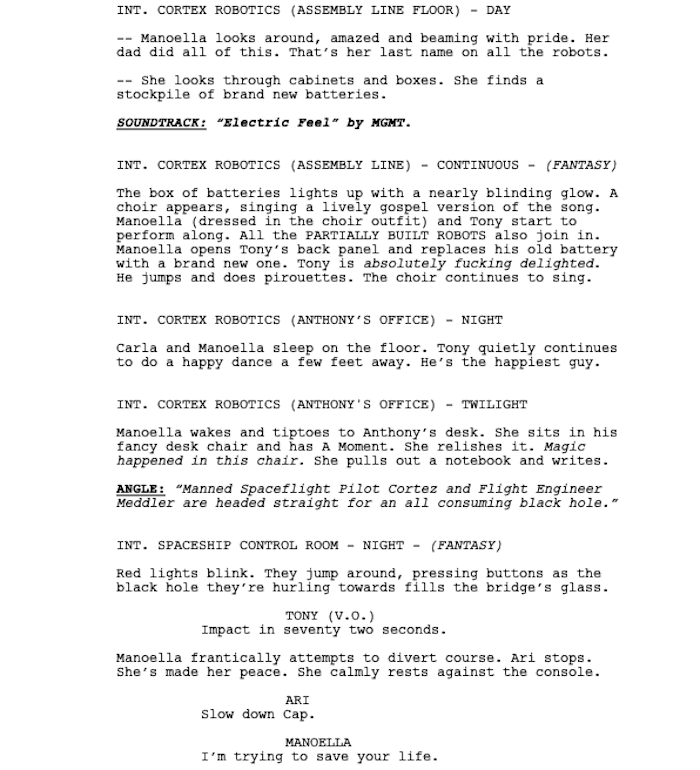
My interview with 2021 Black List writer for her script “Wheels Come Off.”
Kryzz Gautier wrote the screenplay “Wheels Come Off” which made the 2021 Black List. I had the opportunity to chat with Kryzz about her creative background, her script, the craft of screenwriting, and what making the annual Black List has meant to her.
Today in Part 6 of a 6-part series to run each day through Sunday, Kryzz talks about the craft of screenwriting and provides some advice for aspiring screenwriters.
Scott: Okay, a few craft questions. Generally speaking, how do you come up with story ideas?
Kryzz: As I mentioned earlier, they all are born from a question. A random one pops in my mind and I suddenly crave to find the answer. That tends to come with, “Okay, well, how do you populate this world? Who are the characters who will lead the journey to find this answer? What world will offer the most effective canvas to find said answer?” That’s pretty much how I deconstruct it.
I also mentioned this before, but, “Am I going to find this answer in two hours, or will I find this answer in ten hours? How long is this road?” It always starts with a question and that leads to thirty-seven other questions. [laughs]
Scott: Maybe that instinct is back with thirteen-year-old Kryzz, “How do I get to Emerson’s? How do I set myself up to go to Emerson? What do I do to shape myself to be the perfect student?”
Kryzz: I’m inquisitive. I have OCD and severe ADHD. I have a million things running through my mind at all times, but I’m also somehow very methodical about how I manage those thoughts. I’m extremely neurodivergent. I go on very, very intense research spirals when I’m hyperfixating on something. Now, when you put it that way, it’s not surprising that it all starts with questions.
Scott: You say you wrote this script in five days, you go to Sundance, and the person says to you, “Well, you had that in you all along.” Did you have to break story for this? Maybe a better question is, what do you do? If you’re writing for TV, I assume you’re busting outlines and stuff like that. What is your process of breaking story?
Kryzz: I’m a speedy writer. I don’t do outlines. I don’t do treatments. I just sit and start writing the script. I dive right in. Typically, I can write the first draft of a pilot in days. My last hour-long, I also wrote in six days. I’ll wake up with a question or an idea, and I’ll sit down and won’t stop until I get it all out of my system. The first draft will pour out of me. Then I’ll go on to polish.
Scott: Let me ask you, have you ever done an outline?
Kryzz: No. [laughs]
Scott: I know people who’ve tried it. They say, “It just sucks the creativity out of me.”
Kryzz: Mhmm. Definitely my case. My brain doesn’t work like that.
Scott: I remember reading a quote by Mike Arndt. He said he wrote “Little Miss Sunshine” in four days and then spent a year rewriting it. When you knock out your first draft, is it more like Hemingway, first draft and that’s it? He basically was done.
Kryzz: I can write so many scripts in a year. [laughs] Last year, I wrote something like four pilots, two features, and three decks that are series to take out as just pitches. That’s kind of a decent example of my average yearly output. Are they all masterpieces that I’ll sell in the room and will get made? Nah. But at least I’m always writing. Some of those stick, most don’t. We kind of have to make peace with that as writers.
As far as number of drafts, it really depends. It’s never taken me a year but maybe five drafts. Four or five. Some, I have it in two. But I’d say about five is a pretty truthful number. And again, fast writer, so I can crank out five drafts in maybe a month. Or less. At that point, it just really depends how fast your friends give you notes. You’re at the mercy of other people getting back to you with thoughts.
A thing to note, though, is that one of the keys to being a writer is you need to know when to stop. I have a show set up at a studio right now. I wrote the first draft of that in five days. Currently, in the development process, we’re up to draft nineteen or twenty. Not my choice. [laughs] When other people get involved, it becomes a different beast. Development hell is real. The version of the pilot they bought was something I was immensely proud of. It’s one of the best pilots I’ve ever written. I was so, so, so delighted with where it was. Now, not so much. What I’m trying to say is…more drafts don’t mean better writing.
Scott: When you say fast writer, you sit down for ten hours, twelve hours, fourteen hours at a time. How does that work?
Kryzz: When I get notes, I can do a rewrite in maybe six or eight hours. If it’s a pilot. Give me twelve or fourteen if it’s a feature.
Scott: Wow. That’s pretty amazing, Kryzz. It really is. How do the characters emerge?
Kryzz: I tend to also write based on people that I know. Gets me in trouble sometimes. [laughs] I write from very personal relationships. Again, “write what you know” is one of my most prevalent guiding lights as a writer. It sounds corny, I’m aware. I do think that truthfulness is essential in storytelling. Even the most fantastical scripts have a truth they’re trying to get at. I anchor my “truths” on things I’ve lived.
I might write it as a sci-fi set 200 years in the future, and I’ll certainly take some creative liberties, but at its core, I’ll pull from situations I’ve experienced. I’ll draw from the emotions of what I’ve gone through. Fictional truths are built around my truths. But with a genre spin. People that shared those moments with me have recognized it and themselves in my work. It hasn’t always gone well.
Scott: What about theme? If you even think about it. You write so intuitively, it seems like. Do you even think about central theme or subthemes? Does that stuff ever populate your consciousness?
Kryzz: Never. The funny thing is when I say that, it doesn’t even make sense to people. My severe ADHD is why it’s hard for me to grasp abstract concepts most of the time. It makes me sound so stupid when I say it out loud. [laughs] For example, I’ve never been able to understand theoretical concepts of grammar. I can’t for the life of me understand that stuff, but I’m a really, really good writer. I was always top of the class in creative writing, but please don’t ask me to explain what a subordinate conjunction is. I can probably write a perfect one. I’m assuming. [laughs] If you put a gun to my head and threatened to shoot if I can’t break down what a clause is, I’d tell you to pull the trigger. My brain can’t process information like that for some reason. It’s kinda the same with the “rules of screenwriting”. I just write. I’ve tried reading “Story” by Robert McGee, but it’s a dense fucking book. It’s five hundred pages. I had to quit like two hundred pages in.
Words get mixed in my head and don’t stick. I’m not dyslexic, but I’m…something. [laughs] I’m a visual and tactile learner, so when you talk to me about things I can’t see or touch, it’s going to go in one ear and out the other. I can’t do “rules” of anything. It’s why I’m terrible at math and science. I open Final Draft and the writing simply comes. Dialogue is my strength. Writing character is my strength. Themes don’t even cross my mind. They honestly don’t. I write to answer questions. I write characters. I write the truth that I think will resonate with the story and these characters.
Scott: I tell my students I say, “Look, each one of you has heard, read, or seen tens of thousands of stories in your life. You bring an intuitive understanding of story.” The screenplay, all this mystery about screenplays and screenwriting, no, it’s really telling a story. It’s in a specific format or whatnot. People get hung up on that bullshit, but it’s a story. Right?
Kryzz: Right. I’m a highly intuitive writer. I only follow my gut. I’ve always been that way, no matter the medium, whether it’s prose or script. I’m not a formulaic writer. I’m not a “structure” writer. I perch myself in front of my computer and type. Once I put that first draft on paper, I go to the friends who are masters at structure and ask, “Does this work?”. The vast majority of times, it’s nearly there or already there. How do I do it? Don’t ask me. It was built into me innately somehow.
Scott: You follow your curiosity, you know your process. Don’t mess with it.
Kryzz: I have all the quintessential screenplay books. They’re on my bookshelf. I’ve tried reading them. They all say, “By page ten, you must have sent your hero on the journey. By page fifteen, they have to have done this.” I’m like, “No, that’s not what works for me. I’m going to open Final Draft and my hero will go on the journey when it feels right to me for them to go off on it.”
If that type of rigid, “Save The Cat” structure works for you and you want to do that, then by all means, please, but that’s not how writing goes for me. Hasn’t failed me thus far. Not fixing what ain’t broken. [laughs]
Scott: As long as the reader is engaged and involved in these characters’ lives, screw the rules. Does that seem like a fair take?
Kryzz: Yeah. I have this conversation all the time. I even got a note on the Black List script that was like, “They go on the journey too late.” My response was along the lines of, “Listen, their world is about to be turned upside down when this wheelchair breaks. I need people to understand what their existence used to be like, for them to grasp how devastating it is when this wheelchair is not a thing they can rely on anymore. I can’t do that in ten pages. I can’t do that in fifteen pages. I need to establish a routine and what life was like prior to this event so that the audience can actually mourn these losses later.” It was a very intentional decision to take my time with that “before” so that the “after” has weight.
Scott: That’s speaking to making that emotional connection so that we bond with Manoella and Carla.
Kryzz: They can’t be out on the street by page fifteen because then you don’t care that the wheelchair is not in play anymore. The life that they’d settled into for eight years crumbles when that happens. We need to have a deep understanding of what their day-to-day looked like before we quite literally break it and burn it.
Scott: One final question. What advice would you offer to people who are aspiring screenwriters and they’re trying to figure it out? What advice do you have for them?
Kryzz: Learn the rules to break the rules. Over a decade into this, I now have a firm grasp of good storytelling, so I can freely say, “fuck the rules”. I can think, “No, I’m not going to have my hero leave by page ten in this story. That to me makes no sense.” On the other hand, you need to understand the limits to straying away from the path. I’ve seen screenwriters not have the hero start their journey until page sixty. That’s because they have a fundamental misconception of what a screenplay is supposed to be. You have to understand what makes a lousy screenplay in order to write a good screenplay. Have a solid discernment of what great storytelling is before you go chucking it all out the window.
For Part 1 of the interview, go here.
Part 2, here.
Part 3, here.
Part 4, here.
Part 5, here.
Kryzz is repped by CAA and Rain Management.
Twitter and Instagram: @KryzzGautier.
Website: www.KryzzG.com.
For my interviews with dozens of other Black List writers, go here.