Interview (Part 6): Juliet Giglio and Keith Giglio
My conversation with the screenwriting couple whose first novel The Summer of Christmas has just been released to the public.
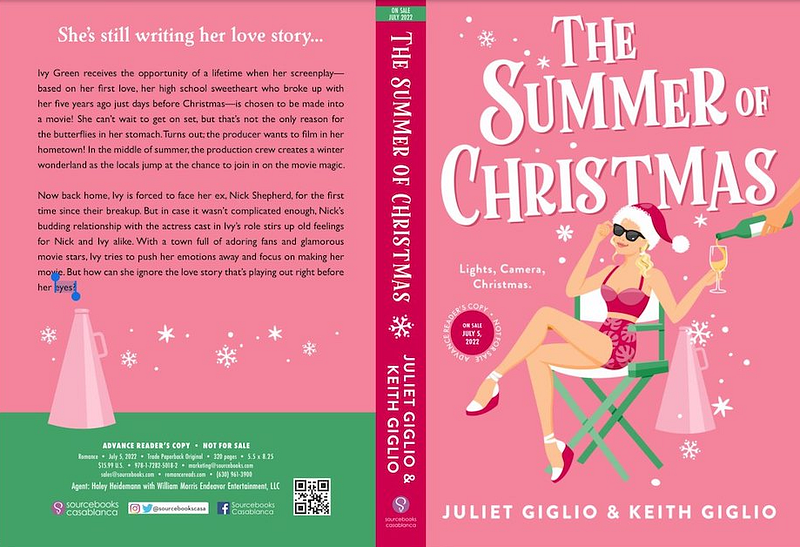
My conversation with the screenwriting couple whose first novel The Summer of Christmas has just been released to the public.
Juliet Giglio and Keith Giglio are a husband-wife screenwriting duo who cover a lot of territory of interest to Go Into The Story readers. They write everything from studio features to TV movies and now novels with the release of The Summer of Christmas. They also teach screenwriting: Juliet at SUNY Oswego and Keith at Syracuse University.
Recently, I had an entertaining and informative interview with the pair. Today in Part 6 of a 6-part series to run each day through Sunday, Juliet and Keith share tips on how to develop as a writer and break into the business.
Scott: You mentioned something earlier. You’d be writing the book, and so you’re doing a couple of chapters, and there’s more freedom in writing the book.
I tell my students, “Look, you can outline this stuff, but you’ve got to be mindful of the characters because sometimes they’re just going to want to get off the outline and go do something different.” Do you find that to be true, and how important is it to say, “I just got to follow the characters?”
Juliet: Absolutely, and sometimes, within this book, something happened that hadn’t really happened with screenplay writing. That’s where new characters would pop out, where we’d suddenly be like, “Oh, my God, we need this other side character here.”
Keith: Writer’s block to me has always been when you’re trying to force the characters to go where they don’t want to go.
Scott: Like Neil Simon said, “I used to outline on the yellow legal pad, but then my characters used to get up and walk away from me, so I just stopped doing that.”
[laughter]
Let’s talk about characters. Talk about developing, because you got a lot of characters in this book. How do you go about developing these characters? Do you have any tips, tricks, techniques?
Juliet: We talk a lot about, before we start writing, their backstories. We do. We try to talk about where they’re from. What are their goals?
Keith: It’s a unity of opposites. You want everybody to be different even though they’re saying the same thing.
Juliet: They’ve got to be different from each other. One thing was interesting in writing the book is that you can’t have characters whose names begin with the same letter. because it’s confusing for the reader.
Scott: Absolutely.
Keith: Len and Lou. [laughs]
Juliet: I tell my students, “There’s 26 letters in the alphabet. Let’s use all of them.”
Keith: In terms of the process, it’s all collaboration on the document. We have desks that face each other.
Juliet: Yeah.
Keith: It’s fun. “What about this? What about that?”
Juliet: We can each be sitting in our own laptop, but I can stop and be like, “Hey, I’ve just added this.”
Keith: We’ll always create a playlist of music. I’m like Pavlov’s dog. If I hear that music, I’ll start writing that script.
Juliet: Or that book.
Keith: Or that book.
Juliet: Definitely, I would listen to the same playlist over and over writing this.
Scott: I’ve worked with writing partners before. Let’s say, you two are like, “Here we are plotting the story, breaking the story. I think it should go this way. I think it should go that way.” How do you resolve that?
Keith: To quote a comedian who people don’t want to quote anymore, “I’m the boss, but Juliet’s the decision‑maker.”
Juliet: We’ll duke it out sometimes. Usually, one person comes around to the other person’s point of view.
Keith: Hopefully, by debating it, to use a kind word, we’ll figure it out. Luckily, our kids are out of the house now. It was always awful when the kids were younger.
Scott: “Mommy and daddy are yelling at each other.”
[laughter]
Keith: Now it’s our dog who gets a little sensitive to us.
Juliet: Our dog limps off and goes outside. Even if it’s a raging snowstorm, he’ll be like, “I got to get out of here.”
Keith: “I’d rather stay outside in the arctic weather of Syracuse than inside with you” Hopefully, that discussion will lead to a third choice. That would be the better choice.
Juliet: After writing together for 20‑something years, we trust each other. If Keith is adamant about it, I’ll cave. And the flip side is true for him as well.
Scott: The inevitable question for you all, which I’m sure you get asked a lot, but what advice do you have? Now, this gets sort of expanded. What advice do you have for writers who are interested in screenwriting, or writing novels, or romantic comedies? What’s the best advice that you can give them?
Juliet: I think you have to write your own story. You need to have a specific vision. It can’t be like you trying to write something cool, or you thinking that something’s funny. You must have clear voice, and it has to be who you are.
Keith: Put yourself in your stories because no one else can be you. Your DNA is so specific. If you can put that into your characters, at least you have something that’s original. Plots are plots. Everyone’s standing on the shoulders of someone else. Everyone’s influenced.
Juliet: I also think don’t you should have a back‑up plan. When you do, then you’ll inevitably do that. When we were breaking into LA, we had no back‑up plan. We had side jobs that made us money, but they were day jobs. We never had a backup, so we couldn’t fail.
Keith: Like tightrope walking without a net. Don’t have a net.
Scott: Don’t have a net.
Keith: We got to LA, and we just kept writing. Everything was writing. I found a job. Einstein said, “Be tired on someone else’s time.” He said the best years of his life were working at the patent office.
Keith: In terms of both books and anything else you do like writing video games, be kind. Be the person everyone wants to work with. Be that person. Be good in the room, listen, participate.
Juliet: He’s right. A lot of times, especially if you want to write in television, it’s not always about are you a good writer? It’s also, “Do we want to work with you?”
Keith: Can we work with them for six months?
Juliet: I think that’s really important, and something we learned early on. Be personable, be kind, send thank‑you notes. We always send thank‑you notes after meeting anybody.
Scott: A producer once told me, he said people in Hollywood like to work with the people they like to work with. I thought, “Yeah.”
Keith: Makes sense.
For Part 1 of the interview, go here.
Part 2, here.
Part 3, here.
Part 4, here.
Part 5, here.
Juliet and Keith are repped by WME.
The Story of Christmas: Amazon, Barnes & Noble, Good Reads.