Interview Part 6: Jane Therese
My interview with the 2020 Nicholl Fellowships in Screenwriting winner.
Interview (Part 6): Jane Therese
My interview with the 2020 Nicholl Fellowships in Screenwriting winner.
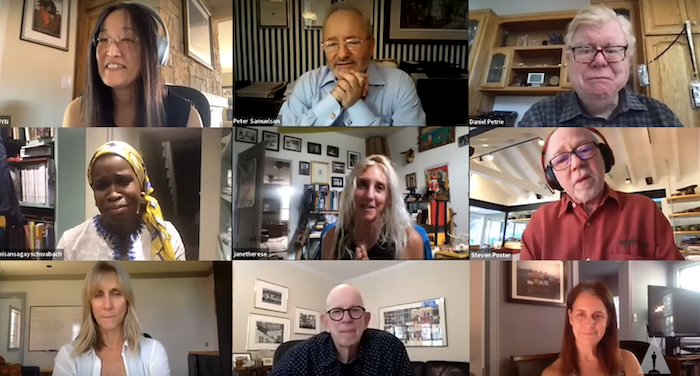
Jane Therese wrote the original screenplay “Sins of My Father” which won a 2020 Nicholl Fellowship in Screenwriting. Recently, I had the opportunity to chat with Jane about her creative background, her award-winning script, the craft of screenwriting, and what winning the Nicholl Award has meant to her.
Today in Part 6 of a 6 part series, Jane answers some craft questions and provides advice on writing a Nicholl worthy script.
Scott: I’d like ask some craft questions.
Jane: Sure.
Scott: I’d be interested to hear if you’ve got this journalistic background, how do you come up with story ideas? Is it like a journalist’s instinct, or what’s going on there where you see something and you go, “Ah, that seems like a screenplay”?
Jane: Yeah. Basically it’s, I guess, listen to what people are saying. I read lots of stuff. There’s always a story somewhere. There’s always something going on, and for me as a journalist, because I love telling stories so much, I look for stories every day.
Actually, I finished a recent project. I covered Delaware, which is a state that I know nothing about, but now I do. I was able to, through one of the portraits, I was documenting, moving to a short documentary of a woman who was going under facial surgery to make herself more feminine. When people see her, they’re not so prejudiced against her physically.
When I asked her to follow up, she was telling me about this, and I’m like, “Kathy, I can’t say no.” You know, if you want to go on board, this is something that really needs to be documented. We need to get this out there.” She said, “Yeah, I’m onboard.”
Things like that, they present themselves, and if we just take the time to pay attention to what’s being presented to us it could turn out to be something quite pleasant to indulge in.
Scott: How about research? Do you have any connections, Ireland, for example?
Jane: It seems like everybody is Irish. There’s a lot of mix in our family. I personally have never been to Ireland. I immersed myself in movies, language, books, images, just all of it.
My son actually did marry a woman who has relatives in Ireland. That’s the closest I can say. The script I’m writing for the fellowship, I’ve flown to the state where I’m covering and really researched it and have read numerous books on the topics that I’m covering.
It really is trying to get the facts straight, an honest way to tell the story, and that has to do with a lot of research, making sure your time period is exactly what has gone on in that time period, which means cars, fashion, songs, all of it.
Scott: Do you work from an outline, typically, or no?
Jane: I guess you could say it was an outline. Right now, I’m writing a treatment. With the Nicholl, we each get mentors. My mentor had suggested something. Even though you know your character, and you know your how, what, where, when, and why, but it was the way that the information was being presented to me that I decided that I’m going to write this story as a treatment.
I have to say, it’s so much easier writing everything down as my treatment and then going to pages. I’ll see how that turns out. It’s a completely different way of approaching a story, but I’m finding it’s going to help alleviate a lot of the problems right off the bat.
Scott: Yeah, I always give my students an option. I say, “If you want to write in TV, you pretty much have to work with outlines.” It’s all the index cards and breaking the story beforehand.
On the feature side of things, whatever works best. Some writers really do prefer to write a more literary version of the story. We see James Cameron has these things that have come to be called ‑‑ I don’t think he calls them, but it’s come to be known as a scriptment, which are like treatments with dialogue things in them.
Jane: Yes.
Scott: It’s whatever works best, and evidently, for this particular project, you’re finding it freeing to work more from a treatment type of a perspective.
Jane: Yes, mainly because the topic at hand, I knew nothing of, which I found really interesting and then began to ask myself, “Well, you don’t know anything about this. Are you sure?” and I thought, “Yes, I am sure. This is how I need to do this.”
The research and the treatment and outline that way helps me visualize this story a lot easier in my mind than, let’s say, “Sins of My Father,” which I was able to do the outline and just go, “OK, this, this, this, and this needs to happen,” and I was able to then readjust the scenes a lot easier through that outline.
Yeah, it’s however you can tell the story to the best of its ability. I don’t think there’s a right way or a wrong way.
Scott: Time for one last question, which I’ve asked all your fellow fellows. You’ll probably be getting asked this by people who intersect with you and find out that you’ve had some success in screenwriting, but what advice can you offer to aspiring screenwriters about learning the craft and just trying to break into the business?
Jane: What could I offer? It’s a job. For anybody who thinks this isn’t a job, then I just think for me personally, that would be kind of a rude awakening. It’s a job. You need to treat it as a job. We all have jobs outside of our home, we all have families, we all have this, that, and the other thing. We’re not a unique ‑‑ we are all doing the same thing.
If we want to follow your passion and follow your bliss, it means putting in the hard work and doing it and doing it and doing it, and do not do it with an ego, and don’t think you’re above it all.
For Part 1, go here.
For Part 2, go here.
For Part 3, go here.
For Part 4, go here.
For Part 5, go here.
For my interviews with every Nicholl Fellowships in Screenwriting winner since 2012, go here.
For my interviews with Black List writers, go here.