Interview (Part 6): Byron Hamel
My interview with the 2021 Nicholl Fellowships in Screenwriting winner.
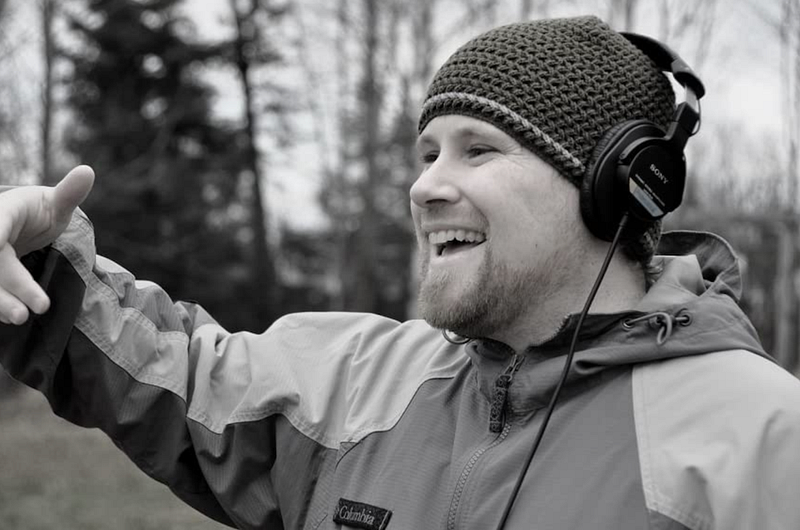
My interview with the 2021 Nicholl Fellowships in Screenwriting winner.
Byron Hamel wrote the original screenplay “Shade of the Grapefruit Tree” which won a 2021 Nicholl Fellowship in Screenwriting. Recently, I had the opportunity to chat with Byron about his creative background, his award-winning script, the craft of screenwriting, and what winning the Nicholl Award has meant to him.
Today in Part 6 of a 6-part series to run each day through Saturday, Byron talks the craft of screenwriting and provides advice for aspiring screenwriters.
Scott: Speaking of characters, now, for this script, you won the Nicholl. A lot of those characters really emerged from your own life experience. Let’s say you come up with a story completely different genre, science fiction. How do you come up with those characters? How do they emerge into your consciousness?
Byron: The Teenage Mutant Ninja Turtles.
[laughter]
Byron: I’m not kidding. The Teenage Mutant Ninja Turtles, the very first poem I ever wrote was about the Ninja Turtles. It was about pizza, sewers, surfing, and all that shit.
[laughter]
Byron: I was always fascinated by the Turtles and how distinct they were. Leonardo leads. He’s virtually not that important. If you really look at Leonardo, his purpose is to move the story forward. Donatello does machines. He explains shit. He’s the person that’s smart and knows what’s going on. There’s your exposition.
Then you have a party dude. That’s Michelangelo. You need some gags. Then you have a mean bastard who goes on his own and goes solo, but he’s still got a good heart. That’s Raphael. When I look through my characters, I’ve almost always got a Leonardo, Michelangelo, Donatello, and a Raphael.
I start there. If I don’t have these four characters, I don’t feel like the story is necessarily complete. In this story with Jamie, that doesn’t exist. It’s not an ensemble thing. Any story that I do that’s a fictional story, and in particular if it’s intended for maybe a family audience, you’ll find versions of the Turtles.
Scott: When I’m working with my students, the way that you’re thinking about it is the way I think screenwriters should think about it: Characters have a function. They have to have a purpose, they exist for a reason.
Byron: They can be too similar. What’s the point? If your characters are too similar, kill one of them. For real. I don’t see the point of two Raphaels. Is Splinter there? He’s going to have to go. If Splinter is there, and that’s the leader of the turtles, he provides some wisdom, but then Leonardo needs to take over. Splinter’s basically your…What do they call it?
Scott: Mentor.
Byron: Yes, but… he’s an Ahab! He’s got the dark history thing with Shredder. Oh and Shredder. Can’t forget Shredder. You got to have your Shredder.
[laughter]
Byron: Shredder. And if you’re really good, he’s got Krang behind him. An immortal evil that never stops but can be rendered harmless for a time. Those archetypes, in a way, it was a perfect comic. It was a perfect kid show. I’ve never gotten over it. I’ve never gotten over how well that chemistry worked.
Scott: Let me ask you, you mentioned you wrote 11,000 poems. I imagine you bring that sensibility to your writing. Describe for me a little bit about that. When you’re writing a scene, and you’re writing scene description or action description, naturally, are you thinking about that? Is more of that executive thinking, after you’ve written it, you’re trying to make it more poetic? How does that work for you?
Byron: When I write, it comes out as robotic often originally. I have to go back through and remove the on‑the‑nose shit because the way that I write at first is so bland. I really am a person who thrives on function and routine. I also tend to beat people over the head with a theme initially.
And that’s just a function of raw communication. If I were speaking as myself, I have a fairly robotic way of speaking. Nobody talks like me. I’m overly honest to the point of being rude. I refuse sarcasm anything that I feel gets in the way of truth, so because I am the source, all of those character do too, at first. They don’t lie. They say exactly what’s on their minds, in clear and functional ways. They speak with my realism. They are slice of life. The emotions are essentially off in this phase. And slice of life can be boring and unclear and void of interest or quality at the best of times, let alone when you remove the emotional element. And the scene description follows that mode too.
Then I go, “How can I make this more human?” I go, “OK, all right. Feelings on,” and I have to turn my feelings on. For me, there is a definitive switch, and these modes are entirely separate.
Then it comes out as more poetic. The edit, I mean. And by poetic I don’t mean the structure of poetry. I mean the ability to communicate more caring and human. More heart to heart with a greater truth than pure realism. That’s the level where, as the writer, you start to love your own work, which I think is important. There’s always going to be something that you don’t like about your work, but it’s important as a creator to be in love with the idea of your creation.
So I turn the emotions on and I go, “Let’s do this,” but with my emotions on, I can’t write 9 to 12 pages a day. I can go through it and edit at a good speed, but I can’t write a rough draft like that. So it’s a difference of function I guess. At this stage, I have to make sure it feels right. And this is the important phase. Literally anybody can write a rough draft as poorly as I can.
But in this phase, I’m not terribly concerned with technical elements or structure or even formatting. When I get to about the fifth draft, that’s when it’s more realistically directly from my soul to yours. And then I finish with a technical polish.
Scott: How important is it for you to find a personal connection to the stories you write?
Byron: If I have a personal connection to it, I seem to be quite good at that. If it’s an artist that I love, Bill Withers, man, someone should give me the Bill Withers biopic, I’m telling you. Bill Withers is highly influential for me. I don’t know if I mentioned him earlier…
Scott: No.
Byron: …but as a songwriter here’s what he did that I attached to: He wrote love stories that were non‑romantic. That, for me, completely blew my mind when I first heard Bill Withers talk about it, and when I heard his music and that soul coming out with “Lean on Me” and…What’s that other one? “Grandma’s Hands.”
He’ll write a story about his grandma. He’ll write a story about how much he loves his neighbor. That’s “Lean on Me.” He’s writing about how much he loves his neighbor in that song. “Hey, man. Come on over for a barbecue, and let me tell you how great a neighbor you are.” It’s weird enough culturally to be different, but it shouldn’t be different. That kind of casual love for people around us should be normal. The generation of small kindnesses should be the default position.
People should be writing all kinds of fucking stories about their friends, who they love, and about their dad who they love, or their teacher, or with their uncle, or whatever. That, to me, that’s amazing. To be able to tell a love story that is unconventional, it’s really powerful. Look at how that song, “Lean on Me” took the world. Look at how people clung to that.
For me, as one of my favorite artists, Bill Withers, and because I relate so much to music because I come from music, too, and writing songs, I wanted to do movies that were like Bill Withers wrote songs as a love nod to him as one of my favorite artists, and one of the people who I consider one of my creative mentors even though I never met him.
Scott: You said that early on, non‑romantic love stories, right?
Byron: Yes, and that’s what “Shade of the Grapefruit Tree” is. Very much I was thinking of Bill Withers when I wrote it.
I wanted to write this story about Felicia, I wanted to honor her, the real woman by writing this story, and I wanted to answer what I felt was a challenge [laughs] from Viola Davis that she issued in an interview. I had all of those affecting the writing of this story, and my girlfriend breathing down my neck because she wanted to read my drama.
Scott: Let’s round it out here with a question that I always ask writers, what advice can you offer to aspiring screenwriters and storytellers about how to go about learning the craft and honing it, and becoming better at what they do?
Byron: You as a screenwriter are getting all your ideas from your culture.
What that means is that every idea you’re going to come up with is an idea that has already been used in some form or another.
If you want to stand out in an oversaturated market, which this is, what you have to do is not deny the culture that you live in but be as much yourself as you can possibly be. Stop trying to write like anyone else and do it 100 percent you. If you don’t, you’re going to be a clone. Unless you’ve already got a writing assignment and you have solid expectations and rules to follow, be yourself. Trust me. It matters.
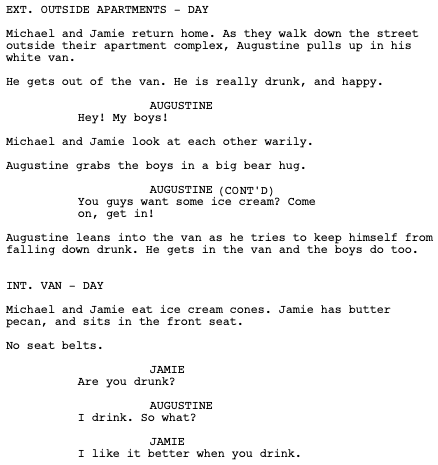
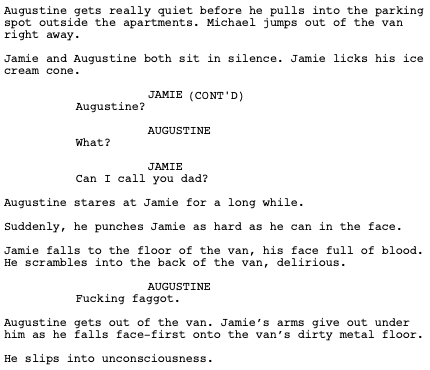
Here is scene from the script “Shade of the Grapefruit Tree”:
For Part 1, go here.
For Part 2, go here.
For Part 3, go here.
For Part 4, go here.
For Part 5, go here.
For my interviews with every Nicholl Fellowships in Screenwriting winner since 2012, go here.
For my interviews with Black List writers, go here.