Interview (Part 6): Brent Delaney
My interview with the 2023 Nicholl Fellowships in Screenwriting winner.
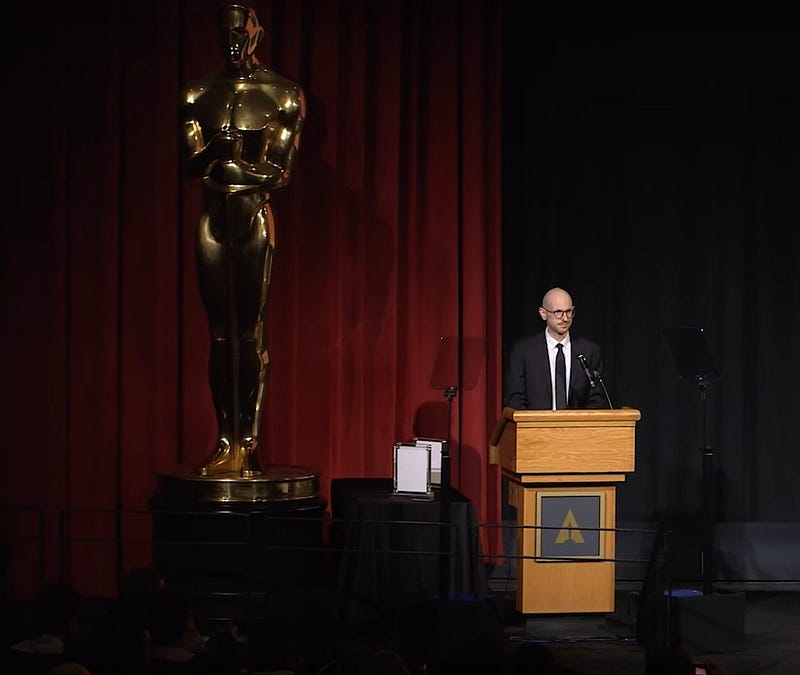
My interview with the 2023 Nicholl Fellowships in Screenwriting winner.
Brent Delaney wrote the original screenplay “Brownie Mary” which won a 2023 Nicholl Fellowship in Screenwriting. Recently, I had the opportunity to chat with Brent about his creative background, his award-winning script, the craft of screenwriting, and what winning the Nicholl Award has meant to him.
Today in Part 6 of a 6-part series to run each day through Saturday, Brent answers some screenwriting craft questions.
Scott: I wanted to talk to you just like a technical thing right here, just take a break from all this psychological talk. I’m always telling students, when you write montages, it’s so hard because on screen they look great, but when you write them, it’s like, people tend to breeze over them.
You have a lot of montages and you do it in a very interesting way, which is almost like these little chapter headings. “How to do 500 hours of community service in 60 days.” “How to remember to bake weed brownies.” “How to care for a loved one diagnosed with AIDS”
Was that a thing that you had a way of organizing time helping with the time transitions? What was the thought process that you came up with this idea about the montages?
Brent: Yeah, you’re right, montages are definitely difficult to read. So, I did want to come up with some way to make them more palatable for the reader. I found that naming them with a specific title that encapsulates the entire montage helps, especially to get the point across quickly.
And, yeah, the most difficult part of writing this script was condensing time. When I was halfway through the script, I almost gave up on it. It was just so hard to condense 20 years into one single narrative and retain the tension, the arcs, and the cohesiveness that’s needed. The montages really helped with that.
Scott: You know, I thought it was very effective. I love the way that you capitalize it. I mean, underlined it, if I remember correctly, too. It’s like, “Hey, reader. Get this point.”
There are several of these moments, two big ones, right in the middle of the story and then right at the end of Act Two where she’s ready to pack it in. Then you have these intersections.
Then that last one with Dennis Peron, you’re talking about this Mentor figure. He says, “Let me get this straight. You want to retire at the very moment when the kids here need you most.” He even says, “You can’t run away from what you are.” That’s just like Carl Jung.”
You really stuck to your metaphorical guns here in that it’s a struggle for her. She doesn’t jump into this. It’s like she really, really resists several points along the way. I admire that because it would have been so easy to just have her like, “Oh yeah. I’m going to be the champion of this whole thing.”
I’m guessing that just was more reflective of her personality? Was it her journey? Was that something that you made as a conscious choice as a writer, that resistance?
Brent: I think both. Part of her personality is being rebellious like I mentioned in her character intro. She’s not going to follow orders from anyone. And the other part is the experience of losing her daughter. The magnitude of something like that happening is so terrible that she would be very resistant to opening up to the world again.
For me, and I think a lot of people, even little tragedies can make us hesitant to go out and engage with the world. Losing a child at that particular age would be so difficult, and I wanted to show the immense impact it had on her.
Scott: She wanted to avoid putting herself in a situation where she might feel that pain again. Then again, fate put her in a situation where she’s like, “My kids,” and seeing them one by one.
Let me ask you a question because there’s a lot of death in the script. Both some of it is like played out on screen, but a lot of it’s intimated in the fact that this AIDS epidemic was happening in San Francisco. Was it hard for you to write this script because of that?
Brent: No, I wouldn’t say it was hard because I’m drawn to tragedy and the darkness of life. I mean, on my wall right here, I have a print of Manet’s Le Suicidé. Yeah, I think about death a lot and what it means.
In storytelling, I think we should be presented with deep philosophical questions like, “What do our lives mean? What’s our purpose here?” And as painful as it can be to think about, death shows us why life matters.
Scott: What’s the status of the script?
Brent: The script is currently being packaged with a production company. The producers I’m working with are truly wonderful. So, I’m hoping that Brownie Mary’s story will reach the screen soon.
Scott: The Nicholl. What was that whole experience like?
Brent: It’s very, very surreal. There was a winner in 1999 named Annmarie Morais, who went to the same university as I did, and I remember looking up to her and the great work she did and continues to do after winning. So, the Nicholl has been my North Star for many years.
I’m sure this must be your experience with your students too. The Nicholl is this dream that you strive for, and to actually open up a Zoom session and see Eric Heisserer… it’s surreal.
And it’s difficult to talk about, really, because with moments like this — moments that you don’t think will ever come true — it’s hard to accept when they do. Let’s just say I’m still in the process of integrating the Nicholl win into my overall narrative.
Scott: Well, congratulations. You certainly deserved it with that script.
Here’s a few craft questions because people like to see how other writers work. How do you come up with story ideas?
Brent: For me, coming up with a great concept or discovering a great story is the hardest part of screenwriting. It takes a lot of time, and it’s almost an alchemical process. Idea generation is magic. In a way, it seems like ideas choose you rather than the alternative. For that reason, I like to think of great story ideas as gifts from the universe.
Scott: Are you one of those writers that needs to have at least some understanding of the story’s themes before you start writing? Or is that something you discover along the way? Or just generally, what are your thoughts about theme and its importance in the writing process?
Brent: Theme is everything for me. Theme is the spine of the story, it’s the protagonist’s arc, it shapes all of the supporting characters. I can’t begin without a strong thematic arc in mind.
Scott: One last question for you. What is the single most important piece of advice you could offer to someone who is an aspiring screenwriter?
Brent: Following Werner Herzog’s advice: read, read, read. For me, I improved most noticeably when I deliberately set out to read hundreds of professional screenplays. I learned so much from the pages of Eric Roth, Steven Zaillian, John Logan… Reading an Eric Roth script is the equivalent of an aspiring composer listening to Bach — the arcs he constructs, the intricacy of his plots, the depth of his themes. In my view, there is nothing more important than standing on the shoulders of giants.
For Part 1, go here.
For Part 2, go here.
For Part 3, go here.
For Part 4, go here.
For Part 5, go here.
Brent is repped by Range Media Partners.
Twitter / X: @Brent__Delaney
For my interviews with every Nicholl Fellowships in Screenwriting winner since 2012, go here.