Interview (Part 6): Allison and Nicolas Buckmelter
My interview with the 2018 Nicholl Fellowships in Screenwriting winners.
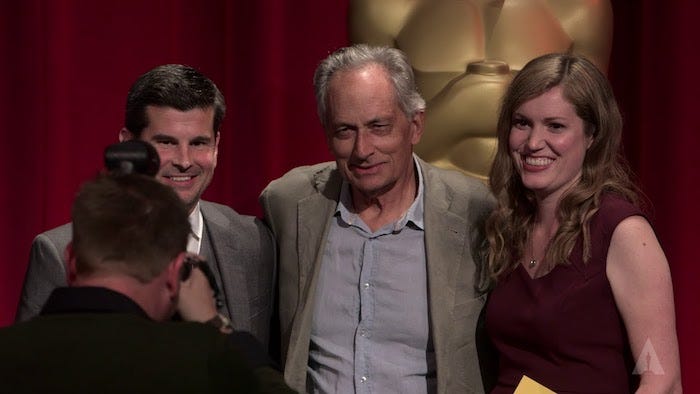
My interview with the 2018 Nicholl Fellowships in Screenwriting winners.
Allison and Nicholas Buckmelter wrote the original screenplay “American Refugee” which won a 2018 Nicholl Fellowship in Screenwriting. Recently, I had the opportunity to chat with the married couple about their backgrounds, their award-winning script, the craft of screenwriting, and what winning the Nicholl has meant to them.
Today in Part 6, Allison and Nicholas share advice for aspiring screenwriters.
Scott: Let’s talk about characters here. How do you go about developing them? Are there any specific, I don’t know, tips or tools that you use when you unpack the character?
Allison: Yeah, there’s a screenwriting book we’ve had for years that has a list of character questions. It’s like 20 questions. It seems so silly when you’re doing it. It asks questions like, “What kind of grades did your character get in high school?” All of these questions, and we fill them out for every character. By the end, it feels like you have a living, breathing person in front of you. That list of questions has been great.
I also got a tip to write quickly and not outline. We used to do a lot of outlining, days and weeks of outlining before starting. What we found is that that makes for more of a plot‑driven movie than a character‑driven movie. We scaled back on some of the outlining because now we trust more in our rewriting skills.
We feel like, “You know what? We have a general sense of the major plot points in this. We don’t need to spell out every detail. Let’s just try doing a first draft,” and we’ll always do those character questions first.
It feels a little more organic, and it feels like the characters are speaking in the page versus I have to get this character to address all these bullet points from this outline in this scene.
Scott: When you’re writing scenes, do you take a similar approach where you’re feeling your way through the scene, or do you sit down before you write a scene and you have certain things you know it needs to accomplish, or both? [laughs]
Allison: We do them both. With “American Refugee,” when we were doing the first draft, we didn’t have any kind of real ending in mind. We were just writing. Our ending changed several times in several drafts. Earlier in our writing career I would have been a lot more nervous to start a script without knowing exactly how it’s all going to end.
Now, I feel like it’s better to start drafts sooner, but it’s also working as a team. I trust in our rewriting process better than if it were just me writing [laughs]. I feel like that’s the area of screenwriting I get most anxious about, is the rewriting process. If I were doing that alone, I might feel like, “Oh, gosh I better get this right the first time.”
Now, I don’t have that same fear. I know that we can always change it.
Nicolas: It also makes for a more exciting writing experience. You leave certain things unplanned because then it does leave a little wiggle room for the characters in a particular situation to take you, as the writer, to places that you hadn’t plotted out in advance.
Leaving some of that breathing space is important to the spontaneity and also the freshness of the writing, and it makes for a more enjoyable process.
Allison: Yeah. It feels tedious to sit down and write out pages of a screenplay from this lengthy outline, but we’ve done it.
Nicolas: We’ve done it.
Scott: You’re talking about the rewrite process. How many drafts of “American Refugee” do you think…I know you submitted it to the Nicholl at least twice. How many drafts do you think you wrote, if you had to estimate, of that script?
Nicolas: At least six.
Scott: Six drafts. What is your rewriting process? How do you go about doing that?
Allison: One of the things ‑‑ and I’m sure all screenwriters do this because there’s a page limit — we’re always trying to trim down everything.
Nicolas: Allison loves attacking the blank page. She does a lot of that. I do a lot of rewriting. It’s true what she says.
A lot of it is trying to be concise, economy of effort, economy of space, getting in and out of scenes more quickly, looking at pacing and giving the story breathing space when it’s required. Looking at those types of things and tightening it up so that it’s a quick and enjoyable read.
Then making sure it’s the product we want. If it isn’t, then we keep at it.
Allison: Having a partnership is really helpful for notes because, if we get notes back, it’s easier to work through them with a partner because you don’t feel quite so defensive. [laughs] If it’s 100 percent your own writing, all of it, and you get a note back to change something, that’s a little harder…At least that’s how I felt before I started writing with Nick.
I felt notes were difficult, but now, together, we sit and we talk. Like, “OK, what did this person mean?” Of course, we might feel defensive for a few minutes while we’re talking it out, but we talk it out together. Notes from readers are helpful, anyone who’s willing to read your script.
It’s always great when people say they like it, but if they can tell you something that bothered them or they weren’t so sure about, and, if you get that note more than once, you know that’s an issue. For example, with American Refugee, one was with Helen and Winter’s relationship.
Nicolas: Some people weren’t buying it in terms of the intimacy. We had to rework that.
Allison: Rework that a lot.
Nicolas: All of this really points to having readers whose opinions you trust. In our case, it’s each other primarily. Being a partnership, especially a married partnership, we have a very thick skin now about criticism. Accepting honest criticism is a learned skill.
We’ve been at it enough in both our writing lives and our personal lives where any idea thrown forward is in service of trying to make a better story. At this point, we don’t care whose idea it was so long as it’s good [laughs] or so long as it helps the story. All of these elements go into rewriting.
Allison: My rewriting is, “Hey, Nick, rewrite this please.”
[laughter]
Scott: That’s your rewriting. Division of labor. One last question, and I’m sure you’re going to be asked this now that you’re in the business. What advice can you offer to aspiring screenwriters and filmmakers about learning the craft and breaking into Hollywood?
Nicolas: Oh, man, if we knew that answer we would have…
Scott: Apart from, “Win the Nicholl.” [laughs]
Nicolas: Yeah, right. Win the Nicholl.
Allison: Contests are helpful. We’ve always done contests, and sometimes a script will get to a semi or finalist round in one contest, and it won’t even get past the first round in another. Obviously, doing more than one is helpful.
Nicolas: Yeah, and with contests I would also recommend signing up for the notes.
Allison: Sign up for the notes for sure.
Nicolas: The more people who are reading it, reflecting on it, and sharing their thoughts, the better. In terms of everything else, I believe that all of those things that we were talking about, writing from a place that matters to you, writing what you know — all of those things about writing are true, at least for us. Be bold. Take risks with your writing.
Don’t try to anticipate what the market wants, just write the things that matter to you. Read all the screenwriting books. Take what you can from them.
Allison: Just go ahead and start a first draft. That was our big thing before, until the last few years. We wouldn’t want to start a first draft until we had thought everything out and the idea was perfectly cemented in our heads. Then we’d imagine a nice long weekend set aside to do it when there weren’t a lot of other things going on in our lives.
But it’s never going to be that perfect time, and you’re never going to have all the answers for the story. Even if it’s a busy weekend, and you only have 45 minutes during your lunch hour or something, just try scribbling out a scene and keep doing that every day. Before you know it, you’ll have a first draft.
Nicolas: Get your hands dirty. Nobody’s going to read a blank page.
For Part 1 of the interview, go here.
Part 2, here.
Part 3, here.
Part 4, here.
Part 5, here.
For my interviews with every Nicholl Fellowships in Screenwriting winner since 2012, go here.
For my interviews with 53 Black List writers, go here.