Interview (Part 5): Wendy Britton Young
My interview with the 2024 Nicholl Fellowships in Screenwriting winner.
My interview with the 2024 Nicholl Fellowships in Screenwriting winner.
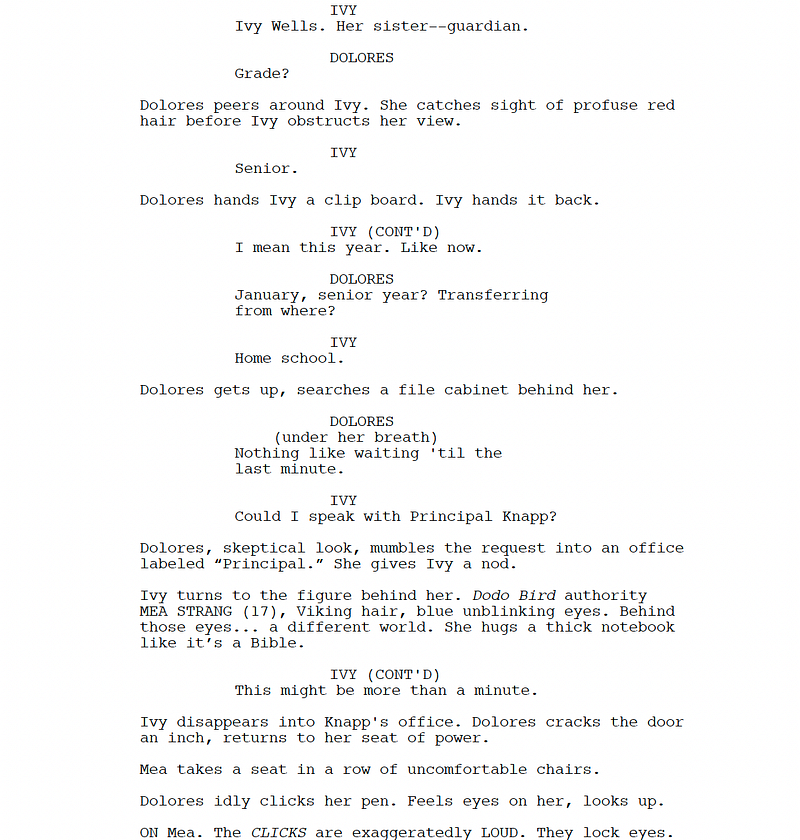
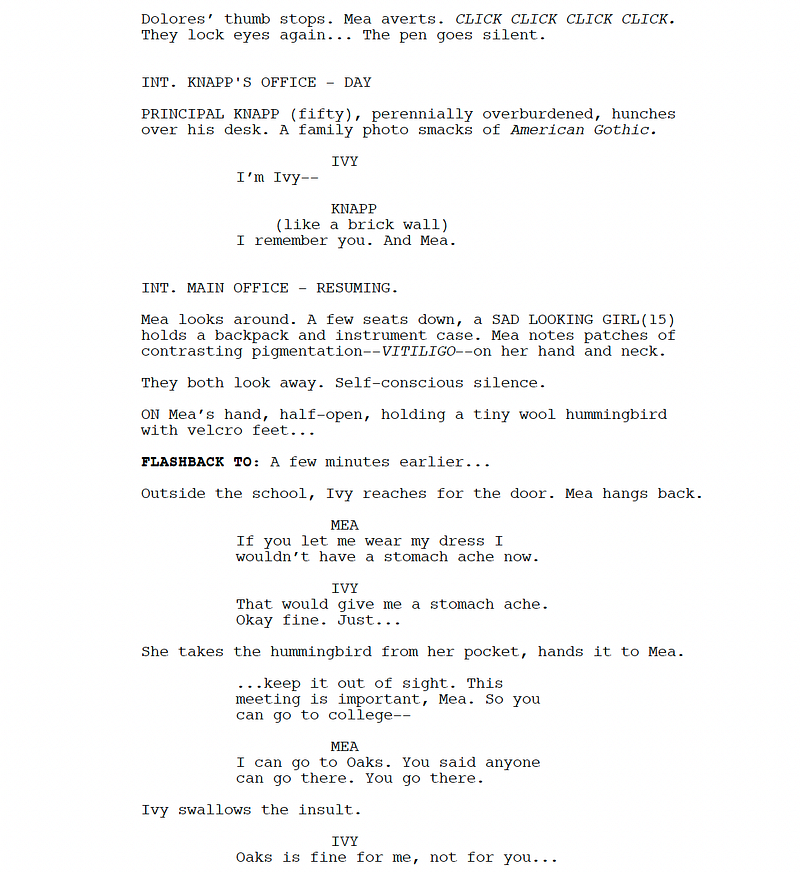
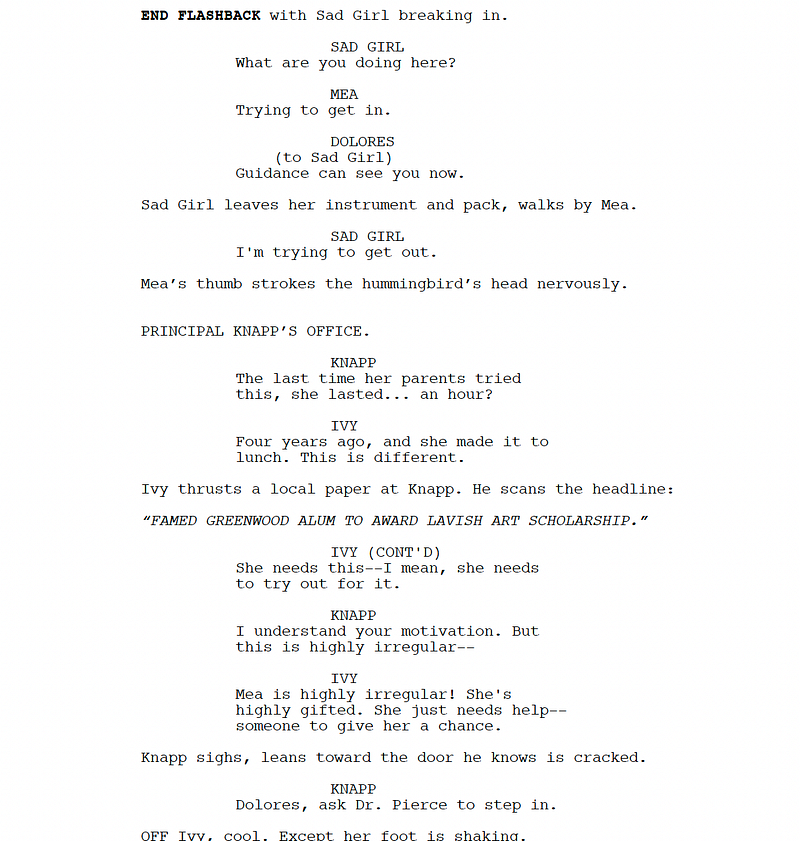
Wendy Britton Young wrote the original screenplay “The Superb Lyrebird & Other Creatures” which won a 2024 Nicholl Fellowship in Screenwriting. Recently, I had the opportunity to chat with Wendy about her creative background, her award-winning script, the craft of screenwriting, and what winning the Nicholl has meant to her.
Today in Part 5 of a 6-part series to run each day through Saturday, Wendy reveals what her experience was like winning the Nicholl Fellowship in Screenwriting.
Scott: So jumping way ahead, there’s a conversation that the two of them have, a very frank conversation — I think it’s the second time we’ve seen that they’ve engaged in physical, intimate relations — that is very mature.
You sort of go in there expecting, “Oh, Ivy’s going to go off on this guy and talk about what a fraud he is and all this sort of thing and storm out, while Reed’s going to have to kind of lick his wounds,” but he has his own worldview, and part of it is that, “I am enjoying myself. What’s wrong with that?”
Again, the characters are so finely drawn in the story, and that scene…Do you remember writing that scene? Because you come out of it like, yeah, these are two people who have legitimate points of view. Do you remember the writing of that? I imagine that took some time writing and then rewriting it. Right?
Wendy: You know that. It was like I had to learn how those characters…I had to learn their truths, because it was initially a little bit more shallow. It got more truthful as I listened to their points of view.
Scott: That decision to go out with Reed… actually, she goes on a date with some other guy, but, I mean, eventually with Reed. That date with the other guy precipitates Mea, with Pandora, again, trying to be nice, “Hey. There’s a party.” So Mea goes to this party, and I’m like, “Uh-oh.” All the way through this thing.
There’s the punch laced with vodka. There’s somebody who gives her a gummy. Pandora brings this guy for her first kiss, which she feels is like a camel spitting, and then she leaves, loses her journal. She’s out. It’s like one thing after another.
That must have been as much as we love our characters, and I’m sure you do love Mea, that must have been hard to write all those things that she had to go through.
Wendy: Interestingly, my initial draft was a lot tougher in that an assault happens, and people did not like that. They kept saying, “It feels like this is two different stories.” A crime is committed here, but she’s asleep. She doesn’t know who it is, and it was like a crime story.
Finally, I was just like, “What is the essence of this story? What is going on here?” I was like, “Complex characters, simple story.” Let the characters be fabulous and wonderful, but don’t freaking make the story go in 90 different directions.
The essence of the story is her unique gift and POV. So I dropped half of what I had written.
It’s still tough, though. I was in tears writing at times, because, from Mea’s point of view, it’s devastating. She has to get her notebook — her work — back in order to complete her scholarship painting.
Scott: When you said, “Complex characters, simple story,” that’s literally something I put online. “Simple story, complex characters.” That’s a good a truism about writing as there is.
I do want to talk about the evolving story of the lyrebird. If you don’t mind, I’m going to read the first part of this thing because it’s really quite lovely. This is Mea’s voice over, “But of all the creatures, it had the most beautiful song. One day, Whistling Wind passed by. Hearing the bird sing, Wind was jealous, ‘I’m tired of whistling. I want a beautiful song.’ When the bird fell asleep, Wind crept in to steal the song.
“Quickly, the bird swallowed it. Wind rushed down its throat, but it could not catch the song. Finally, Wind gave up and fled, leaving behind a tiny gust. When it awoke, the baby bird could make no sound. The song had fled into its tail feathers, which formed themselves into the shape of a lyre. The lyrebird was mute except to echo the other animals.
“One night, 10 years later, maybe more, when the lyrebird slept, Wind took its parents away in a storm. ‘Be careful, lyrebird,’ warned its mother, ‘The forest is full of fearsome creatures.’”
Could you maybe talk about the genesis? I mean, so much of that obviously is directly applicable to Mea. Could you talk about the genesis of the story within the story, this lyrebird story?
Wendy: Yeah. It’s a direct expression of Mea’s point of view. This is her mythical interpretation of what happened to her to make her different from other people. It also shows that Mea’s parents, especially her mother, were fearful, and that Mea absorbed some of that fear.
Scott: You were in the zone. Moving ahead in the story, there’s a significant All Is Lost moment. You don’t think Mea’s going to be able to participate in the scholarship contest, let alone the fact that she and her sister have a big break, but then things turn out.
The very ending of it, on the last page, “The forest is full of life and good medicine,” which is a wonderful callback and a beautiful way of rounding out the story.
Wendy: I was lying awake at night, and I was like, “What is the ending?” Because when I write I have to have the ending. Sometimes I write the opening, but I don’t get to do all the in-between stuff until I pretty much have the ending. Even if it changes, I have to have that beautiful thing that I’m writing toward.
If I have something that I know is like this little pearl that really moves me, then I can write. So I had that ending pretty early on, and I remember when I thought of it, I was like, “That last line is just…yes.”
Then at the very, very end where Jake is looking through the notebook, and he sees the picture of the lyrebird that Mea is giving him. Then there’s the moment where it turns its head and looks at the audience.
I was like, “That’s magic,” because to me, it’s like saying, here’s a beautiful story and it’s about your voice, and it’s about imagination, and that look out to the audience is like an invitation: “What’s your story, what’s your voice, and what are you going to do with it?”
Scott: It’s circling back to hero’s journey: “Follow your bliss.”
Wendy: Yeah.
Scott: Find that thing you’re passionate about. If you feel like you can share with the world, then do that.
Wendy: It’s a little bit magic, you know?
Scott: Yeah. It is magic. I think you mentioned that you had some good news recently. You had an option agreement on this and a director attached. Is that right?
Wendy: Yes. A director and producer team have optioned it. The director is Manfred Lopez Grem, whom you worked with at a Black List Feature Lab. He read the script a while ago, and gave me some fabulous notes. When I won the Nicholl, he saw it as an opportunity for the story to move forward, and asked to direct it.
The producer is Simon Taufique. He’s produced a number of beautiful films, including “Imperium,” starring Daniel Rdcliffe. He has a film currently premiering and in competition at Sundance 2025, called “Ricky.” And he’s composed music for many others as well.
When the three of us met, I felt like everybody was speaking the same language, and that the story was in really great hands. I’m looking forward to collaborating with these guys!
Scott: Well, sending our creative juju towards you so that this will be in Sundance in 2026. Shifting over to the Nicholl, what was that experience like?
Wendy: Wow. So fun! They’re such warm, authentic people. I couldn’t get over the fact that…I just couldn’t get it into my head that these cool people on the Nicholl committee read the script and voted for me. I told Susannah Grant, who wrote “Erin Brockovich’ and “Ever After,” among other things, that I wake up in the morning and think, “If I could just write a script like Erin Brockovich, I would die happy.”
Scott: Well, don’t die on us yet.
Wendy: Yeah, not this week [laugh]. It was just so warm and supportive and encouraging. In fact, you have to do a little speech when you accept your award, and I talked about the power of encouragement, and I thanked all of the encouragers there. That really is what they do, and they do it beautifully. It did kick me up to a different level, not just in terms of visibility, but also in confidence in my own voice. So kind of a mini Lyrebird moment.
Tomorrow in Part 6, Wendy answers some craft questions.
For Part 1, go here.
Part 2, here.
Part 3, here.
Part 4, here.
For my interviews with every Nicholl Fellowships in Screenwriting winner since 2012, go here.