Interview (Part 5): Ward Kamel
My interview with the 2024 Nicholl Fellowships in Screenwriting winner.
My interview with the 2024 Nicholl Fellowships in Screenwriting winner.
Ward Kamel wrote the original screenplay “If I Die in America” which won a 2024 Nicholl Fellowship in Screenwriting. Recently, I had the opportunity to chat with Ward about his creative background, his award-winning script, the craft of screenwriting, and what winning the Nicholl has meant to him.
Today in Part 5 of a 6-part series to run each day through Saturday, Ward shares what it was like to learn he was a Nicholl winner and his experience during the Nicholl Award week in L.A..
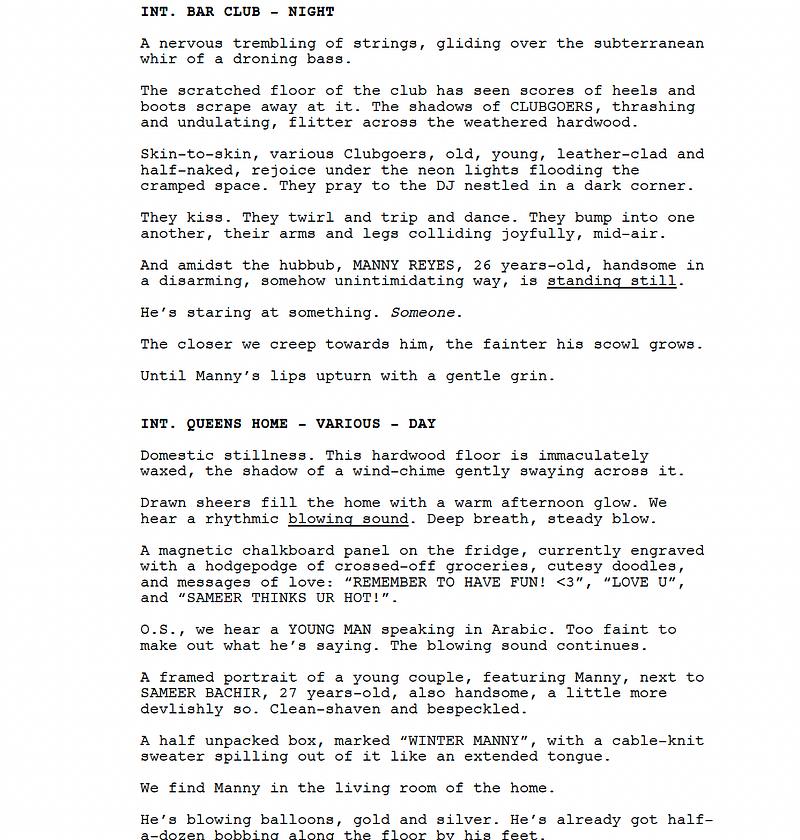
Scott: One last thing. I mentioned you’d set up the very first scene where we meet Manny and he’s in a club. Then Sameer, the very last thing is the same thing, but it’s switched. Manny is the one who at first was staring at something, someone, the closer we creep towards him, the fainter his scowl grows until…
Manny did that first, but then Sameer does the exact same thing. I was curious, what was going on there?
Ward: In my mind, what that moment is, the very first moment and the very last moment, is the moment that they first met.
That’s never in any of the flashbacks. The earliest flashback in the film is their first date, but we never really find out how they met. Then we obviously, after that first date, it’s like all the way up until Sameer’s death, and it’s never really brought up how they met.
I really did feel like at some point or another, I wanted to touch on that. It just felt like having a full flashback of them just doing this meet-cute wasn’t tonally correct. I’ve subscribed to the adage of come in late and leave early in more ways than one.
Even when you’re cutting a movie, even when you’re shot listing something, but even when you’re writing something, you want to come in late and leave early. I do think that there’s a lot of weight often, I think, in our memories of people when it comes to our very first impression and that very first moment that we saw them.
I liked the idea of bookending it visually because this film goes so many places, literally, between these scenes in Brooklyn and in Queens and the flashbacks and then obviously in Dubai and we’re crossing countries.
There’s a really diverse visual palette that bookending it felt correct and bookending it in this world that they’re probably most comfortable with which is this like Bushwick rave scene. It’s a world that I know very well.
In my mind, the very, very first shot is what Sameer was seeing when he first met Manny, and the very, very last shot is what Manny was seeing when he first met Sameer. It’s just locking eyes across this dance floor.
Scott: Yeah, that’s beautiful. Great script, really enjoyed it. Let’s talk about the Nicholl experience. What was that like, both learning that you’d going through that process of, oh, quarterfinals and learning that you won, and then also the Nicholl week experience and getting to meet the other cohort members from this group?
Ward: Yeah, it was absolutely a whirlwind. It was wonderful. The experience of finding out was surreal. I’m sure you’ve heard this from other fellows. Essentially, it’s a really quick deluge of notifications that within the span of a month, I went from finding out that I was a quarter finalist to finding out that I was a finalist.
That’s really not a long time compared to a lot of other, like when we’re talking about festivals or we’re talking about other screenwriting competitions, found out I was a quarter finalist, a week later, semi-finalist, a week later, finalist.
The switch between semi-finalist and finalist was also pretty intense because A, you’re going from 150, I think, to 10. The finalists, there’s only 10 of them. Since there are five winners traditionally, that’s essentially a coin toss, so great odds.
Then secondly, when you’re going from semifinalist to finalist, that stage is you’re only being read by Academy members. You’re not being read by just the Academy readers. All the people that read the semifinal scripts are Academy members.
At that point, when I got to the semifinalists, I was like, OK, well, this is where my script is going to get thrown out. Like this is as far as I’m going to go. Then we find out that we’re finalists and I was over the moon. It’s already such an honor to be a semi-finalist, let alone a finalist.
Then very quickly afterwards, they got us on a Zoom and they were like, yep, you’re the five that won. It was the week that I was waiting between being a finalist to finding out whether I won was maybe one of the longest weeks of my life. It was very, very difficult to think about anything else. Imagine trying to do your laundry, you know what I mean?
But it was obviously a highlight, an all-time high for sure, finding out that I won. Then it was just go, go, go. The Academy moves very quickly and they’re very efficient. The time between me finding out that I won in the actual Nicholl Fellow week was, I think less than a month, and so it was figuring out flights because I’m based in New York and everything happens in LA.
The Nicholl week, the Fellow week itself was life-changing would be like a little bit of an understatement. It’s a beautiful combination of these mixers with previous fellows, these workshops and little seminars with a range of different people, including past fellows, but fellows from a range of different…
What I’m trying to say, I guess, is that we were often meeting with fellows who had been in the industry for 20, 30 years because they won the Nicholl in the year 2002 and we were meeting with fellows that won last year, what their experience one year out of winning had been like.
We met with people that talked to us about management, representation, how to find a lawyer. It was really a bit of a bootcamp. We also did a tour of the Academy Museum, which is lovely. Then we just got to meet all the other fellows, which was really special.
I hadn’t had an opportunity to meet everyone else like Colton, Wendy, Alicia, David, Charmaine, and they were all amazing. They’re all wonderful, and we got along really well. I really have just the most positive things to say about it. It was equal parts educational and just so enjoyable and so fun.
Scott: I think you said that you intend to direct “If I Die in America.” What’s the status on that now?
Ward: We are at the moment, technically still in development. I’m still putting the final touches, I think, on this current iteration of this draft. Then we’re going to be sending it to potential production partners in 2025. We’re looking to shoot in early 2026.
Right now, I think the two biggest hurdles for us are having a really concentrated exploratory period about where it would make most sense to shoot this because it’s set in Dubai, but there might be a lot of reasons as to why we might want to shoot somewhere like Morocco or Jordan.
Then budgeting that out, because you need to work with line producers that have had some experience shooting in those specific regions to wrap your head around how much that would cost. Then obviously cast attachments would be the step after that. We’re really excited about that.
We have some people in mind. We’re just waiting to make sure that, A, we’re not sending anything that’s premature from a script perspective, but that when we are reaching out to cast, we have some rough semblance of when and where we’re going to shoot.
Scott: Well, good luck on that. Let me ask you a couple of craft questions. You mentioned sequence theory. You mentioned approaching scenes, get in late, out early. What is your prep process like? Do you spend time brainstorming doing character development? Do you break up the cards? How do you break story?
Ward: I’m happy to talk about my process. I don’t think that anyone should copy it. I think the ultimate whatever works for you, but I don’t do cards. I don’t do a lot of outside the outline character work. For example, I know I have friends in my writers groups that do like diary entries and all sorts of really fun craft things.
I’m pretty straightforward when it comes to my process and it’s always been the same for every single one of my features. I’ve never deviated from it. My process goes as follows. I’m a really, really heavy outliner and I don’t write a single page until the outline is in pretty detailed shape.
I try to leave off writing until the very end. That’s essentially for me, the very last step. There are reasons as to why that’s not super clever, because I think that doesn’t leave a lot of room for discovery on the page.
Then I also think the other con of doing something like that is that you do get pretty attached to your first draft because your first draft is actually pretty developed. That makes it difficult to then commit to a page one rewrite or makes it difficult to kill your babies.
The pro of that in my mind is that I have allowed myself in the past, every feature that I’ve written, to write it in less than 12 to 13 days, but what I do is I just outline for a good three to four months first, and then I meet with fellow writers in my writers groups about my outline and not my actual script.
That accomplishes a couple of things for me. When I’m getting major notes on an outline, then while I’ve just described that I’m more precious about my first draft, it’s a lot easier to slash and cut and play around with an outline because at a volumetric level is just a lot easier.
The parts are smaller, it’s fewer moving parts, at a word count level. When someone is asking me to consider changing the way that this scene flows, it’s just changing the way that the sentence is written out as opposed to rewriting 10 pages. The outline phase is very fluid and really flexible.
I usually write close to 15 to 16 different iterations of the outline from start to finish. They end up being pretty beefy outlines. They’re like scene by scene outlines, the end up netting at around 18 to 20 pages for the outlines.
Then once I’m really happy with that, and I feel like I have an outline that I’m extremely satisfied with, then and only then do I then go somewhere else and I spend, usually every single retreat I’ve done, I’ve done 12 days to be very exact.
I do six writing days, a break day, six writing days. Average out 10 pages a day usually. That works out for a 120 pager, but a lot of days it’s not quite 10 pages a day, but a lot of scripts aren’t quite 120 either, so it works out.
That’s how I’ve done it every single time. At the outlining phase itself, I can be maybe sometimes a little bit more creative when it comes to, not quite cards, but there are times where I do a full outline pass where I make it so that every single beat is…It’s that like Matt Stone and Trey Parker thing where they talk about how every single beat be…
Scott: Therefore, but …
Ward: Therefore, but, exactly. I do sometimes do some funky outlines for the lack of a better term, but generally speaking, it’s just outline for four months, write for 12 days, and then move on to the next one. Moving on to the next one is maybe ideate for two or three months. That’s just very, very loose. That’s just like five log lines every day. That was something that my professor at Tisch would have me do.
In those moments where I’m just ideating, I try to do five log lines a day, or it’s just staring at your blank cursor and trying to watch the movie in your head while I’m thinking about what the log line for it would look like. Yeah, that’s my rough process.
Scott: When you say ideation, you’re intentional. You’re intentionally sitting down and saying, I’m going to come up with ideas. Is that right?
Ward: Yeah. I think that’s the only way. I subscribe to that, but that often can be a really, really frustrating experience, obviously. A lot of it can sometimes feel like you just wasted three hours because you spent three hours writing three sentences.
To me, you need that level of infrastructure around, infrastructure being temporal infrastructure. You need to be able to just stare at a wall for 20 minutes for something to come to you, in my mind, but it is active in this way.
I’ve never really written anything that I just thought of randomly one day. It’s always been these like five log lines a day that then I look back on at the end of the week and I’m like, well, these three are pretty good. That’s what’s nice about outlines.
That’s what’s nice about being really strict about not putting pen to paper on final draft or on whatever screenwriting software you use, because then there’s also this exploratory period or some level of stress testing where if before I’m even writing, I’m trying to see…
Like, the first step I take after I’m trying to graduate from a log line to a outline is I mark out a sentence for each sequence. It’s usually a sentence for each sequence plus two more things. It’s normal world, inciting incident, refusal of the call, it would be great to have, but it’s not that important.
Then the lock-in, and then it’s fun and games, sequence three, midpoint. Subplot, sequence five in my mind is usually the subplot and then dark night of the soul and then climax. Then you can have your three-part climax, the Snyder three-part climax. For me, it’s usually just some variation of storming the castle and then sequence eight, the resolution.
That’s a sentence each and not to put pressure on anyone reading, but in my mind, there’s no reason why you can’t have a log line and then do what I just described, hit all those points in less than an hour. If you can’t, then you either just need to think about it a little bit harder or maybe that log line is no good or something’s broken about the log line. That to me is step two.
If I do that and I’m like, “Wait a minute, this is actually pretty great,” and I actually love this climax and I think that that’s really cool arc, that’s when maybe I’ll start thinking about, should I start outlining this for real, and do some work on the normal world and do some work on the midpoint. If I’ve done that for two weeks straight, then I’m in too deep, and now I’m going to write it.
Tomorrow in Part 6, Ward shares his take on aspects of the screenwriting craft.
For Part 1, go here.
Part 2, here.
Part 3, here.
Part 4, here.
For my interviews with every Nicholl Fellowships in Screenwriting winner since 2012, go here.