Interview (Part 5): Tara Tomicevic
My interview with 2021 Black List writer for her script “Thicker Than Ice.”
My interview with 2021 Black List writer for her script “Thicker Than Ice.”
Tara Tomicevic wrote the screenplay “Thicker Than Ice” which made the 2021 Black List. Recently, I had the opportunity to chat with Tara about her creative background, her script, the craft of screenwriting, and what making the annual Black List has meant to her.
Today in Part 5 of a 6-part series to run each day through Sunday, Tara reveals what it was like to learn that her script “Thicker Than Ice” had made the 2021 Black List.
Scott: These are characters that accompany Hannah on her arduous journey. They’re just a hoot, these two characters. Hannah learns something from them in that process, doesn’t she?
Tara: Absolutely. Cosmo and Martin were the right people to put in Hannah’s path to help change her in the way that she needed to.
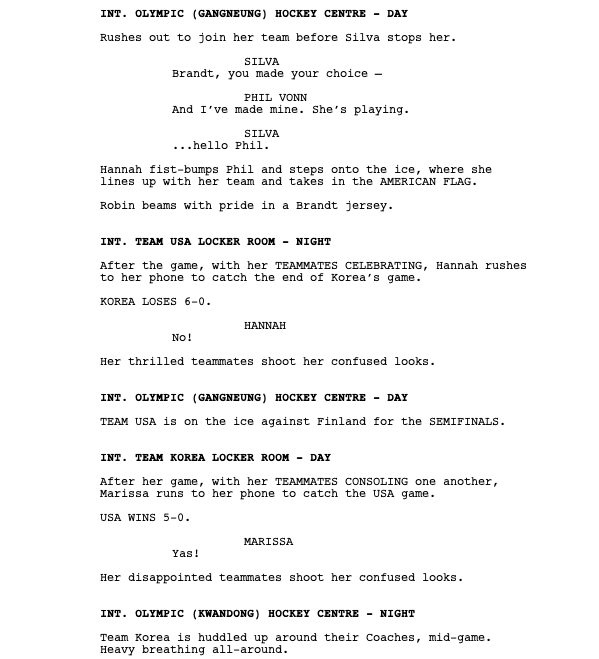
Scott: It’s really that emotional high point, in some respects for me, where they’re at the Olympics and Hannah defies her coach. The coach has that line like, “Whatever you do now is going to define you.” It speaks to that question about, “Who am I?” She says, “I’m going to go,” and she goes to see her sister, right?
Tara: Yeah.
Scott: That’s more important than even right now, we’re on the edge of the gold medal final. They do go on this journey in which they discover stuff about themselves including that their sisterhood is super important to them.
Tara: The most important.
Scott: You mentioned you’re doing this back and forth with calling and Zoom sessions and whatnot with the sisters. How long did it take?
Tara: I want to say that I got on Zoom with them for the first time in November of 2020. Then, I remember spending Christmas break watching various sports and biopic movies. I really didn’t
find anything that I could try to emulate, nothing was really speaking to me, it all felt a little bit outdated. Then I started figuring it out in January, February, and that’s when I started writing.
I think I was done in June. It certainly felt longer than that [laughs] It felt like… I had to write three movies before I really figured out this one. It was a lot of moving big parts, and then, like I said, being accused of not knowing what story I was telling, which was completely true.
So maybe eight months altogether.
Scott: You always look for those crawls at the end. Where are they now? I guess they live together. There’s some sort of philanthropic thing that they’re involved with.
Tara: Yeah. They’re a part of multiple philanthropic groups, mostly surrounding adoption and intercontinental adoptions. Also, they have an ice rink named after them now in their hometown, which is badass. They live together. They have a dog together, they’re best friends. Then, Hannah represented Team USA again last week.
Scott: In the Winter Olympics. All right. They got to celebrate. And you got to celebrate on December 13th, 2021 with the roll-out of the annual Black List. Were you tracking this at all?
Tara: It’s something that I’d wanted but I was actually on my very first episode of television when I found out so I didn’t have the bandwidth to be tracking it.
I was on my first tech when I got a text from my manager, Kendrick Tan, and a text from my showrunner, Matt Lopez, because we have the same management company and he’d heard too.
Scott: There you go. Hollywood has a way of squashing you. I hope you celebrate it later, but it’s like, “OK, great. Now I got to go do this.”
Tara: It felt like two fruits of many years of labor.
Scott: Can you talk about the TV show that you’re on?
Tara: Yeah, it’s “Promised Land” on ABC. I think episode five aired this week, so we’re in the middle of the first season.
Scott: Which episode is yours?
Tara: Seven.
Scott: Congratulations. Terrific script. I hope that somebody sees the merit in this thing.
Tara: Thank you. I can’t help but feel that all the sports movies that I grew up loving are in men’s sports. If you look at the Disney+ categories, they have one that is literally called “feel good sports movies,” which is very much my jam, obviously. They’re all men’s sports. The one that is about female athletes is the new series “Big Shot”… but it’s actually centered on the male coach, or a classic, “Double Teamed,” which is from 2002 and that’s just sad. It’s a pattern that I cannot unsee.
Scott: There’s ancillary things like “Bring It On,” which is about cheerleaders.
Tara: “A League of Their Own” was a wonderful classic.
Scott: Yeah, absolutely.
Tara: But how many years ago was that? It’s like, “We could use another one guys.” [laughs]
Scott: It was ’89, ’91, something there.
Tara: I think I was born…? [laughs]
Scott: Hollywood’s had that whole “similar but different” approach for years. You say,
“It’s Mighty Ducks in the Olympics but with girls.” I put on my producer’s hat, I’m like, “Yeah, I see this.” Good luck with that.
Let me ask you a few craft questions here if I can. Maybe this is the way you come up with story ideas. You browse through the Internet or are there other ways that you generate story ideas?
Tara: The last few have been research. The process is somewhat different every time depending on what kernel I start with. There are a couple of scripts that I’ve written that were more personal, more autobiographical. If that’s not the case, then it’s a lot of reading and finding something that sparks.
Scott: You’ve been a producer. You produced some films that you talked about earlier. How important do you think that story concept is where the conceptual elements are to the success of a spec script?
Tara: Funny you ask. Today I read a Twitter thread saying that a couple of decades ago, it was all about concept. It was all about idea. It was all about writing something that was commercial, that you could quickly retell and intrigue with. His argument, and it was a manager who was saying that, was that that’s not necessarily how people are getting studio work anymore. It’s not writing the big splashy thing that is more likely to sell, yes, but it’s more about writing something smaller and more charactery and more voice-y. I can see that. I’ve certainly read a bunch of scripts that were not concept-y nor big ideas and launched careers. In terms of selling, it does seem like idea is king.
Scott: You made an interesting point there which is that, someone out there writing a spec script, you got to say, “What is your goal here?” At the risk of chasing the market, I know writers who do this and made a living doing this.
I know that the standard thing from professional screenwriters to aspiring writers is, don’t chase the market. Write what you’re passionate about. Absolutely. I do know writers who do or at least aware of the market.
If you do want to sell something, it’s almost like you got to push the concept more forward, because it’s all about marketing nowadays so much of it, running an eyeball.
Which I think you’re right, in terms of being able to craft a career and establish yourself with having a unique voice or a distinctive story to tell, the less concept these stories can work for your benefit.
Tara: Yeah, that seems to be what I’ve seen but maybe in a couple of years I’ll have a different take. I still feel very new to the feature side. It’s just so different because if they buy it and then hire three other people to write it, then it does seem like concept is what matters because…
Scott: That’s what they bought, it’s the concept.
Tara: Exactly. Television is different.
Tomorrow in Part 6, Tara shares some thoughts about the craft of screenwriting and offers advice to other writers.
For Part 1 of the interview, go here.
Part 2, here.
Part 3, here.
Part 4, here.
Tara is repped by Paradigm and Lit Entertainment Group.
For my interviews with dozens of other Black List writers, go here.