Interview (Part 5): Stefan Jaworski
My interview with 2021 Black List writers for his script Mercury.
My interview with 2021 Black List writers for his script Mercury.
Stefan Jaworski wrote the original screenplay “Mercury” which landed on the 2021 Black List. Recently, I had the opportunity to chat with Stefan about his creative background, his script, the craft of screenwriting, and what making the annual Black List has meant to him.
Today in Part 5 of a 6-part series to run each day through Sunday, Stefan discusses his approach to writing chases in an action film.
Scott: You’ve got all these adversarial characters in Michael’s life. There’s Laura as she turns out to be. There’s this Burke character, Jason’s very physical, ex‑boyfriend of Laura, supposedly a cop. It’s like, Michael has got this whole underdog thing going on there. It strikes me, there’s two things that would be a real challenge for someone such as yourself writing these types of things. The first is the problem‑solving. Not only how a character will solve the problems, but even coming up with the problems in the first place.
You’ve got, for example, there are these things, these assets. As a writer, there’s a gun that he gets a hold of. There are cell phones which are used in multiple ways. There’s police scanners, there’s the police.
How do you do that? Is that something you start at the end and you work your way back, or feel your way through? Literally working out the problems that the character has to overcome in order to achieve their goal.
Stefan: It’s a combination. Some of these setups and payoffs are preplanned before I start writing. Others present themselves as possibilities as I’m writing, and then you have to go back and plant them organically to make the payoffs land and resonate.
Of all those many little things, the “object” that I’m most happy with in this script, is the knife Jason presses against Michael’s throat during their first encounter, and then in the end Michael ends up using that very same blade…
Scott: …To free him.
Stefan: Exactly. Michael has blamed himself throughout the entire story that he once failed to rescue his brother out of a crashed car. Now, in the end, he liberates himself by saving the villain out of a similar situation, using the very knife, Jason used to threaten him. Dramatic irony like that, setups and payoffs in character resolutions like that? To me, that is the stuff that I hope to do, when I sit down to write something like Mercury. You have to look at it never as fancy plotting, but always as unfolding a character arc.
Similarly, I made Michael an Uber-driver, because I liked that combination of him being a skilled driver, knowing the city, and at the same time being ultimately always alone. But then, later in the script, the fact that he is an Uber driver gives him access to information he can use to track down Laura. Stuff like that, where plot grows from character? Is what I at least strive to do in thrillers like these.
Scott: Another thing that was pretty fun, was how you used his cell phone and how it pays off at the end with Laura and the airplane.
Stefan: Oh, cool.
Scott: I thought that was a pretty nice little trick.
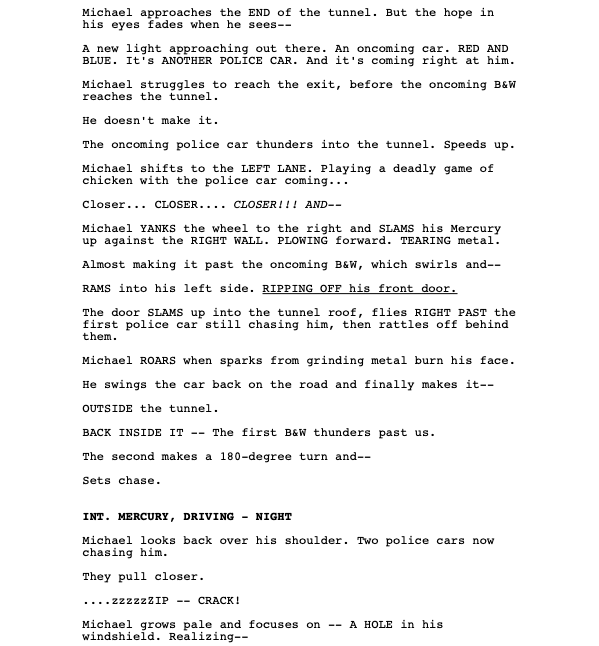
The second thing about these type of movies is, they bring so many great car chases in cinema history. “The Italian Job,” the Bourne movies. Of course, “French Connection,” “Bullit.” How do you ‑‑ because you’ve got some significant car chases in there ‑‑ approach that to come up with stuff that’s fresh and interesting? How did you approach that whole process?
Stefan: Car chases are, for obvious reasons, one of the most difficult things to make fresh and original, because we’ve seen every iteration of them a billion times. In this movie, I actually tried to go smaller, go real, ground the chases as best as I could.
What you do, I guess, is imagine the beats. Imagine the flow of the whole sequence play out beat by beat, visually, dramatically. A good chase sequence is all about tension and release, new tension, new release, pauses, surprises, final relief… and then possibly a surprise twist again in the end. The rhythm and musicality of orchestrating a chase like these is something I find great joy in working with.
And then, finding small new variations of what the audience expects from this genre. For instance, there is one place in the script where Michael tries to escape the police, and he drives into this mud pool. The Mercury gets stuck, but he tries to plow through it. Wheels spinning, engine roaring, he drives, like, five miles pr. hour through 100 feet of mud. The police are stuck behind him and are shooting at him, the engine revs, but still the car moves so fucking slowly… bullets zipping by… I was, like, “I haven’t seen that before”. A really intense car chase beat at five miles pr hour suddenly felt much more dangerous than speeding by at a hundred…
In the end, though, it’s always character. It’s always a matter of looking at intention and obstacle. Michael is never “in a car chase”, he’s trying to rescue this woman that he feels could be his future love of his life from her horrible past. And he happens to be in a car, when that goal sets in. That’s what the first car chase is.
So, always infuse a dramatic necessity in every chase. And then use character to flavor what happens, skill as well as mind-set. In this script, Michael is a romantic out to save his “damsel in distress”. That self-perception affects his willingness to go to great lengths to escape. Also, he has a history of being an Uber-driver in a big city, which means he knows the small alleys and shortcuts. He knows the parks and parking houses. He knows the city in a way that you and I would not, and hopefully he can utilize that in these chases.
Scott: I want to talk to you about what I call narrative voice, which is essentially how a writer handles scene description. It’s like genre plus style equals narrative voice. You got to have an understanding what the style can be related to the genre and you do such a great job with your scene description. How conscious of you are that? Are you influenced by screenwriters?
Do you read people like Tony Gilroy, Dan Gilroy Walter Hill, or Shane Black? How have you developed your narrative voice? Then in particular with this project, were you conscious of that, because it’s very, very effective?
Stefan: Yeah. Thank you so much. I read as much as I can, not just for fun and interest, but also to see different styles and be constantly challenged in shaping and sharpening my own. To me, I very much visualize the scene, and then I try to write it as I see it. To me, there is a very rhythmical, musical aspect of writing, and the constant presence of a ticking clock.
The constant feeling of progressing time is very present with me. I don’t know. When I write anything, but especially action sequences, I feel like there’s a drumbeat constantly pushing forward, and the need to write to that beat. I need to shape the rhythm of the reading experience.
I’m very conscious about how I can optimize that. Long sentences, short sentences, single words, white on the page, I am constantly composing the page, essentially. I spent a lot of time on that and at some point it becomes more organic, but the core of it is : Write what you see in your mind, and pace it on the page like it plays out in your mind. To me, it can’t take longer to read it than it would take to see it. If it takes longer to read it, than it will to experience it on screen, then I need to cut it down.
So, action is tight, short, compressed. If you wanna move fast. And similarly, if you reach a point where you want the audience to stop and stare at a close up for 15 seconds, then that close up needs to take up a quarter of a page. Rhythm and visualization, all the time, write what it looks like, and keep pushing forward.
Scott: How long from the point of conception where you said, “OK, I’m going to start writing this,” to the point where it went out to market. How long of a process was that and how complicated or how many rewrites and whatnot?
Stefan: For this particular project, it was not that long a process. It probably took three months of actual writing, but spread out over more. This was a spec, and I try to carve out time to write those between paid jobs. Then it went out, and Ace got engaged, and then I did a rewrite with them, and that’s the one that made the Black List.
Scott: You did make the Black List like ten years ago, but let’s talk about December 13th, 2021, this year. I guess it’ll be nighttime for you when it was rolling out. Were you paying attention at all to the Black List?
Stefan: Not at all, actually. I didn’t know it was even a potential thing with this script, before I got emails from Adam and Kendrick, like; “Congratulations, you made the top 10.” I was like, “What!?” [laughs] But it’s an honor to be on it and I feel very, very humbled to be recognized by a community of people who single out what they’ve been excited about reading. The fact that this list exists, and that it elevates and celebrates writers on all levels, from highly successful writers to totally new writers, and then all of us somewhere in‑between. I’m very grateful and humbled to be back on it for a second time.
Scott: Congratulations again. A few craft questions for you. I’m in it. I’m intrigued by this. I always ask, where do you come up with story ideas? You got these two bids. One of them is the concepts. One of them, what was it? Personal…
Stefan: …Issues probably. [laughs]
Scott: I’m curious, what is that? Are they ideas that pop into your head and you put them down? How does that work?
Stefan: Well, it’s whenever you feel that you react emotionally to any given story, situation or conflict in life. When you experience something that speaks to you on a deeper level, emotionally, psychologically. Something that at the same time feels deeply personal and universally human.
It’s important to stress the difference between a private and a personal story, because the distinction is pivotal : Private stories are stories told as they happened to you. Personal stories convey the emotional truth of what happened. Private stories are difficult to deal with, because you risk getting stuck in your own loyalty to what actually happened. While personal stories are something you know and can invest in emotionally, but you can also liberate yourself enough from the hard facts of your own experience to craft the best possible story.
So, find a personal story, not a private one. And then, you need “the poster idea” that fits and challenges and merges with it. I’m reluctant to use the word high concept, but I do mean high concept. An idea whose core conflict can be easily and sharply conveyed, and which organically fits this personal story of yours. If you have only one or the other, you don’t have a movie. I personally need both before I can write anything.
Scott: That’s so interesting that you mentioned that. The way you framed that personal versus private. That whole thing they say, “Oh, write what you know.” I say, “I don’t know about that. Write what you know emotionally.” That makes sense to me, right?
Stefan: Yeah. I remember when I started working in the States, the core question was often whether there is ‘truth’ to an idea, where in Scandinavia we often talk about whether a story is ‘real’. That distinction between ‘true’ and ‘real’ is crucial, and — to me — ‘true’ is much more interesting and important for the movie-going experience.
Is it emotionally true? Is it humanly true? In a world where we could only tell ‘real’ stories, we would have no Super Hero-movies, fantasy movies, no space operas, no James Bonds, Indiana Jones’ or — basically — anything larger than life. The core of those movies is emotional truth. That’s why they resonate. In the midst of whatever spectacle they might bring as well.
Scott: In Hollywood, they’ve had that saying forever, which is, “Don’t let the facts get in the way of the story.” It is just a launching‑off point, and it’s more about the emotional truth.
Stefan: Yeah. At the same time, of course, there is a limit to that saying, where you end up violating factual reality to a degree, where it breaks suspension of disbelief and ultimately ends up hurting the emotional truth of the experience.
Tomorrow in Part 6, Stefan provides advice for writers learning the craft and attempting to break into the business.
For Part 1 of the interview, go here.
Part 2, here.
Part 3, here.
Part 4, here.
Stefan is repped by Lit Entertainment Group.
For my interviews with dozens of other Black List writers, go here.