Interview (Part 5): Sophia Lopez
My interview with 2021 Black List writer for her script A Hufflepuff Love Story.
My interview with 2021 Black List writer for her script A Hufflepuff Love Story.
Sophia Lopez wrote the original screenplay “A Hufflepuff Love Story” which landed on the 2021 Black List. Recently, I had the opportunity to chat with Sophia about her creative background, her script, the craft of screenwriting, and what making the annual Black List has meant to her.
Today in Part 5 of a 6-part series to run each day through Sunday, Sophia takes on some screenwriting craft questions.
Scott: I’d like to ask a few craft questions for you. Maybe step out from “Hufflepuff: A Love Story,” something that requires an original story concept. How do you come up with story ideas?
Sophia: Some ideas I feel like I’ll have a dream or something and I’ll journal it, or I keep a Notes app on my phone whenever I’m in a funny situation. Or I meet a wacky person, who has a very specific POV and is interesting in some way.
I’ll write a little description and jot it down, even if it’s a random person I only ever met once at a coffee shop. I’ll have different ideas, a running list, and not all of them are fully formed ideas. A lot of them are just thoughts or stream of consciousness.
Then sometimes I’ll find that I can combine different areas of things that interest me. Taking a character on my list, then plopping it into a different loose idea I’d written down. And sometimes I’ll think “oh, wouldn’t it be fun to do a vampire thing?” Then the next question is, what kind of vampire would I want to write? Then who do I know, or know of, that is sort of vampire‑ish, or who could be the unexpected vampire that I know, and just go from there.
Scott: I think Nora Ephron’s mother told the kids, “Everything is copy.” Everything you experience — the people you meet, the dialogue you hear — it’s all potential content you can use.
Sophia: That’s how I feel. Exactly. Pretty much I can’t think of a script that I’ve written that doesn’t somehow draw on my own life experiences, or a person that I know or a person I met for two seconds or something, or a person I’m a fan of.
Scott: My class, right now I’m teaching, I have them do this each week: Dialogue from Real Life.
Sophia: That’s awesome.
Scott: We start off our classes like, “OK, what did you hear this week?”
Sophia: What’s the funniest thing that you’ve heard? [laughs]
Scott: The other day someone was saying, “Well, I was sitting in this place and I was having a yogurt, and all of a sudden these people next to me started making animal sounds. They were conversing like they were animals.” [laughs] We were like, “OK. Let’s riff with what. What’s going on there?”
Sophia: That’s like in “Mean Girls” when they’re doing the cafeteria tour.
Scott: Yeah, right. Okay, another question, this time on prep writing. How do you go about breaking a story? You go to cards? Do you get the outlines, character development, all that process?
Sophia: I definitely love a strong outline. I’m a big outliner. That’s something that USC Film School taught me.
In school, they would always drill and do outline, outline, outline. Sometimes I would be like, “Oh, I feel like I don’t have time to outline. I’m behind on this assignment. I’ll just dive in and start writing because I’ll save time that way.”
“Save time.” Then I would be three‑quarters of the way done with a script, and it would all fall apart and it’d be a mess. I would be crying. [laughs] It would be horrible, because I had no roadmap of where to go with it.
Without an outline, I was not driving towards anything specific and my writing was vague because of that, because I didn’t know exactly what I was trying to get at. I had an idea, but I didn’t know exactly. I definitely learned that outlining is essential for me — not only for big picture structure stuff, but also for specificity in the scene writing and dialogue and character development.
Scott: Now that you’re on staff on a TV show, that’s it. Right?
Sophia: Yeah, definitely. Outline, outline, outline.
Scott: How about developing characters? Are there some specific things like questionnaires, biographies, monologues, any techniques you use to discover them?
Sophia: Yeah, I’ll do character bios, character’s life timelines, sometimes I’ll even think about the character’s astrology and their sign. I’ve seen a lot of awesome resources for developing characters online so many places. Also, in school, my professors would give lectures on character and what’s the want, what’s the need? And I personally always like when a character either gets what they want — but it’s not what they need, OR, if they don’t get what they want but they do get what they need. Something else that really stuck with me was the idea of “the positive modifier” and “the negative modifier”. You know, when there’s two characters who physically represent the two different paths the protagonist could go down.
In “Star Wars” for example, there’s Darth Vader as the negative modifier and Obi wan as the positive modifier. Luke looks at Darth Vader like, “Oh, that could be me if I’m not careful.” Or in Mean Girls, Cady could become Regina if she doesn’t hang onto her authenticity and moral compass.
I love characters in scripts that the protagonist looks at and either aspires to be, or fears becoming.
Also with character development, writing a character bio before I start writing is helpful in terms of, where are they from? What are their parents like? Do they have siblings? Are they insecure? If so, what are their insecurities, or are they hyperconfident? Or, is it fake confidence?
With Oswalda, I had the idea for like, “Oh, this fun zany character,” but I feel like she would mean nothing if she didn’t have an emotional anchor for why she acted that way. I was intrigued by the idea of her having a deceased family member. That grounded her emotionally and also, it’s tragic irony that you have magic in this world but you can’t use it to bring back your loved ones from the dead.
Scott: You’ve packed a lot in there. I got this book coming out and I did all this reading on Carl Jung, and he talks about the shadow. You mentioned that Luke Skywalker could have become Darth Vader. That’s literally that scene he has in Episode Five.
Then there’s that scene in “Raiders” where Indy meets with Belloq who says, “I am a shadowy reflection of you. It would take only a nudge to make you like me, to push you out of the light.”
Sophia: It’s the classic villain line of: “You and I aren’t so different.”
Scott: Right. In “Hufflepuff,” you gave Finn a choice. He has a choice to stay at the apex of his life with this girl Lavender. He could stay there, but he chooses not to. He doesn’t go to “the dark side.”
Another craft question: How about when you’re writing a scene? What are your goals for writing a scene?
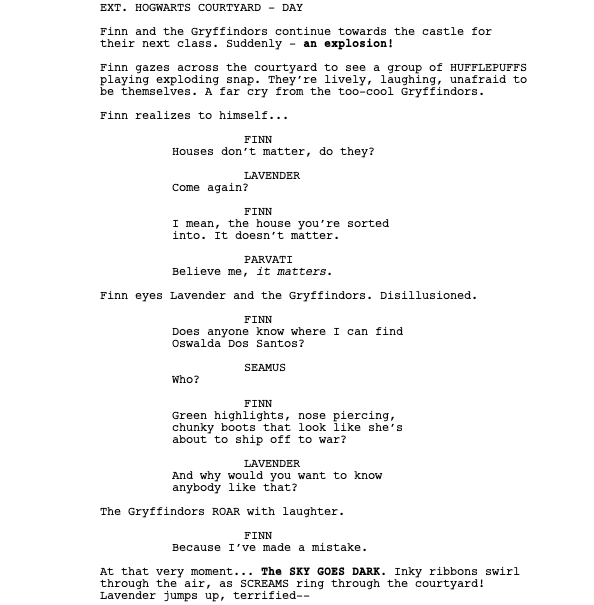
Sophia: I always love reversals in a scene, or doing something really unexpected. Of course it can’t always happen but I love when it does. I had an amazing professor who basically said, “There’s no excuse for a boring scene. You can make it interesting. A scene doesn’t have to be the most obvious way of two people having a conversation. You’re the writer, you can have them talking in a diner and then have the diner blow up mid-conversation.”
Because prior to that, my scenes were always two people sitting down in a room having a conversation back and forth. Not that that can’t be amazing, but when I was doing it, it certainly wasn’t. [laughs] I was doing the most basic. “Hey, how’s it going? Oh, good. Did you eat yet? Yeah, I had breakfast. I had a bagel for breakfast. What did you have for breakfast?” That kind of stuff that no one cared about really. Then I realized, “Oh, OK. I can have them having conversations while doing things that are fun and interesting.” Or they’re walking around and they’re having this conversation and something explodes or whatever.
You can do whatever you want because if it’s writing, it’s all hypothetical anyway. Unless you’re writing to get it specifically made on a specific budget or something. I think that was big for me, but also giving myself the ability to write the scene how I would like to write it at first, and knowing that I would probably cut it down later.
I think it was Alfred Hitchcock who said, “Movies are life with the boring parts taken out.” I like that. I write the scene a little longer, and then I’ll go back and trim it and trim it and trim it, until it’s down to just the essential part of the scene.
Because I definitely tend to be long‑winded as maybe you can tell. [laughs] I tend to be long‑winded.
Tomorrow in Part 6, Sophia gives advice on how to learn the craft and try to break into the business.
For Part 1 of the interview, go here.
Part 2, go here.
Part 3, here.
Part 4, here.
Sophia is repped by Verve Talent and Literary Agency and Bellevue Productions.
For my interviews with dozens of other Black List writers, go here.