Interview (Part 5): Scott Derrickson
My interview with the co-writer and director of the hit Marvel movie Doctor Strange as well as horror movies The Exorcism of Emily Rose and…
My interview with the co-writer and director of the hit Marvel movie Doctor Strange as well as horror movies The Exorcism of Emily Rose and Sinister.
I started following filmmaker Scott Derrickson years ago on Twitter (@scottderrickson) because I enjoyed his movies, plus, he’s a huge fan of Flannery O’Connor and Bob Dylan, two of my very favorite creatives. So I reached to Scott for an interview and was especially pleased when he said yes.
Recently, we enjoyed an hour-long conversation which was wide-ranging in nature covering three of his movies: The Exorcism of Emily Rose, Sinister, and Doctor Strange, as well as his thoughts on storytelling in general and the horror genre specifically.
Today in Part 5, Scott reflects on what he considers to be his most personal movie: Sinister:
Scott Myers: The protagonists in the three movies — The Exorcism of Emily Rose, Sinister, and Doctor Strange — have a similar arc. There’s a widening of their universe from rationalist, realist, materialist or whatnot to somebody who is more open to the possibility of a more magical, mysterious world.
It reminded me of a verse in the gospels, “He who has ears to hear, let him hear.” It’s as if maybe, in a way, one of the things that might be underlying your storytelling instincts is to say to people, “Look, open up your spiritual eyes to the fact that the universe is a much more mystical place than we imagine.” Do you think that’s a fair comment?
Scott Derrickson: It’s fair to say, yes. That just in my DNA. Given my religious conversion when I was young, my high school years within strict fundamentalism, and then attending at an evangelical college, I think my desire to propagate my own point of view may be impossible to extract. I wish I could.
I believe strongly that as a filmmaker, I shouldn’t set out to communicate to the audience something that I think they need. Who am I to think that what I believe, or what I know, or what I experience is so important and so significant that, literally, millions of people who are going to pay to see this movie, ought to listen to what I have to say about life? I want them to share my emotional experience, not my point of view.
As I’m aging, I’m trying hard to push myself to creatively discover the meaning of the stories I tell, rather than trying to express something. I’m trying to deepen my own awareness of the mystery of life and respect it, appreciate it, and embrace it because that enriches my life when I do that, and for me, directing is a part of that.
Each of those movies that you mentioned were a profound filmmaking experiences that I was personally transformed by. Even though there’s a part of me that’s always going to have to work hard to resist thinking that my views or my ideas are worth listening to, I try hard not to do that. I’d rather challenge my own point of view in making a movie than directly expressing it.
I try to respect the creative process and put to the test what I believe and see what growth there is in the story for me to learn from, and how this story can expand me. If it enriches and resonates with me, then hopefully it will do the same for the audience. Those three movies did that, I think. I was a different person by the end of each of those three films because of the writing and directing of them.
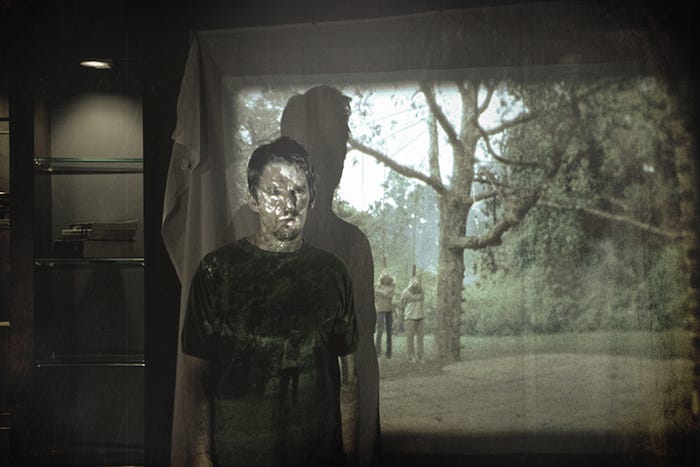
Scott Myers: Let’s turn to Sinister. The 2012 movie, you co‑wrote and directed. IMDb plot summary: “Washed‑up true‑crime writer, Ellison Oswalt, finds a box of super 8 home movies that suggest the murder he is currently researching is the work of a serial killer whose work dates back to the 1960s.” What was the inspiration for this movie?
Scott Derrickson: For me, the inspiration for that movie was the depression, fear, and anxiety that I felt for two years following the failure of The Day the Earth Stood Still. That was a big studio movie that was very hard to work on, and was a very difficult process. The writer’s strike happened while we were in prep.
I got along alright with the studio — it wasn’t like some big combative fight situation. It was just that the script for Day the Earth Stood Still, written by a very talented writer, never had a chance to get where it needed to go. For legal reasons involving a lawsuit against me by Bob and Harvey Weinstein, I got stuck making a movie that I didn’t have much confidence in. And it shows.
So after finishing that movie, I took a severe critical beating. It was a global financial success but not a domestic financial success — and the domestic number is the sexy number. It really wrecked my career. I felt that my career may be over. For two years, the only things I was getting offered to direct were bad movies and weak sequels that would’ve ended my career forever had I made them.
But then Jason Blum came to me with a proposition. This was before Jason Blum was Jason Blum of Blumhouse. Really, all he had done at that point was discover Paranormal Activity. I don’t think Insidious had even come out yet. He was a huge fan of Emily Rose. He said, “I’ll give you three million dollars to do a horror film. You can have final cut. You can make it whatever you want.”
I felt like this was finally the opportunity to make something completely uncompromising. If it’s going to be the last movie I ever make, I thought, it’s going to be my movie. If I have to die on a sword again, it’s going to be my sword that I die on. That was my attitude.
So when it came to the writing of Sinister, I was creating a character that was representing a lot of the worst feelings, instincts and fears that were in me at the time. A lot of the worst aspects of myself.
I was an Oswalt character. I related to him so much. I was very honest with Ethan about that, which is why I think Ethan looks so much like me in the movie. By his own choosing, he grew a goatee and literally bought the same brand of glasses as me.
But in writing and directing it, I was in a place where I felt…After the failure of Day the Earth Stood Still, I felt so much more anxiety than I wanted to feel. I felt ashamed of how scared I was about my career. I hated the fact that I was so afraid that I was going to lose my status as a filmmaker. I was going to lose my financial security. I was going to lose my identity of being successful. I was facing those fears and anxieties about my own ambition. I was facing the fact that these things mattered way more to me than I’d ever want to admit.
So that’s where my contribution to that character comes from. It comes from me trying to reckon with these undesirable aspects of myself all within the context of a story that was brought to me by my writing partner Cargill.
He and I just happen to run into each other in Las Vegas at the Mandalay Bay at 3:00 in the morning. He pitched me the story idea when I was already working on a separate idea for Jason Blum. He just pitched me the basic story of the guy who goes up to the attic and finds these murders on on Super 8 film.
I felt like it was one of the best concepts I’d heard for a horror film, so I scrapped the idea I was working on, and we wrote Sinister together. From that first meeting, to the filming and editing of the film, to the completion of the sound mix, was less than a year. Then it came out, and was a big hit. That never happens.
It was a beautiful experience and a huge recovery for me both personally and professionally. Doctor Strange is a very personal movie, but I doubt that I’ll ever make any movie that’s as personal and revealing, and not in a good way, as Sinister.
Tomorrow in Part 6, Scott discusses what he drew him thematically to the movie Doctor Strange.
For Part 1 of the interview, go here.
Part 2, here.
Part 3, here.
Part 4, here.
Scott is repped by WME and Brillstein Entertainment Partners.
Twitter: @scott derrickson.
For nearly 200 more in-depth Go Into The Story interviews with screenwriters, TV producers, filmmakers, and industry insiders, go here.