Interview (Part 5): Scott Beck and Bryan Woods
The co-writers of A Quiet Place go deep into their background, creative process, and the evolution of their hit horror movie.
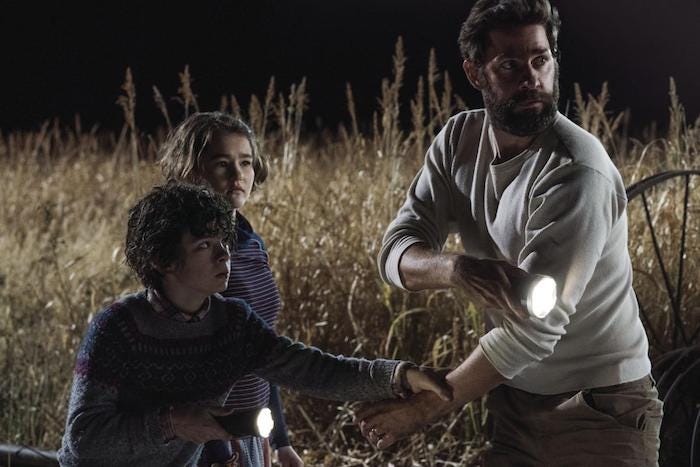
The co-writers of A Quiet Place go deep into their background, creative process, and the evolution of their hit horror movie.
As of today, the Paramount movie A Quiet Place has grossed $241M in worldwide box office revenues. Given the movie’s reported $17M production budget, that represents a ginormous ROI, but the movie is not only a success financially because critics have given the film an enthusiastic thumbs-up: Rotten Tomatoes (95%), Metacritic (82%), IMDb (8.1). Thus, it’s no surprise Paramount has announced a sequel is in the works.
Where did this movie come from? Who came up with the central conceit of the story? Who wrote the original screenplay which sold as a spec script?
The answer is longtime friends and filmmakers: Scott Beck and Bryan Woods. As it turns out, the two have been Go Into The Story followers for several years and with thanks to Joshua Caldwell, I ended up grabbing an hour of the writing duo’s time for an in-depth interview. It turned out to be not only a fascinating conversation, but also an inspiration for anyone who aspires to cinematic storytelling who resides far outside of Hollywood’s pearly gates.
Today in Part 5, Bryan and Scott provide some background on a horror movie they co-wrote and co-directed Haunt as well as answer some craft questions:
Scott Myers: Let’s talk about the movie itself. It’s a small cast by virtue of the story conceit and, basically, a contained thriller, but what a cast. That Millicent Simmonds, terrific job as the daughter.
Bryan: Amazing.
Scott Myers: I thought that was phenomenal. Of course, she herself is deaf. As I understand it, Krasinski insisted on that.
Bryan: Yeah.
Scott Beck: It was one of those situations where, by virtue of it being a deaf character, that if you cast somebody that actually had a hearing impairment, it would not only lend more credibility to that role, but, more importantly, it would inform that role in a way that I don’t think we could do as writers.
I think it really helped John as a director to simply have somebody that has lived this life and form who this character really should be and what those life experiences really are like. It’s certainly a really incredible story for us to see how Millicent Simmonds has taken that role and really achieved something that is better than the sum of its parts.
Scott Myers: Both of you were executive producers on it. Were you on set for the entire shoot?
Bryan: I was about to say “unfortunately” we weren’t and, yet, this is the greatest gift we could possibly have. We were directing another movie that we wrote at the exact same time that A Quiet Place was shooting.
It’s this movie called Haunt. We were deep into pre‑production and then eventually production while A Quiet Place was shooting, so we weren’t able to pull away from our production base on Haunt in Kentucky.
Scott Myers: Yeah, I’m going to talk about Haunt in just a second. So A Quiet Place had a great response at South By Southwest. I remember reading the reviews when it first was there. Of course, it’s a monster hit, pun intended there.
[laughter]
Scott Myers: With film critics, it’s got a 95 rating currently on Rotten Tomatoes. Commercially, 160 million dollars worldwide. Why do you think this movie has resonated so much with film critics and audiences?
Scott Beck: If I had to guess, I would suppose because it’s relatively unassuming. It poses itself as a monster movie, but with a concept that we feel hasn’t really been done in films, especially in this context. Beyond that, I’d like to think it’s the characters as well.
Many times you go into horror films with certain expectations, but if you can deliver something a little deeper in terms of character work and thematic layers that resonate with an audience ‑‑ in this instance it would be about family and be about parents trying to protect their children ‑‑ that can have a lasting effect that really subverts what your expectations are.
Bryan: Another thing that Scott and I talked about early on what we had hoped the final movie would be was something that was pure cinema, something that does what cinema does better than any other art form in the way that it uses visuals, and sound, and music.
By doing so, by not having dialogue in a traditional sense, by not having a language barrier, our hope was that it would play just as well in every other country on planet earth as it does here domestically.
That was always our pipe dream, is that it could travel, and play, and just work as cinema. Perhaps there’s something there. I don’t know.
Scott Myers: I think that’s right. It’s doing very well overseas. The international audience, visual storytelling is even more important because a dialogue can be culturally specific. You’re dealing with universal themes here ‑‑ communication, protecting your family, the lizard brain, just fear and survival.
If all that isn’t enough, there’s a tweet from an author of some repute who called the movie, “An extraordinary piece of work.” That was Stephen King. What was your reaction to that?
Scott Beck: Could not believe it. That, for us, is probably the pinnacle of this whole process. As lifelong Stephen King fans, that meant the world to us.
Scott Myers: I retweeted a Variety article talking about how the movie was far exceeding box office projections. I tweeted something like, “Huh, a movie that’s not a prequel, not a sequel, not a remake, not a reboot. It’s almost like people want to see original films.”
[laughter]
Scott Myers: That got picked up and was retweeted more than anything else I’ve ever done.
Bryan: No way.
Scott Beck: That’s funny.
Bryan: I love that you said that. That is, hands down, our favorite thing. As filmgoers, we have been craving something fresh and new and something that’s not a comic book, not a sequel, not a remake or a reboot, or whatever. We crave those stories.
We felt like we can’t be the only ones out there that want to see something slightly different or a new spin on an old thing. The fact that the movie’s been embraced on that level is our proudest achievement. Hopefully, now as filmgoers, we get to watch more movies like that.
Scott Beck: Yeah, in some ways, we feel like it’s somewhat full circle going back to the movies that inspired us in high school like Magnolia, American Beauty, and The Sixth Sense, all these films that just offered a fresh perspective in an otherwise crowded cinema market.
As Bryan said, that’s one of the favorite things that have come out of this journey. Again, yeah, hopefully empowering not just us, but other filmmakers as well to pursue their own voice and, more importantly, their own passion and get those stories on screen.
Scott Myers: Out of this, you’ve got this movie Haunt that you talked to me about earlier. It revolves around a group of friends who discover an extreme haunted house Halloween attraction turns out to be deadly. I think you’re in post‑production now.
Bryan: We are in post‑production.
Scott Beck: Yeah, we’re editing right now. Actually, as of a few hours ago, we were still in the edit room. It’s a Halloween movie, so it can’t come out 4th of July, it can’t come out 1st of January. It’ll have to come out, we’re hoping this Halloween or next Halloween.
Bryan: It’s been such a fun process. We partnered with Eli Roth early on. Our producers had sent Eli Roth the script and he got really excited. We heard he was going to come in. He had some notes for us and wanted to be a part of the project.
Immediately, we start going through Eli’s filmography, which, of course, we had seen all of his movies and were fans. Fans of him as not just a filmmaker, but also as an ambassador for the horror genre.
We were really curious. We’re like, “What are these notes going to be? Is it going to be more violence, more gore? What’s he going to come to the table with?”
It was so cool to us as writers. He came in and said, “Let’s invest in these characters. Let’s make these characters so lovable.” He talked a lot about how his feeling was a lot of times studio horror doesn’t work because the number one thing they forget about is investment in character.
A scary movie isn’t scary unless you love the people that you’re following. It really spoke to our hearts and made us even more excited to make Haunt and get it made, so we did a bunch of revisions with him and then eventually got to shoot the movie.
Scott Myers: That’s great. That’s a nice segue into some craft questions. I preach to my students all the time to start with character, end with character, find the story in‑between. How do you go about developing characters for your stories?
Scott Beck: I would use A Quiet Place, as an example, where we’re trying to figure out the characters in the story simultaneously in terms of how does the character service the story and how does the story service the character?
The character of John in A Quiet Place, that was one where we knew it was a survivalist. It was somebody that is trying to keep their family together. From that inception point we needed to figure out what was their arc? What does this character need? What does this character want?
That led us to the inevitable conclusion that he comes to in the story about needing to communicate to his daughter, who he does not have a healthy relationship with. That’s somewhat our inception point.
Bryan: Another thing I would say in terms of process and craft, Scott and I, the advantage we have as co‑writers and two people who have been friends for many, many, many years is that we have a shared experience.
It’s awesome and easy for Scott and I to go, “Oh, remember Andy in high school? What if we had a character like him? Remember the neighbor you had across the street in the cul‑de‑sac?” We can draw from our shared experience in our real life and people that we know.
It’s not to say we take people and put them in our movies. It’s more about, “Oh, remember the way so‑and‑so used to say a certain thing a certain way,” stealing little elements from real life that we connect to and doing our best to make the characters as truthful and honest to our experience as possible.
Scott Myers: Let’s talk about the writing duo dynamic. One article I read, you mentioned “the healthy competition of ideas.”
Scott Beck: Yeah, yeah.
Scott Myers: Could you describe what your process is like?
Scott Beck: Certainly. To describe the competition aspect, it’s simply the idea of if Bryan comes up with, let’s just say, a concept. He’ll pitch that to me. My reaction may be, “That’s cool, but I think we can take that even further.”
We ping‑pong ideas back and forth to the point where ‑‑ whether that’s a character, or a concept, or a plot point ‑‑ it’s much stronger from that back and forth than it would be if we just settled on the first idea.
We always like to incubate our ideas for a long time, sometimes to the frustration of our agent or manager who just want us to write faster, but we feel and our hope is that if we take a little more time, that it will be a much stronger final product.
Bryan: That extends all the way to the writing process, too. That’s us kicking scenes, or dialogue, or whatever back and forth, back and forth, back and forth. Each of us privately, in our own space, doing passes on each other’s work and then sending it back and just trying to elevate or strengthen the material as much as possible.
One of the best benefits of having a writing partner who you trust is that you never feel ‑‑ at least in our experience ‑‑ we never feel precious over the material. [laughs] I never have that confidence of like, “Oh, I wrote this thing, and it’s so great because I wrote it.” It’s more like it feels like somebody else wrote it because Scott and I have such a good collaboration.
It always feels like something that’s other. We’re never precious about it, very easy for us to tear down our own ideas or attack our own scenes and try to make it as good as possible, and it’s always best idea wins.
Scott Beck: I would also say ‑‑ I’m just realizing in retrospect ‑‑ it’s impossible for us to ever point back to an idea and be like, “Oh, that was Bryan’s idea, that was my idea,” because they’re all thrown in a blender. Again, what comes out of that, we feel, is always stronger than if it was just one of us.
Tomorrow in Part 6, Bryan and Scott offer advice for aspiring screenwriters and filmmakers.
For Part 1, go here.
Part 2, here.
Part 3, here.
Part 4, here.
Scott and Bryan are repped by ICM Partners and Madhouse Entertainment.
Twitter: @beckandwoods.
For nearly 200 Go Into The Story interviews with screenwriters, filmmakers, and Hollywood insiders, go here.