Interview (Part 5): Samantha Buck and Marie Schlingmann
An in-depth conversation with the co-writers and co-directors of the movie Sister Aimee which premiered at the 2019 Sundance Film Festival.
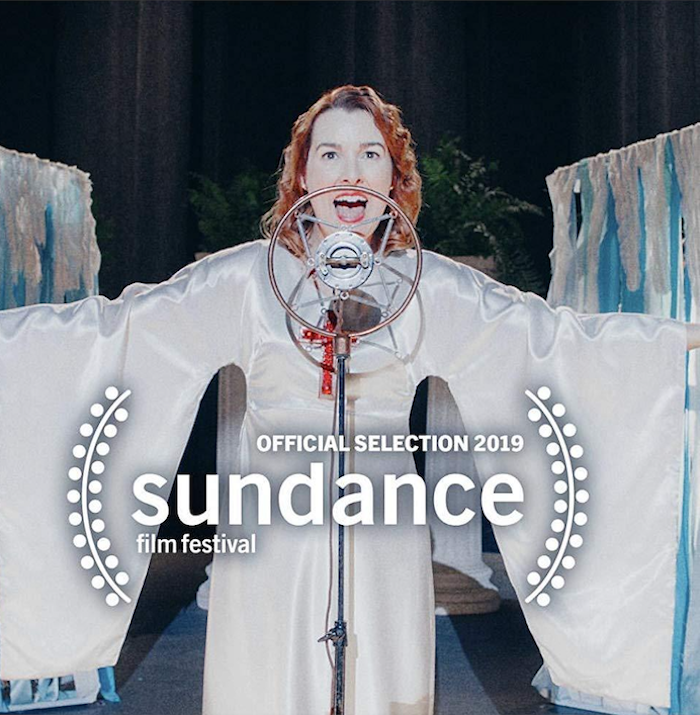
An in-depth conversation with the co-writers and co-directors of the movie Sister Aimee which premiered at the 2019 Sundance Film Festival.
The very first movie I saw at this year’s Sundance Film Festival was Sister Aimee. It was a 9:30AM screening on a Monday morning. I am not a morning person, so the fact I was so taken by this film should tell you something about how entertaining it is.
In watching the post-screening Q&A with the film’s co-writers and co-directors Samantha Buck and Marie Schlingmann, I was so struck by the story behind the story of how this project came to be, I decided I needed to interview the pair. I got in touch with their manager Lee Stobby which led to a 45-minute conversation which I am happy to share over the course of this week.
Today in Part 5, Sam and Marie share details about the movie’s shoot which lasted all of 20 days.
Scott: I’d like to talk about that final sequence where Aimee has to convince these Mexican figures, these authority figures that she’s just an entertainer, basically. At that time, they were persecuting religious people, right? That scene is so much fun and so fanciful. It’s a musical at that point. How soon did you hit on that as like, “We want to have the big, culminating thing be that”?
Samantha: Actually, pretty early on when we were writing the first draft. We knew that in Mexico, at the time, it was the brink and the beginning of the Cristero wars. Aimee, factually, was found walking from Mexico into Arizona. We were like, “Oh, that’s interesting, that she was there when this whole religious war was brewing.”
We knew that somebody would have to find one of her costumes. What would she do, knowing that the whole journey is about her trying to like her identity, embracing herself? It was very clear that they would have to find the costume.
She would have to convince them that she’s an entertainer and the musical aspect of it also early on, because of how her shows were described at the Angelus Temple. They sounded like they were Broadway shows.
We thought, “Well, what better way to end this journey for Aimee than for her fully embracing this character, and this persona, and who she is and for the audience to be able to see full‑out what a great performer she is?” Since meeting her in the very beginning of the movie, at the time where she could no longer perform, we knew we had to put on a show at the end.
Scott: That’s great, really enjoyed the movie. Let’s talk about the process of how it got made. You write the script. Did you have any financial backing or, at that point, your interest, or was this entirely on spec and then based on the script, you got things moving forward?
Marie: Yes, we had nothing in place. It came in a moment in our lives too when we were in development on a lot of things that we didn’t know if they were ever going to happen. We felt like we have to write something that is doable on an independent level.
Obviously, we were still ambitious by making it a period piece and a road trip. There’s musical number and violence and all of these things, but we were very confident that we could write it in a way that would allow us to do it for not that much money.
We wrote it in a month. We went away. We stayed with Sam’s mom and just wrote it in a month, which was April 2017. Then we had a producer that we were working on something else with. We felt like she also wanted to make something and make something quick.
We gave it to her. She really went with it. Basically, a year after we wrote the first draft, we were in pre‑production. All of that came after the first or second and third draft, really.
Scott: I can imagine. I’m sure you just stretched that budget dollar. It really feels like a substantially larger‑budget type of a thing. You had that in mind when you were scripting it, stretch the dollars?
Samantha: We did. We definitely did. Also, we talked to our DP. Before we wrote the first draft, we met our DP, Carlos, for a drink and said, “We’re going to go away and write this. You were going to shoot this.”
Again, he’s super talented photographer who also needed a feature under his belt, and our production designer as well who we’ve worked with on two other short films. We’re like, “We’re going to go away and write something, and we’re going to send it to you.”
We started talking about visual language and talking about production design limitations, all of those, all of that stuff from the very beginning. As we were going through drafts, we were addressing things that we knew could bite us in the ass later on.
Then we got also lucky with the community down in Austin, Texas and being able to get really great locations for good price and people pitching in in the right way. I would say the directing and the writing were going hand in hand from the very first draft. We knew we wanted to shoot it.
Scott: How long was the shoot?
Marie: 20 days.
Scott: 20 days, wow. I remember that when I saw it at the screen, it’s Sunday. I said Anna Margaret talked about how together and in sync you all were and the production was extremely smooth, at least in terms of how you knew what you wanted to get. Maybe talk about that process, the 20 days of making the movie.
Marie: Yeah. You know that that’s going to be super intense. You don’t feel like it’s enough for sure, but you also know that. Again, we had started so early on to pull the heads of departments into the process that we felt everyone would be really prepared by the time we were starting, including our first AD who’s a dear friend of ours. He was living in Hong Kong.
We said like, “OK, guys, we know who it is that can help make this movie in 20 days.” He was really well‑prepared. We actually started shooting…It gave us a heart attack, but it was very wise from our first AD.
We started with the musical number. It was the first thing we shot. Two days, it was 54 shots. Two days, it was insane. We knew it was going to set the tone. Also, it would allow the actors to be prepped because in that kind of schedule, there’s no time in between to go and rehearse a musical number once you’re off and running.
It was a very fitting beginning to a really intense shoot, but we were so aware that we would lose…You’ve read the script. There’s not a lot of fab in there.
Scott: No, not at all.
Marie: We knew there was not like, “Oh, you know what? If we don’t shoot these four scenes, we’ll be fine anyway. We can figure something out.” We knew that if we’re losing whole scenes, we’re losing the movie. We also knew that there were very little chance that we were able to do any kind of reshoots. We were very disciplined in order to get everything.
Samantha: I do think having Hugo, our first AD, there and Carlos, our DP…You always have to be prepared to cut shots, but we preemptively, even before we started day one, the four of us, we were on the same page. Hugo and Carlos really understood what we wanted creatively.
We went in earlier than sometimes you have to or want to and got real practical in terms of what’s possible and what’s not possible. We still were met with challenges. The crew was hired also in New Mexico. We had five days to do all these exteriors. It was monsoon season.
Every day, two o’clock, production is being halted because of a monsoon. We can’t go into over time, so there’s parts of the movie where you understood like, “OK, we have to figure out how are we going to get this into a shot, have the film have the same integrity. We either get this scene or we don’t have a movie.” We can’t be precious. We got to figure out how to do it with no pillow time.
Scott: The project is with Endeavor Content. Have you got a distribution set in place at this point or no?
Marie: It’s all still ongoing.
Samantha: There’s talking.
Tomorrow in Part 6, the duo share advice they give to aspiring screenwriters and filmmakers.
For Part 1 of my interview with Marie and Samantha, go here.
Part 2, here.
Part 3, here.
Part 4, here.
For more exclusive Go Into The Story interviews with screenwriters and filmmakers, go here.