Interview (Part 5): Sam Boyer
My interview with the 2022 Nicholl Fellowships in Screenwriting winner.
My interview with the 2022 Nicholl Fellowships in Screenwriting winner.
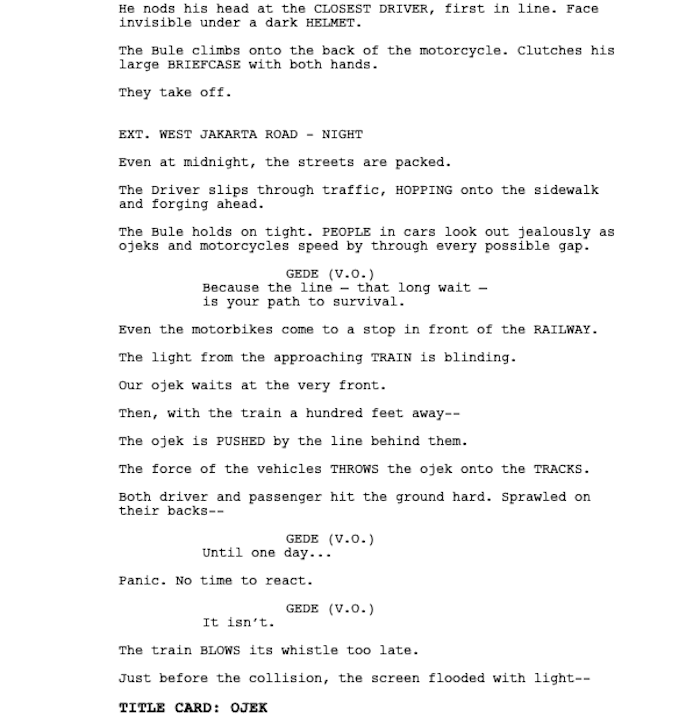
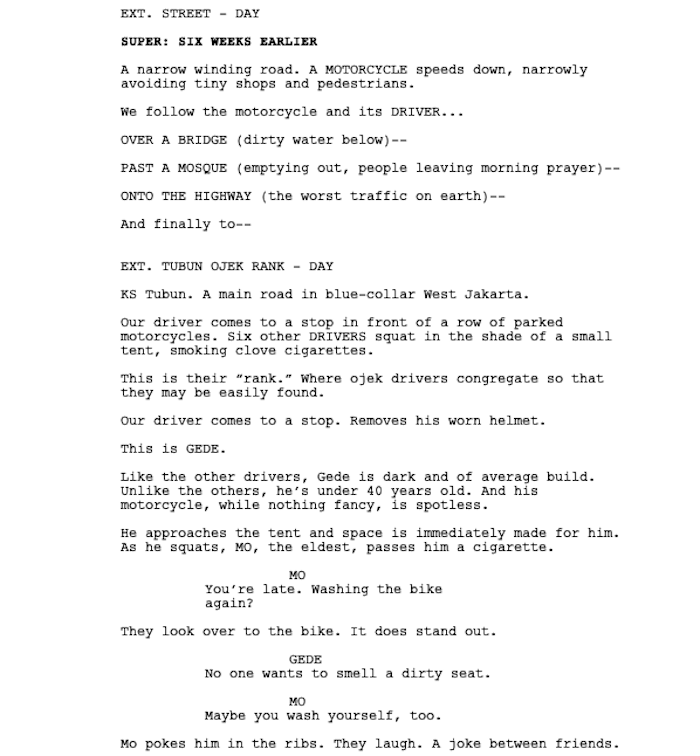
Sam Boyer wrote the original screenplay “Ojek” which won a 2022 Nicholl Fellowship in Screenwriting. Recently, I had the opportunity to chat with Sam about his creative background, his award-winning script, the craft of screenwriting, and what winning the Nicholl Award has meant to him.
Today in Part 5 of a 6-part series to run each day through Saturday, Sam talks about the Nicholl experience and answers some craft questions.
Scott: Let’s talk about the Nicholl experience.
Sam: Sure.
Scott: Talk me through the two parts of it. First, learning that you won the Nicholl, and then the Nicholl Week in L.A..
Sam: I remember that becoming a finalist felt surreal. Just being in that Top 10, and thinking there was a possibility I could win this. I’ve been writing for a while ‑‑ longer than some people, shorter than others ‑‑ but for me, it felt like a while. I’ve worked a bunch of other different jobs to make ends meet. I was honestly at the point where I wasn’t thinking about the Nicholl that consciously anymore. I’d submit every year or so, and wouldn’t get my hopes up for any reason.
Then, for it to suddenly happen now out of nowhere, it truly feels like a dream I haven’t woken up from yet. My girlfriend was in the room with me when I found out that I won. I was flabbergasted, and we were literally up and dancing afterwards.
I remember finishing the first draft of Ojek in a friend’s laundry room that I was living at the time. For it to happen with this script has felt absolutely crazy.
Then, the actual week itself, we’re so lucky to have been the beneficiaries of that. It was a cool week of events and Zooms with members of the Nicholl committee and Nicholl Fellows past who shared their advice.
It culminated in this day at the Academy Awards Museum where we got to each thank the academy — — despite not even having a produced script! How often does that ever happen? Then, we saw these wonderful actors read scenes from our scripts, which truly had me tickled.
I’ve never had that happen before. You’re so used to reading the words either in your imagination in your own head, or out loud like a crazy person. Then, to have someone in a movie you saw three months ago reading one of your lines is absolutely incredible.
Then, all the other Fellows were so talented, kind and gracious. You feel like you’re being inducted into this fraternity of incredible writers. It reminded me of my days at that MFA writing program where it is this community of letters and words. It’s so cool to find that as a writer, because it’s such a solitary pursuit most of the time.
Scott: What scene did they read, the table read?
Sam: [laughs] It was the exact scene you were quoting from with Bejo in the nightclub where Gede meets Rocky for the first time, talks to Lia in depth for the first time, and Bejo’s able to make his pitch to Gede on why they enter this illegaly delivery business.
Scott: Congratulations. That’s wonderful. What about in terms of representation?
Sam: I got new managers shortly after the Nicholl. It’s been off to the races since then.
So many cool meetings with companies whose movies I’ve grown up watching and admiring. To be in the same room with these people, and let alone, having them say congratulations or compliment my writing, it’s been wonderfully surreal.
Totally, knock on particle-board, I’m excited about what could potentially happen for Ojek in the future in terms of its path towards getting made.
Scott: That’s great. Let’s ask some craft questions for you. How do you come up with story ideas?
Sam: Oh, man. A lot of writing, you do when you’re not writing. It’s truly whatever you can do to get yourself in that act of mesmerism. To the point where you’re not thinking intently about anything else is when a story idea comes to me. A bunch of them have come to me in I‑10 and I‑405 traffic, too. A bunch have come in the shower, and a bunch have come in absent‑minded walks around the neighborhood.
The less you actively focus on thinking, the freer your mind will be. Especially for any bigger concept or movie idea, or if you’re working out a scene. One of the worst things you can do is be chained to your chair trying to write it out when you’re stuck.
Scott: That’s subconscious writing. Like Stephen King says, “Idea is like a fish floating over your head. You, every so often, put a net out there, and catch it.”
Sam: Exactly.
Scott: What about your prep‑writing process? Breaking story, how intense is that? Are you one of those pantsers that starts in on it?
Sam: Oh, man. I have nothing but admiration for those people. I never could. I need an outline before I can write a script. It’s non‑negotiable. I went through this period where I would write a movie a month for a little while to try to get the structure down. Don’t worry, I didn’t do this for long. It made me very tired, and they weren’t very good.
What I would do is the first week, I would spend outlining. Using an index card method, basically, to keep the broad strokes and beats of a script down. I like those because you can visualize them. I like to put them up on the corkboard.
You can play around with them, see if it looks like the shape of a movie. Once you’ve written a few, you know what the general shape of a movie looks like, and if you’re way off or getting close. You can move things around at will.
Then, once I’m reasonably comfortable with the outline ‑‑ it’s never perfect, so I never shoot for that ‑‑ then I start writing. I try to write as much each day as I can. I used to do this thing where I do, in the first draft, 10 pages a day. That felt like a good goal. Some pages are sloppy, and inevitably, you’re going to have to rewrite this anyways.
I truly, after a few scripts, stopped worrying about it. I’d try to write it wrong as fast as possible. That’s been my method ever since. I do not worry about being perfect, or even being very good. I do put a lot of effort into getting it done, because so much rewriting is involved.
The one thing I’d tell myself…I am a big fan of your blog. I’ve read a bunch of the Nicholl interviews. It’s always been so cool to see, as an aspiring writer, what techniques people use.
The one thing I’d tell a 22‑year‑old or 20‑year‑old who’s about to start their first script, or anyone, is, “Don’t worry about getting it right. Just get it done. Then making it better can begin.”
Scott: That’s exactly what I tell my students. It’s like, “The first draft is a journey of discovery. That’s all it is. Get to the end. You’ll know more about your characters, and know more about your story than you would in the beginning. Don’t be precious. You’re going to have to rewrite it anyhow.”
Sam: I celebrate every step, honestly. When I finish the first draft, my girlfriend and I, we go out to dinner, or we have a good time. I truly don’t let myself get bogged down by whole, “Well, it’s not good, and then also, these 10 things need to happen for it to work” thing. Don’t get in that mindset, or you won’t be encouraged enough to continue.
Scott: How do you go about developing your characters? Are you thinking more archetypes, or are you more instinctual?
Sam: That’s a good question. A lot of it for me, in the development of a character, it’s subconscious. A bunch of these characters are assembled out of people I know from my own life.
I remember hearing this thing that you can’t dream a new face. Your dreams can only have existing faces of people you already know from real life. A certain amount [laughs] of that winds up in our imagination when writing scripts, too. We aren’t dreaming that many new faces. They are versions of people that we already know, or sometimes, amalgams.
I think that in terms of building characters, you often feel like they come to you, but they’re pulled from different aspects of the most memorable people you know.
Scott: How do you go about writing dialogue?
Sam: The one thing I don’t do is say it out loud when I’m writing it. Some people who hate this script might be like, “Yeah, man. We could really tell.” In terms of dialogue, I try to make characters feel distinct from each other.
The thing I saw early on in film school is you’ll start to read student scripts, and everyone will sound like the student that wrote it.
The one goal has been ‑‑ especially, if I’m revisiting pages, and I would encourage myself to be better about this ‑‑ is make sure that someone could blind point to a piece of dialogue in your script, and go, “That’s from that character. That’s from this other character.” Things feeling distinct is all that’s key.
Tomorrow in Part 6, Sam provides advice on how to approach learning the craft of screenwriting.
For Part 1 of the interview, go here.
For Part 2, go here.
For Part 3, go here.
For Part 4, go here.
Sam is repped by Range Media Partners.
For my interviews with every Nicholl Fellowships in Screenwriting winner since 2012, go here.
For my interviews with Black List writers, go here.