Interview (Part 5): Max Taxe
My interview with 2022 Black List writer for his script Ripple.
My interview with 2022 Black List writer for his script Ripple.
Max Taxe wrote the screenplay Ripple which landed on the 2022 Black List. I had the opportunity to chat with Max about his creative background, writing a Black List script, and the craft of screenwriting.
Today in Part 5 of a 6-part series to run each day through Sunday, Max reveals what it was like to make the annual Black List for the second time.
Scott: Another movie that came to mind, though, your script was set up before it came out was Everything Everywhere All At Once because you’ve got that big story, the multiverse thing. It’s hard. It’s a mother‑daughter story and that big story, small story thing.
I’m just curious what you have any thoughts about Everything Everywhere All At Once, other than just being a terrific film?
Max: I loved everything about it. It was a reminder to go as specific as you want, take big swings, don’t settle for the middle. They went for their vision to the fullest. Their voice. They did not pull back. They left nothing on the table. That’s so difficult to actually pull off. That whole movie is a miracle.
And, I get the parallels with Ripple, but… It’s so different. Maybe… It could only be a benefit, if anything. Maybe their success opens people’s minds a little more to the viability of a movie like this.
Part of Ripple is an unintentional response to the multiverse movies. Not just Everything, but — there have been so many recently. Ripple has all the trappings of one, but it’s not. At one point I did have a character point it out, I don’t remember which draft it was in. But they make the point that they’re all living linearly the whole time, they’re not exploring these different versions of themselves, they’re just living in whatever reality they’re in.
I will say that one major benefit of Everything Everywhere and movies like it is… Audiences get it now. You don’t need to explain things for an hour. There’s a multiverse? Got it. These are the rules? Understood. That’s how time travel works here? Roger that. [laughs]
Scott: I’m curious about what your writing space looks like, because while Ripple ‘s not mind‑bogglingly confusing, there are these different life‑world experiences. Did you have the whiteboard with the thing or the corkboard with the color‑coded index cards to track all those changes?
Max: Yeah. I have my whiteboard here. We’ve gone through so many rewrites that it really… Again, it comes down to structure. The main structural points haven’t moved much over time, especially in the first half. So there was a freedom to try some stuff out and I knew I wouldn’t have to totally rebreak it later. I tend to write the full outlines out for myself, and rewrite them, and try to hit a place where I feel good about what’s going to happen, and then, when I’m into pages, be willing to throw it all out the window.
I try to find that mix of planning things down to the letter and having that freedom and playfulness and getting excited by some new idea that pops up organically. Like, I feel like setups and payoffs are so critical in a movie, and when someone does them well, they can make the movie. But those can feel so programmed, so writerly, so unless they’re major, major plot points, I try to write out pages, and go back and see what I accidentally setup. Then the setup feels organic. It was never forced. It was just something that felt natural to the character, a piece of dialogue, something they carried in their pocket… And then I’ll go back into that outline, and start jotting down in the margins how I could use it later. It’s this whole back and forth process of planning and discovering, planning and discovering.
Now that I know that that’s my process, I really push myself in those early drafts to throw everything in. A character can mention anything that comes to their mind. I’ll add every detail of where they live, what they have on them. It’ll all be deleted later, but one or two of those things do become setups that I can pay off later. The goal being that moment where you go “oh my God, they set that up so well.” This is all a long way of saying I like backing into my setups.
It can get messy for this kind of script, but… I don’t know, I never wanted it to feel too clever at any moment. I wanted it to be organic. It’s in the tone. Like I knew, for this kind of movie, there were going to be moments early on where you, the audience, will go “oh, they’re saying that because it’s going to change once the time travel kicks in,” and… You do need those moments, but you don’t want too many of them, you don’t want to be so blatant about it, or it gets exhausting, you feel the hand of the writer.
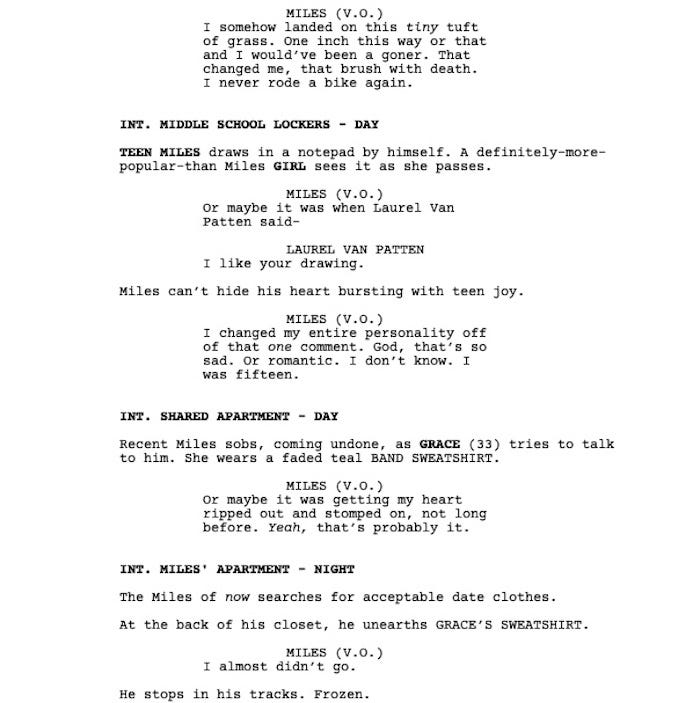
So, yeah, this one was a lot of planning, a lot of outlining, and then a lot of writing, and deleting, and writing in the margins, and more rewriting. I don’t know if I got there, but I kept trying to make it all feel natural and in the moment. I envy any writers who do that well.
Scott: That’s what I tell my students. I say, “Sometimes, you’re in the receptive writing mode, where you’re there with the characters, you feel your way into the scenes.” I always tell them, “Write your scenes from a feeling place.” There are other times where you step outside, and you look at things and go, “Oh, wait a minute.” That executive kind of writing.
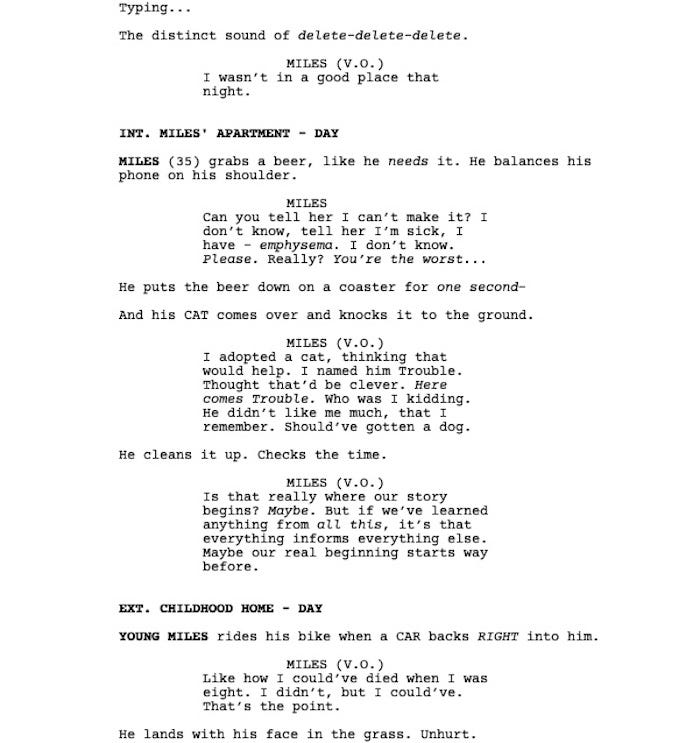
It sounds like you’ve got that balance in between the two. I’d like to ask you about, first of all, delete, delete, delete. It’s right up front. It’s like a big clue if you’re really paying attention.
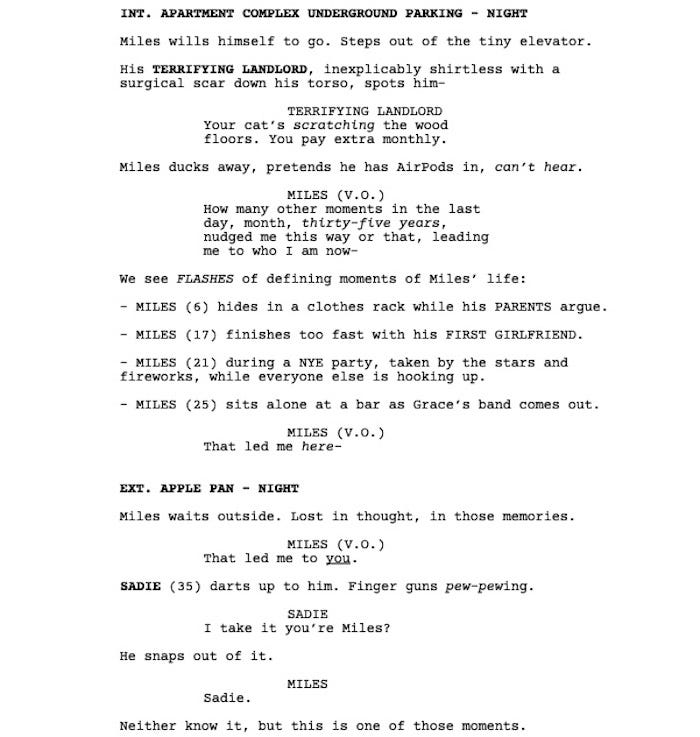
Did you always have that ending in mind? It does have that classic Hollywood thing of, give the audience what they expect and give them what they want. Did you always have that ending in mind?
Max: The short story had an ending that was a little different, but it’s the same kind of feel. It’s all been there from the beginning. There was one time we toyed with taking it out, and the producers immediately were like, nah, go back. We’re all on the same page with what the movie should be, so the second it went off course, we all felt it. So this ending, with slight alterations, has been there in every draft.
It’s where the movie wants to end. The characters have changed. It’s a romance. We’ve invested so much in these people being together. And the ending doesn’t have them get back together, but there’s a hope that they could, and this time around, they’re better off, they’ve changed in ways that will make their relationship that much more powerful.
Some of that is just… My outlook on the world, and the producers’ outlook on the world, coming through. We want these characters to be in a good place. We want that hope. We want to feel good, and the characters have earned it. It’s a bit of a gut feeling, but I feel like it had to end on that note.
Scott: I concur because I was so happy. It’s such a lovely little moment. By the way, I hope this movie gets made and you get a lifetime free pass at the Apple Pan.
Max: I don’t even need the free pass. Just being mentioned in the same breath as the Apple Pan would be the dream.
Scott: Let’s talk about your Black List experience because you did it in 2012. What’s that like this time around in December when it’s announced that the script made the Black List?
Max: This time is so much different. The first time it was revelatory. It was such a big deal, rightfully ,because, first of all, it got me read by so many more people than would have read me before. I had a manager going into that, but it got me agents at the time. It opened up the world.
I was 23 when that happened, so I was very young. I didn’t take advantage of it in the ways that maybe I should have. It was ultimately a learning experience. I got thrown right into the business and it taught me how to approach, or how not to approach, this business.
I’m lucky it happened that way, that it wasn’t some instant ticket to success or anything. It rarely is. You learn quickly that being on the Black List is a huge deal, but it doesn’t mean you’re about to get paid. You’re not given a career. You still have a lot of work to do.
It was a stamp of approval, it was validation, it was… We’re all crazy for pursuing this career, but it made it feel like… It’s worth sticking around for a little longer to see what happens. That maybe this career could happen. And that little bit of hope goes a long way early on.
This time, it felt different. It’s hard to explain, because it was this wonderful thing, there was still this thrill to it… Maybe this is just me being healthier about my work and my life, but it felt more like… Gratitude that people responded to this script, to this project I love, and that people spent the time to give it a read, and then take this extra step to tell other people about it. It means a lot.
It’s, like, I’ve been lucky, in a lot of ways. I’ve had a movie produced. I’ve made a career out of this. I’ve been working with a lot of people in the last couple of years have been good to me, personally and creatively. But that need for validation… It never goes away. We always feel like frauds, and I’m not immune to that.
Especially for a script that became more and more personal with every passing draft, it was nice. I’ve gotten some meetings that I wouldn’t have had otherwise and met some allies. It might not feel like the same groundbreaking, what-is-happening-right-now moment that it did ten years ago, but it’s no less impactful, just in a different way.
It’s more about this project in particular instead of about me, and hopefully, giving this one more of a life and more of a chance to get to the goal we really want, which is to get it made and get it out there.
Scott: I would hope so. In a town where business decisions are often made based on fear, to have the Black List, they’re attached to this project. Now, if you’re going out again, trying to get it set up, hopefully, that will benefit you in that regard.
Max: Absolutely. It makes everyone’s job a little easier. You’re always fighting to prove you’re worth someone’s time, because everyone’s time is so limited and they’re sent so much stuff. Being on the Black List gives it a little more excitement as they open up the first page. That’s all you can ask for. It’s hard to do. It’s a credit to what Franklin Leonard’s done for writers. There’s really nothing else out there that does that. I’m incredibly grateful to have been a part of it twice now.
Tomorrow in Part 6, Max answers some craft questions and offers advice to aspiring screenwriters.
For Part 1 of the interview, go here.
For Part 2, go here.
For Part 3, go here.
For Part 4, go here.
Max is repped by Entertainment 360.
Twitter: @taxe
For my interviews with dozens of other Black List writers, go here.