Interview (Part 5): Kevin Sheridan
My interview with 2023 Black List writer for his script Backcountry.
My interview with 2023 Black List writer for his script Backcountry.

Kevin Sheridan wrote the screenplay Colors of Authority which landed on the 2022 Black List. Then his screenplay Backcountry was named to the 2023 Black List. I had the opportunity to chat with Kevin about his creative background, writing two Black List scripts, and the craft of screenwriting.
Today in Part 5 of a 6-part series to run each day through Sunday, Kevin shares advice he received from his manager: “He always says just make the reader turn the page. I don’t care what you do. If it’s captivating, if I’m turning the page, that’s all that matters.”
Scott: The project is with Star Thrower Entertainment. Where are you in this process? Do you have a director attached?
Kevin: Yeah, Ben Younger. I was such a fan of his films, Boiler Room and Bleed for This. He’s an extreme snowboard himself. He goes out into the backcountry. I think he read it as he was flying a plane. He’s just one of those unique individuals, and he read it and really resonated with it.
What Ben does so great, especially with Boiler Room and Bleed for This, is that he can really dive into subcultures and specific communities. I have no doubt that he’s going to do the same with Backcountry. Star Thrower, I can’t say enough amazing things about how incredible they are and the value that they added in the story.
Laena Caroll, Allen Mandelbaum, Trevor, and Tim, Ella Yehros — I wake up every day lucky to be in cahoots with them because it really is a foxhole. I can’t think of anything harder for me to do with my life than to sit down alone and try to write a story that is meaningful and worthy of the money that it takes to be made. They’re all so great on every facet.
This is such a collaborative medium. I have these pillars that I work with to find out who I want to collaborate with. Are they smart? Do they have good taste? Are they hardworking? Are they good people?
Then there’s the unknown thing — do you speak the same creative language? When you’re talking stories, are you riding on that same current? It’s really important to find the people that you speak the same creative language with. For me, they’ve really been that.
Scott: Yeah, you could just as easily have heard producers, like, “Oh no, by 25, we’ve got to have the avalanche.
Kevin: A thousand percent. They’d be like, “It’s page 13 already… where’s the fucking avalanche?”
Scott: Make me care. Care about the characters. Well, congratulations on that. I got a couple of craft questions for you that arose from reading the script. You can just tell that you love language and you really worked with the words you chose.
I’m sure you’re aware there’s these so‑called screenwriting rules. One of them: Avoid flashbacks. You’ve got some. What was your thinking about that and why you chose to feature those moments?
Kevin: Growing up as a kid, we had surf VHS tapes and DVDS. And they were all super meaningful to me and my friends. I wanted to incorporate that and use it in Brooks’ backstory. And the way that the flashbacks played out, just came together in a really organic way and I can’t really take credit for it. It just happened that way. It’s almost like the muse taps you on the shoulder — really, really softly. It’s so soft that if you’re not paying attention, you’ll miss it. I never get that big aha moment in life. It’s always a nearly silent whisper. And if I’m not doing the work, I’ll miss it.
The good thing, I have a great mentor, Kay Foster. She’s always so honest in pointing out what works and what’s not working for me. When she read the script, and dug the flashbacks, I knew I had something.
Scott: I cringe when people say, “You can’t do this and you can’t do that,” when particularly some of the greatest movies of all time feature flashbacks.
Kevin: If it works, it works. And it works in the progression of Backcountry. It’s some of my favorite moments in the script. Especially the hallucination he has at the end. These tapes Lily discovers in the garage, she’s just trying to understand who her father really is… and it’s these tapes, Brooks’ backstory, that is what leads to their rescue. I can’t really take credit for it. It all just fell into place in a really cool way that has meaning.
Scott: That’s right, Lily is the one who says he’s on Alder Mountain. Isn’t she the one?
Kevin: Yeah, she’s the one. We cut back to the flashbacks of Brooks after his crash as he’s trying to reclaim his career he lost and he is just not the same skier. He’s broken. And its Lily who is watching the tapes, and she’s getting a glimpse of why her father is the way he is.
Scott: It’s also visual storytelling.
Kevin: Yeah, I was trying…
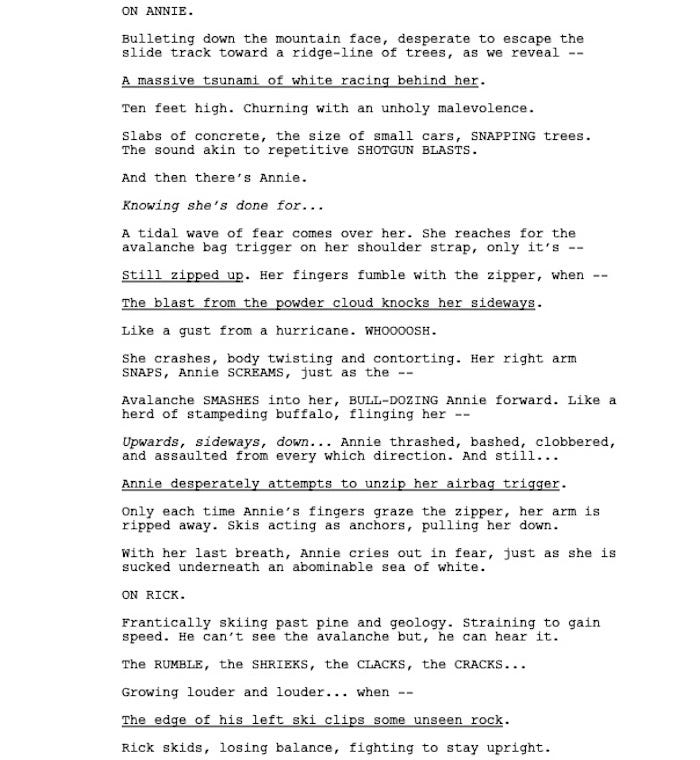
Scott: How about the so‑called unfilmables rule: “Oh, you can’t write anything that the audience can’t see or hear in the movie.” Yet in your script, you’ve got wonderful moments where you comment about a characters’ emotional or psychological state, even dipping into their inner life just a bit to give the reader that insight. You’re judicious about it, a screenplay is not a novel, but you do occasionally engage in that type of editorializing. What are your thoughts about the so-called unfilmables rule?
Kevin: My manager John Zaozirny is a brilliant guy. He always says just make the reader turn the page. I don’t care what you do. If it’s captivating, if I’m turning the page, that’s all that matters.
For me, I wish I could have more white space. I’m always envious of these writers who can have all this white space, but I’m trying to paint the portrait of the movie I see in my head. The style, the tone, and the feel, and the substance of it… so I probably have much less white space than normal.
Scott: I was in Austin for the Film Festival Writers Conference this year, and moderated a panel with namager who said, “I look for scripts with Yes Pages.” I was like, “OK, what does that mean?” When I get to the bottom of the page, I go, “Yes, I want to go on to the next page.”
Kevin: I don’t think any of the unfilmables matter. I think that as long as you’re getting people to turn the page and you’re making people feel something, that’s all that matters.
Scott: Concur. I’ve got one last question for you. Nowadays, you know how hard it is to get original stories set up, let alone get made, in Hollywood. They’re so addicted to pre‑existing content, prequels, sequels, and remakes, and reboots. They’re so fear‑driven, like, “It needs to be based on something.”
What’s your advice to screenwriters who are drawn to writing original stories?
Kevin: I think if someone has an original story and they are hyper passionate about it, they should to write it. Obviously, be smart and calculated about what you write.
If you’re passionate about a story that’s already been done before ad nauseam, maybe you shouldn’t write it right now because that’s been done four times already in the past three years.
For me, obviously I try to look for true stories, but I also try to look for subcultures that I think haven’t been properly portrayed. With Backcountry I couldn’t think of a movie that really honestly depicted the skiing community — not the glitz and glam of Aspen — the other side of the coin. I wanted to see the real mountaineers. The people who work nine to fives but skiing is their passion.
And that was something that I felt that people would want to see. I still do. I think this is a movie that, when this thing does gets made, knock on wood, that people will be excited to see it. And more importantly, when they watch it, it will make them feel something along the way.
Scott: Look for interesting subcultures that haven’t been explored already?
Kevin: That’s just one of the things I look for. Ultimately, follow your passion. Follow what gets you excited. That excitement is so important. It translate into every word that’s typed. Circling back to skiing and the skiing community — these people are doing just that. They’re pursuing their passion every chance they get, despite the dangers that may be lurking.
Scott: Maybe we should end with that advice for writers: “Follow your passion.”
Kevin: Yep. Follow your passion. Follow the energy. Follow what gets you excited.
For Part 1 of the interview series, go here.
Part 2, here.
Part 3, here.
Part 4, here.
Kevin is repped by WME and Bellevue Productions.
Twitter: @Sheridankevin
For my interviews with dozens of other Black List writers, go here.