Interview (Part 5): Karin delaPeña Collison
My interview with the 2021 Nicholl Fellowships in Screenwriting winner.
My interview with the 2021 Nicholl Fellowships in Screenwriting winner.
Karin delaPeña Collison wrote the original screenplay “Coming of Age” which won a 2021 Nicholl Fellowship in Screenwriting. Recently, I had the opportunity to chat with Karin about her creative background, her award-winning script, the craft of screenwriting, and what winning the Nicholl Award has meant to her.
Today in Part 5 of a 6 part series to run each day through Saturday, Karin delves more deeply into the key characters in her Nicholl-winning script.
Scott: The theater group, that is where this Lolita‑type thing happens. How early on was that character, Edward, in your thinking? Was that something that was to facilitate this idea of the sexual development, or did the character pre‑exist that?
Karin: I honestly can’t answer that, Scott. There was an inkling in my mind that there would be a character in this troop who would have an ambiguous relationship with the mother and with the daughter — and would be intoxicating to the daughter. Would go too far with the daughter. I had that idea from the drop.
The fact that he smoked the same cigarettes and wore the same aftershave as the dad. Those sorts of details, the fact of the tutoring, I don’t think I had those from the drop. I can’t remember now exactly. I think coming up with the tutoring was a way to solve a problem, because she had to have schooling.
Then having him as one of her tutors … and the John Donne poem — it all seemed to fit.
Scott: That’s that wonderful thing we do as writers, referred to as that receptive writing and executive writing. That receptive writing as an actor and a writer, that thing where you’re just really receiving from the characters. Then there’s a time where you step outside.
In this case, it’s like, “Well, I got to do a bit of problem‑solving here. If Trisha, the mom’s, going to take the daughter away from her education, she’s going to have to somehow substitute it.” So she reaches out to people in the company…Anu teaches her biology. Harry, I think his character, teaches her math.
Karin: Math and history.
Scott: Math and history. Edward’s got literature, which is quite great that you’re able to facilitate that. There’re so many levels. It’s a complex story. Very simple in some ways. It’s not your typical, the Protagonist has got a goal, got to do this in order to achieve that. It’s not that. It’s more of a slice of life thing, and yet it does have a structure to it. There is this complex mother‑daughter relationship. There is this relationship with her father that’s played out through the relationship with Edward. Mostly, it’s about the sexual and psychological maturation of the Charlotte character.
I want to talk about a specific moment with Edward, an abusive moment. Yet the tone of the story is also comedic. Did you know exactly the specifics of what was going to happen there, and how you handled that in terms of the script?
Karin: I didn’t want Charlotte to be a victim. I wanted her traumatic experience with Edward to exist in a morally gray area. In other words, I didn’t want to have a predator and a victim. I wanted to explore the complications. Clearly, a better man wouldn’t have succumbed to that level of temptation. A lot of men would, though. A lot of men would. Definitely back then.
This nubile protagonist — this girl whose body is so physically developed — and who is clearly intoxicated with the man in front of her, and by her own sexual feelings … well, a lot of men would succumb to that temptation. I also wanted to make it clear that although for her, a tremendous amount happened — objectively, not very much happened. That’s how she felt about it.
I wanted to show that the whole experience was as unexpected to him as it was to her; that he is not a natural predator. (Again, I have a slightly different take on it in the series. More morally ambiguous.) He reels back from what happens. He starts focusing on the mother. He basically rejects Charlotte. Also, they’ve finished the literature curriculum by that time, so he doesn’t have to see her in private anymore. This, of course, is devastating and terribly confusing for her.
That was what I was trying to achieve there. I was really trying to take this experience out of the realm of black and white. I wanted audiences to be turned on, because that’s the real world. But also, to be shocked. I wanted all of that complexity. We are incredibly complex creatures. That’s what I was going for.
Scott: It really lays the groundwork for her, because she has all those experiences, she is turned on, and she is shocked. At some point, it feels like she’s got a sense of shame about it, too, like it was her fault.
Yet then you’ve got these counterveiling characters like Gloria, who is sexually libertine and comfortable in herself and they become chums. There’s a rebalancing in a way. It’s great that it’s a female character, too. It’s a maternal type of a figure.
Having that Gloria character, was that one of those things where, again, receptive writing, these are the characters you know in the theater, but then, as you are working with the story and Charlotte’s character, Gloria plugs in. You can see how she serves as a mentor figure in a way at that time.
Karin: Yes, Gloria definitely beamed in to me … she’s definitely a product of receptive writing. And she becomes Charlotte’s mentor in a very girly way.
Scott: Trickster’s kind of way.
Karin: Yes. She’s not like Anu.
Scott: No. She’s more like a trickster.
Karin: Yes. She’s like a trickster. She’s teaching Charlotte some feminine wiles.
Scott: Limericks.
Karin: Yes, naughty limericks.
Scott: Then there’s Catholicism. You said that you yourself went to a convent school. Trisha is quite observant of Catholicism as a mother, but not in a strict, disciplinary way; I don’t know what it is. More of a cultural thing — or does she feel like it’s an appropriate or necessary thing to do as a parent?
Maybe unpack a little bit of that Catholicism and how that plays out because it comes into play at the very end with your ending, which I love.
Karin: That is very personal actually — very true to my life. My mother was a Catholic convert. When you’re a convert, you’re much more passionate about your faith. I swear I could speak Latin before I could speak English. I remember kneeling down, saying the Pater Noster and the Ave Maria by my bed next to my mother. Now despite being a passionate Catholic, my mother was not a straight-laced person. She was very contradictory. Quite confusing to me.
Tricia’s more straight‑laced in this script than my mother was. She has a flirtation with Edward in the film, but it never goes anywhere, because she’s a loyal wife.
In reality, as I said, my father bailed on us. He had no religion whatsoever. My mother raised us as Roman Catholics. But once she was a woman without a husband, she had men in her life. But very discreetly. She was always balancing these two dynamics.
This is not in the script. I don’t think I even put it in the pilot. If for some wonderful and bizarre reason, the series got produced and took off into a few seasons, it could definitely be a part of Tricia’s character arc.
In true life, my mother had TB. One of the convalescent homes she went to was run by Catholic nuns. She’d been brought up as an English Protestant. It was they who converted her.
She remained a loyal and very observant Catholic until she died.
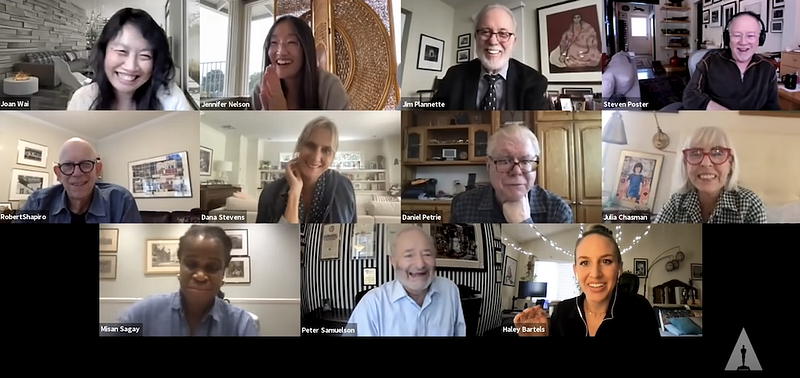
Here is a video clip in which the Nicholl committee tells the 2021 Fellows they have won this year’s award.
Tomorrow in Part 6, Karin advises writers on why they should find a coach they can trust.
For Part 1 of the interview, go here.
For Part 2, go here.
For Part 3, go here.
For Part 4, go here.
For my interviews with every Nicholl Fellowships in Screenwriting winner since 2012, go here.
For my interviews with Black List writers, go here.