Interview (Part 5): Karen McDermott
My interview with the 2019 Nicholl Fellowships in Screenwriting winner.
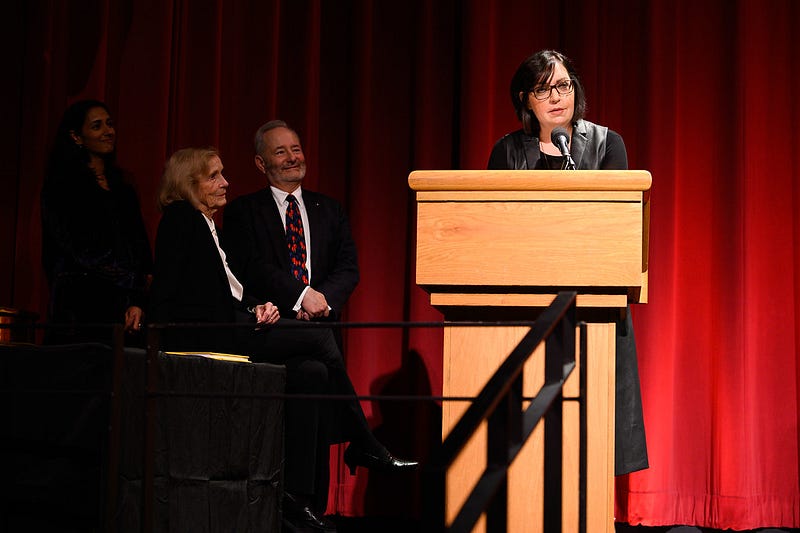
My interview with the 2019 Nicholl Fellowships in Screenwriting winner.
Karen McDermott wrote the original screenplay “Lullabies of La Jaula” which won a 2019 Nicholl Fellowship in Screenwriting. Recently, I had the opportunity to chat with Karen about her background as a screenwriter, her award-winning script, the craft of screenwriting, and what winning the Nicholl has meant to her.
Today in Part 5, Karen takes us into the dramatic events of her script’s final act and talks about the use of setups and payoffs in the story.
Scott: I’d like to talk about a couple of other characters that Dahlia meets in confinement. One is Nurse Teresa.
Karen: Yes. In the cage, Dahlia is traumatized. She experiences losses. At one point, she wants to take revenge, to kill a guard who has raped her friend. But Nurse Teresa pulls her back from the brink. She says, “Don’t become them.” (the guards) So ultimately, Dahlia avoids the cycle. (“They call us criminals then they make it so that’s the only thing we can be.”)
Scott: She’s a mentor figure, Nurse Teresa?
Karen: Yes. I wanted to have at least one compassionate adult in the cage. I thought if I didn’t, it would seem like an unrealistically evil world. (I think Mister Rogers said this: you’ll always find good people, even in the worst of situations.) But they may be outnumbered, as Teresa is. All she can do is mumble her little sarcastic jabs.
Scott: There’s also another character who’s being held in the cage, Estefani.
Karen: Yes.
Scott: She strikes me as a mentor figure in a way too but in a different fashion. She’s been there before. She knows things about life there. She’s got that knowledge that she passes along to Dahlia. Then she’s assaulted and she changes. Could you talk about her storyline?
Karen: I wanted a shortcut way of having Dahlia learn the rules of survival in the cage, so I decided to give her an older sister figure. Estefani is a version of my sister, Stephanie, who sort of protected and nurtured me as a child.
But I also wanted to show the reality of life for children in border detention, the reality of sexual assault. So Estefani is a kind of sacrificial lamb, to show that horrendous reality. I didn’t want that to happen to Dahlia; I wanted a happy(ish) ending for her, and I didn’t think she’d be able to come back from that.
Scott: Did you ever at any point think about parallels to the The Shawshank Redemption?
Karen: No, I didn’t.
Scott: Do you remember the Brooks character who goes and commits suicide when he’s freed?
Karen: Oh, yes. I do remember that now that you mention it.
Scott: There’s “get busy living or get busy dying.” Brooks is the guy who represents ‘get busy dying.’ That’s the path that Red could have gone on. I’m thinking that in a way, Estefani creates that path. Your script starts with Dahlia basically loading these rocks in this backpack. She’s going to try and commit suicide.
Karen: Going to kill herself, yes.
Scott: There’s that. Then also, too, I was struck by the fact that poetry absolutely helps keep her alive, psychologically and emotionally.
Karen: Yes. It’s the beauty in the ugliness. And her connection to her mother.
Scott: Yeah. Andy with music, Mozart.
Karen: Yes!
Scott: Of course, the prison thing. I throw that out there for you as something to think about.
Karen: I didn’t think of that, but you’re right. I’ll have to watch that again.
Scott: One of the more fascinating aspects of this is once she’s out, this well‑intentioned couple from Los Angeles, Michelle and Clark, who bring her out and bring her to their wonderful home that has a view of the ocean and whatnot.
Then, in some respects, the story gets even more challenging for her. What was your thinking on that as you’re approaching moving toward Act Three and the life that she has post the cage detention thing?
Karen: I wanted a new setting for Act Three. We had spent enough time in a cage. And I was always trying to build in the La Llorona folktale (the ghost who lurks at the edge of the water, looking for children to steal), so that’s how the American couple ended up in a beach house. They had to be near a body of water. They had to remind us of the child-stealing ghost.
I also wanted their privileged lifestyle to make the point that no amount of luxury can compensate. Dahlia doesn’t need nice stuff. She needs her mother, her family, her own culture. I wanted to answer the question, “What’s wrong with placing them with very nice families and giving them luxuries they wouldn’t have in their own countries?” What’s wrong is that we don’t get to steal children, then justify it with ethnocentrism.
Also, in that third act, I wanted to show Dahlia’s PTSD. Her time in the cage damaged her. At an “upscale” restaurant, photos of indigenous (exploited) farmers on the wall trigger her, and she makes a public scene. Her foster parents don’t understand why she acts out, why she can’t appreciate what they have to offer. But she’s angry. She’s devastated. She’s lost important people in her life. And she’s carrying that darkness with her.
Scott: There’s a crushing moment where she reunites with her father. He tries to justify it. He says, “All men are weak.” She returns to her father and she says, with contained rage, “I knew a man who walked across a desert to find water for his mother. I knew a man who risked his freedom to protect a little boy he hardly knew.”
Karen: She’s talking about her brother, Felipe, and the boy she loved in the cage, Juan Alberto.
Scott: “And, I knew a philosopher…”
Karen: The little boy from the cage, Hector.
Scott: Yeah. “…who thought everyone was beautiful even when they treated him like an animal that belonged in a zoo. So, no, not all men are weak.” What’s your reaction when you hear those words now?
Karen: I love that scene — if I say so myself. It’s part of the “los muertos” theme. In that scene, Dahlia pays tribute to three of the people she lost and who inspired her. The screenplay is filled with the influence of the dead. The words of a dead poet comfort Dahlia, her family crosses the border on The Day of the Dead. In her “all is lost” moment, Dahlia’s vision of her dead grandmother inspires her to keep going. And in the folktale of La Llorona, Maria comes back as a ghost.
Scott: I don’t want to give away the ending. It’s emotionally charged. It’s both uplifting but also, given everything Dahlia’s experienced, it’s also quite bittersweet. Did you always have that ending in mind?
Karen: Always. After I wrote the Hector scene, the next scene I wrote was the ending.
Scott: The final poem excerpt, “They shall not bind me, no. This world of chains for me is naught. Who will confine a smile? Who will wall in a voice? I am tall, buoyant, free, tall, buoyant, free. Free.” Why is that the last poem?
Karen: That was her mother’s favorite poem, the one she read to Dahlia just before they set out to cross the border. Hopefully, the reader/viewer will remember it.
Scott: Call back.
Karen: Yes. Setups and payoffs. In that poem, Miguel Hernandez is claiming his emotional freedom, even from within a prison cell. So, it’s uplifting. But there’s another reason I end with it. The word “buoyant” which is repeated, is a bookend, or a mirror, using Blake Snyder’s term, of the opening image in which Dahlia tries to drown herself. In the beginning, she’s drowning; at the end she’s buoyant (afloat.) And so, we see her arc.
Scott: I mentioned this quote with another one of your 2019 Nicholl fellows. In their script, the protagonist went through hell and back just like yours. It’s from Janet Fitch, a novelist. She said, ‑‑ I’d like to get your reaction to this ‑‑ “The writer is both a sadist and a masochist. We create people we love, then we torture them.”
Karen: [laughs] Yeah.
Scott: “The more we love them and the more cleverly we torture them along the lines of their greatest vulnerability and fear, the better the story.” What are your thoughts on that?
Karen: That’s so true. We’re always creating ourselves and the people close to us — and torturing them. Estefani, like I said, is based on my sister, whose beauty was always a kind of burden. It made her… susceptible, a target. Estefani is described as having a curvaceous body, and she uses her long hair to cover it “like camouflage.” Her beauty is her vulnerability — she’s afraid of it. And this foreshadows her later rape.
Tomorrow in Part 6, Karen answers some screenwriting craft questions.
For Part 1, go here.
Part 2, here.
Part 3, here.
Part 4, here.
Karen is repped by APA.
For my interviews with every Nicholl Fellowships in Screenwriting winner since 2012, go here.
For my interviews with 53 Black List writers, go here.