Interview (Part 5): Julia York
My interview with the 2024 Black List writer for his script The Seven Guys You Date Before Marriage.

My interview with the 2024 Black List writer for his script The Seven Guys You Date Before Marriage.
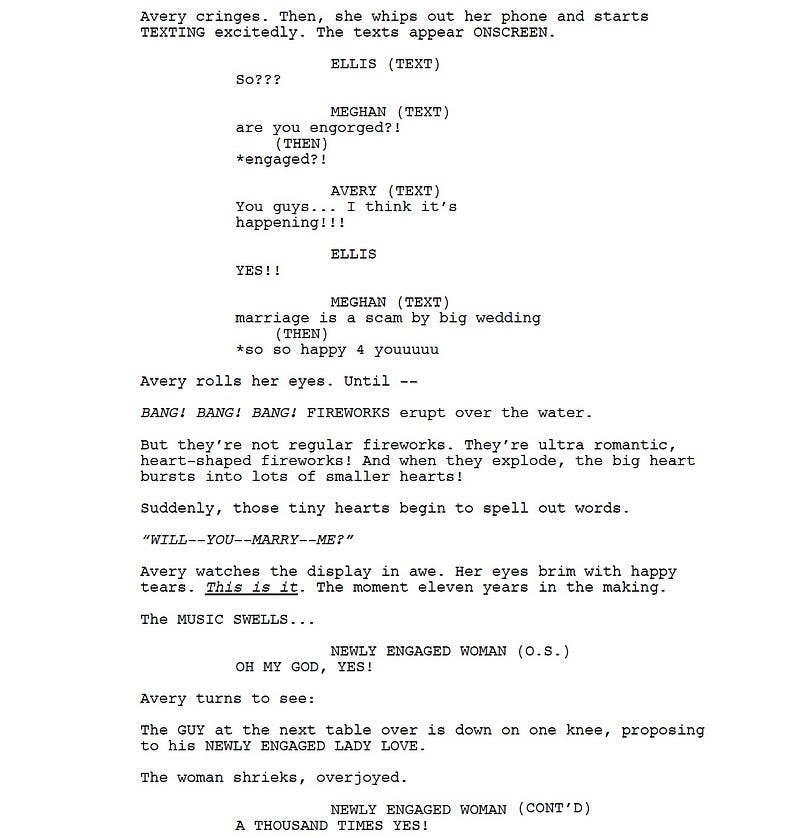

Today in Part 5 of a 6-part series to run each day this week, Julia reflects on working with rom-com tropes and what she felt when she discovered her script had made the Black List.
Scott: One thing about rom‑coms, the tropes, and the challenge there would seem to me because I’ve never really written or ran a comedy, but I would assume that one of the big challenges is you’ve got to kind of nod to them. You’ve got to kind of say, “OK,” but then do it in a way that’s a little bit of a twist.
I mean, you’ve got there’s the education‑about‑dating type thing, sort of the mentor, the best friend. There’s a little bit of a makeover before her first date. The meet cute, which you do not once, not twice, but three times…
Julia: The rule of three.
Scott: Rule of three. Exactly. So how do you approach that? You’re writing a romantic comedy. You’re a fan of them, obviously. You’ve got these tropes. How do you approach them so that you’re doing it in a way that is similar but different?
Julia: I think you want to kind of whisper to what feels familiar because people want to see what they love. Just a way of doing it differently, I think really feels rooted in what makes sense for these characters. That, to me, was kind of the fun of it of, “OK. This is a fashion show, but how do we have Avery be the one to do it?”
I can’t tell you how many times I’ve walked out to my friends and been like, “What do you think of this outfit?” And they’re like, “An oversized button down? That’s what you’re going to wear on this date?” You know what I mean?
It just is so funny when you’ve been in a relationship for so long, you really don’t know how things work. It was so interesting to me. That was really what it was. It was like, “Show us modern dating,” in a way that I think if you’ve been in a relationship for a long time or if you’re not of this particular era, it’s a totally different world.
I was shocked. I met my ex‑husband on a dating app in 2015 and logging on to that same dating app in 2024, you would do different things, like you didn’t have to swipe left or right anymore. You had to send hearts and flowers and rose. I was just like, “What is this? I don’t even understand how this works.”
That’s was kind of my thought of at least the explaining dating part and the makeover part. The meet cute, I loved the idea because I think so many people have that person who you really do think is, “This is my next person,” particularly with women and then they just disappear or disappoint. I really wanted that to be the twist of what you think this movie is going to be.
Scott: Well, speaking as a guy, I can say I was very disappointed in that dude because I was hoping that might work out, but as a screenwriter, I’m going, “No. This is not going to happen because page count wise, there’s a lot more to go.”
Julia: Well, see, that’s what I appreciate because I think when you’re watching it, you think, “Oh, no. There’s a chance that he’ll come back.” Right? Or there’s a chance that this is the person because it’s around the midpoint when they have their kind of music swell moment. So you think, “Oh, OK. Now this movie is about this guy,” and in reality, it’s not really about any of the seven guys. It’s really just about her.
Scott: There’s so many great lines of dialogue. I could’ve highlighted dozens of them. We talked about that one scene where she does almost have a sexual encounter with a woman, and she’s so funny. She says, “I’m embarrassed by my heteronormativity…” It was just so funny.
Then there was earlier…I just pulled out another. Ellis had this line, “If I wanted to get into the head of a straight man, I’d listen to country music,” and I’m like, “Well, Julia must be the kind of person who has got a really good inner recording device.”
You live in New York. I’m sure you’re in conversations all the time, and you’ve got all your friends and whatnot. Because the lines of dialog just feel like they’re funny, but they also feel very authentic, like real, like they could have come from real life. So I’m just curious how you feed yourself in terms of your dialog. How does that work?
Julia: I think my acting background really helps. I think that dialog is something that I love so much because I really see the characters very clearly in my head as I’m writing, and if I don’t see them, I cast them, and I know that that can kind of be a no‑no, but I need to hear their voices, and I need to know who they are so that I can know how they speak.
For me, I wanted to make sure, particularly with our three best friends, that they didn’t sound alike, that they couldn’t be interchangeable, that they had to have different, distinct, unique personalities.
There’s one line that I always think about because it’s how I dress. She’s talking about dressing for dates, and she goes, “I don’t have anything. All of my clothes were made for cuteness and general ease,” and I’m just like, “That’s how I feel.” That’s what would come out of my mouth.
So I think Avery and I have a lot in common but she’s the more kind of neurotic, more adorkable version of me in my head. I really have a fun time with dialog. I read everything out loud to make sure that it works and that it feels right, and then just really picturing the characters.
Scott: The ending, I don’t want to give it away. Did you always have that in mind?
Julia: Yes. I wanted something to happen where we’re hopeful because I think for a lot of people, the fear is ending up alone, but it’s such a big world. There are so many people. You never really know what’s just around the corner. Yeah, I wanted to end it on a hopeful, positive note. It wasn’t enough for me to just be like, “She’s happy by herself.” You know?
Also, then you move into maybe there’s a sequel, but I know the sequel, which would be The Seven Guys You Date After Marriage. Then you can have, “The Seven Girls You Date Before Marriage.” What’s been so funny too is talking to guys about who are the seven archetypes of women. You know?
“Who are the seven archetypes of women before and after marriage? How do you do this? Does Marty, her dad, have an opportunity to find love again?” “The Seven Women You Date After Death.” There’s so many different ways and Hollywood loves franchisable.
Scott: Oh, sure. Absolutely, and they’ll find a franchise wherever they can. My theory on this, ‑‑ because I wrote this book called “The Protagonist’s Journey” and Joseph Campbell and Carl Jung, because I do a lot of reading of Carl Jung ‑‑ this idea that the journey that the hero or heroine takes is the journey they need to take.
It’s all about self-identity. It’s about going inside. All the outer stuff is really about driving them inside. So, you can look at these seven experiences that she has with these different interchanges with these potential dates, that’s really about each one of them is kind of piercing through her defenses and causing her to go a little bit deeper to determine who she is.
So often, the end of the movie is the beginning of the Protagonist’s new life.
Julia: I love that. I think too, again, what’s so interesting is rereading it now, I really didn’t realize how autobiographical this movie would be. It really is crazy, and I feel, not protective, but I guess I love it. It’s been a fun ride.
When I was in “Jack Reacher,” I got to work with Chris McQuarrie, who I had literally just…I was like, “I just studied you in film school,” and we talked a lot about screenwriting. I remember when the movie premiered, I went to the cast‑and‑crew screening, and it was right then that I had gotten repped by Gersh and was starting this process with Chuck and Larry Gordon to really bring it all full circle.
Chris said to me, “The best piece of advice that I can give you is to not be precious.” This was at a point, now he can be precious, but before, he was like, “Even I can’t be.” Right? You know? He said, “I’m still at the whims of what the studios and what everybody wants.”
I really took that to heart, not in a way where I am so quick to give up things that I believe in, but really that in order to get to a place that you want in your career, you have to be a team player, and you have to know kind of what your role in it is, and if I wanted things to be printed the way that I wrote them, I would have become a novelist. Right?
A screenplay is a blueprint, and it’s so collaborative, and at the end of the day, it is the first piece of a very large puzzle, and I believe it’s the most important piece of a very large puzzle, but it is just one. Also, if this movie can make what anyone but you made, then who cares?
Scott: Let’s talk about your script being named to The Black List in 2024. What was that experience like and what has it meant to you?
Julia: It meant a lot. As I said, last year was a really, really tough year for me, and if nothing else, it just felt like something incredibly positive. It felt like that kind of thing of like, “OK. You’re going to be fine.” It was also a weird year where so much happened, it felt like, to me, but I was also waiting on a lot of, “This is set up, and so we are out to talent.”
I had another project that’s set up that was out to talent last year. So it was a lot of things where it felt like I was on the precipice of something happening, and then nothing really did, and so it really just felt validating.
Tomorrow in Part 6, Julia provides some thoughts on the craft of screenwriting.
For Part 1 of the interview, go here.
Part 2, go here.
Part 3, go here.
Part 4, go here.
Julia is repped by CAA.
For my interviews with dozens of other Black List writers, go here.