Interview (Part 5): Jimmy Miller
My interview with the 2023 Nicholl Fellowships in Screenwriting winner.
My interview with the 2023 Nicholl Fellowships in Screenwriting winner.

Jimmy Miller wrote the original screenplay “Slugger” which won a 2023 Nicholl Fellowship in Screenwriting. Recently, I had the opportunity to chat with Jimmy about his creative background, his award-winning script, the craft of screenwriting, and what winning the Nicholl Award has meant to him.
Today in Part 5 of a 6-part series to run each day through Saturday, Jimmy talks about a central theme of the script and what his Nicholl experience has been like.
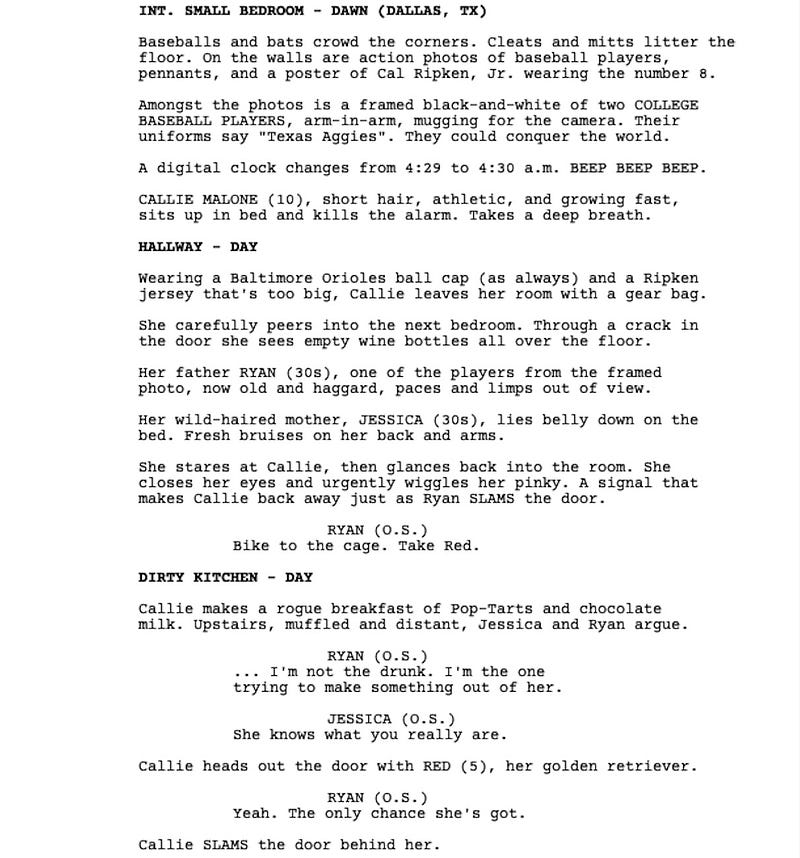
Scott: Now I’m thinking about that philosophy: Be here now. Be present in the moment. It really flows through this whole story. like there’s scenes where Jessica and Ryan get together at some point, like pretty late in the story, 71, I think.
She goes to Ryan and says, “Jesus, not everything’s a competition. We both suck. The only reason she’s still at the ranch with her grandfather and Jessica is I haven’t screwed up again. Can we just agree that we’re both shitty parents and just stay the hell out of the way?”
Like, just accept being in the present where we’re at. Don’t project from the past and project into the future. The only thing she needs from us is to for once not suck at loving her which is a pretty profound comment and I think did shake up Ryan.
Mason has a similar note. This is a grandfather, he says you can love someone and hold them accountable at the same time. You can be hurt and find forgiveness at the same time so again it’s just like try to avoid getting caught up in the web of past and future and just be here now and live in the present. Doesn’t it seem like that’s a theme that’s playing throughout a lot of different levels in the story?
Jimmy: Yeah. That’s one of the basic things I’m talking about in the whole story and in scenes like that. Letting go of the mistakes. What does our child really need from us? And that’s Jessica saying, she doesn’t need us anymore. The only thing she needs from us is to just love her, just accept who she is.
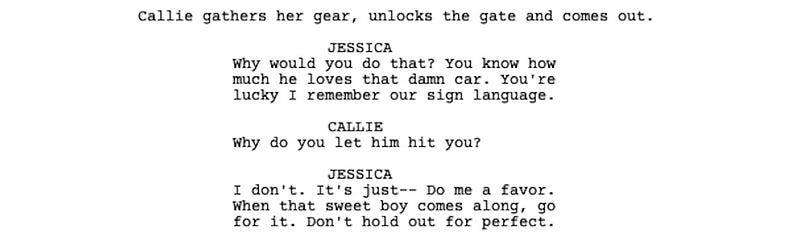
Jessica had to decide to let Callie be mad at her. It’s a hard position for a parent, but she knew it would have to be that way. She had to let Callie express her anger without trying to correct her. Jessica had to accept that she did something really awful…
Scott: Left her for seven years.
Jimmy: Left her for seven years, didn’t say a word and took the dog. She knew her only hope to repair things was to be honest and accountable and to be worthy of her daughter’s trust again. I’ve been in a 12-step program, I’ve dealt with addiction, and making amends in part of my own story. Being accountable to whoever you harmed, and accepting that they have the right to whatever reaction they have.
I was not owed forgiveness. I was not owed a certain response. I’m just doing my part to try to make it right and their response is theirs, and I have to let them have it, no matter what it is. When you stab someone, you can’t judge them for the way they bleed. Don’t worry, I didn’t stab anyone, but I think that’s part of what Jessica is going through and what she’s trying to tell Ryan. Callie has the right to be as mad as she is and as hurt as she is and exactly who she is — because of who they are and what they’ve done.
So there’s a lot of struggling to accept mistakes and being accountable. And Ryan and Jessica don’t handle it the same way. But I don’t think you can be truly present if you haven’t accepted the past.
Scott: There’s a moment where the team is down, I think six to nothing in the championship game and this little kid, his name José, if I remember correctly…
Jimmy: Yeah.
Scott: There’s one out and he’s coming up to bat, he’s not a good hitter, he’s a little dude, and Callie says to him: “Just swing. Anything can happen.” There you go…
Jimmy: “A swinging bat is a dangerous bat,” I think she says.
Scott: I don’t think I’m giving away too much here but that’s the first time he’s ever I think it’s a what is this strikeout would you call it a…
Jimmy: Walk-off strikeout, yeah.
Scott: I don’t want you to give it away because it’s also, again, two plus two equals five there, but was that moment there all along? It was a great moment.
Jimmy: You mean when Roger says, this is my Kirk Gibson moment?
Scott: Yeah, exactly. The ’88 World Series. Dodgers vs. Oakland A’s.
Jimmy: Yeah, because his best hitter is injured…
Scott: The Natural, the Robert Redford baseball movie.
Jimmy: Versions of that moment were always there, but in the later drafts I decided to just name the moment, have Roger say it. I saw that moment live on television and it’s an iconic moment in baseball history that I thought would be fun to see with these characters — after everything that has come before. I wanted to feel like Callie could really be a part of that history, and this is what it might look like. And it’s showing how Roger has a love of baseball, too. He would know that moment. And Callie knows the moment, too, even though she was far from being born when it happened.
And that whole thing with a walk-off strikeout, that’s me showing my absolute love for the strange complexity of baseball rules.
I love the idea that if it’s the bottom of the ninth and it’s 50 to nothing, but you can still come back and win that game. I love the idea that there’s no clock. It’s the fairest game. Everybody gets the same amount of tries, and a baseball game is never over until that third out in the bottom of the ninth and sometimes not even then.
Scott: I don’t want to give away the very, very, very ending of your script. It is like The Natural moment, but again, two plus two equals five. Did you always have that in mind?
Jimmy: Yes. I knew that’s how it had to end. Because there’s no point to the movie otherwise. All of this was leading to her discovering that she never needed her father’s approval to be whole and to be happy. She realizes she never had to make him proud.
His feelings about her are not relevant to what she’s doing. And it’s also really important that her father says nothing and walks away. He finally understands. That’s what I need to do for her. This is her moment. It had nothing to do with him.
There might be something for them in their lives in the future, but it’s not right there. And her growth was understanding she never needed him, and he was wrong. Everything from now on and what she wants to do with her life and what baseball means to her. It’s not about anybody else anymore. All of that is built into that ending. And if it wasn’t so hard to get there, it wouldn’t mean as much.
Scott: Isn’t there that line in A League of Their Own, “The hard is what makes it good” or something like that?
Jimmy: “The hard is what makes it great,” That’s a thematic driver in so many wonderful movies. That’s part of what I was doing here, too. I learned that from so many movies that I love.
Scott: Well, it extends the screenwriting. It’s certainly hard to write and to achieve some success which you did when you won the Nicholl. Maybe you could talk a bit about that what was that like that experience.
Jimmy: The experience was very surreal and strange. But the people at the Nicholl and the Academy are so wonderful.
They’re so generous and kind. People in the industry who I’d want to emulate. They’re so interested in encouraging and fostering writers outside the business and inviting them in. I think that’s incredibly generous, and I respect it so much. I want that to be part of my career, is mentorship and encouraging undiscovered writers who are going through their struggles, the same ones we all go through, that they think they’re going through alone.
I think that’s the best thing about the entire Nicholl experience is being able to meet the people on this committee, becoming friends with them, with the other Nicholl fellows who are incredible writers and incredible people. We’ve been able to get to know each other and every one of them is unique and interesting and talented.
Being able to be around such talented people who care about the art and the craft of screenwriting is incredibly inspiring. It’s motivating. It’s the world I want to be in. It made me realize even more that this is where I want to be. This is what I want to do.
Scott: Well, congratulations once again. Time for a couple of craft questions for you. How do you go about developing characters? Are there any specific techniques or tools or things that you do to unpack a character?
Jimmy: Every writer is different. For me, when I conceive of an idea, I rarely feel like it’s a real ideal until I know how it ends. Until I have some sort of idea of what feeling I want the audience to walk out with and how my ending will create that, I can’t really start writing pages. What am I doing? What is my ending? And those are questions always answered by characters.
One of my things I constantly must work on as a writer is, wherever that character is at the end, I need to drive them as far away from that as possible. Because that’s where their story will begin. Everything that Callie is at the end of “Slugger” does not exist in her in those first pages. She has to battle through everything to get from point A to point B.
I had to decide what was the worst possible situation I could put her in, that is the opposite of where she’s going to end up.
That’s common advice for writers, I think. I’ve heard it from lots of places. But it’s still something I battle. My early drafts often have characters with very flat arcs. And I realized a lot of times it’s because I love them so much, I don’t want them to suffer. [laughter]
But the suffering is necessary. They have to go through it. It has to be hard or why is it a movie? Why does it connect with other people? Why do people want to watch this? Why would they have an emotional experience? And that’s what you’re trying to do. I think you have to give your audience an emotional experience for it to really mean something. Whether it’s laughter or sorrow or anger or whatever it is, we want them to feel. There are so many details I have forgotten about the movies I love. I often can’t remember the director, the cast, who wrote it, when I saw it or the details of the plot. But I remember how it made me feel. People remember the emotional experience.
Tomorrow in Part 6, Jimmy answers some screenwriting craft questions.
For Part 1, go here.
Part 2, here.
Part 3, here.
Part 4, here.
Jimmy is repped by Marc Manus at Persistent Entertainment.
For my interviews with every Nicholl Fellowships in Screenwriting winner since 2012, go here.