Interview (Part 5): Jake Disch
My interview with 2023 Black List writer for his script The Adults in the Room.
My interview with 2023 Black List writer for his script The Adults in the Room.
Jake Disch has made the annual Black List two times: In 2018 for his script Gunfight, then in 2023 with The Adults in the Room. Recently, I had the opportunity to chat with Jake about his creative background, the craft of screenwriting, and the challenges associated with writing a story based on actual historical events.
Today in Part 5 of a 6-part series to run each day this week, Jake answers some craft questions.
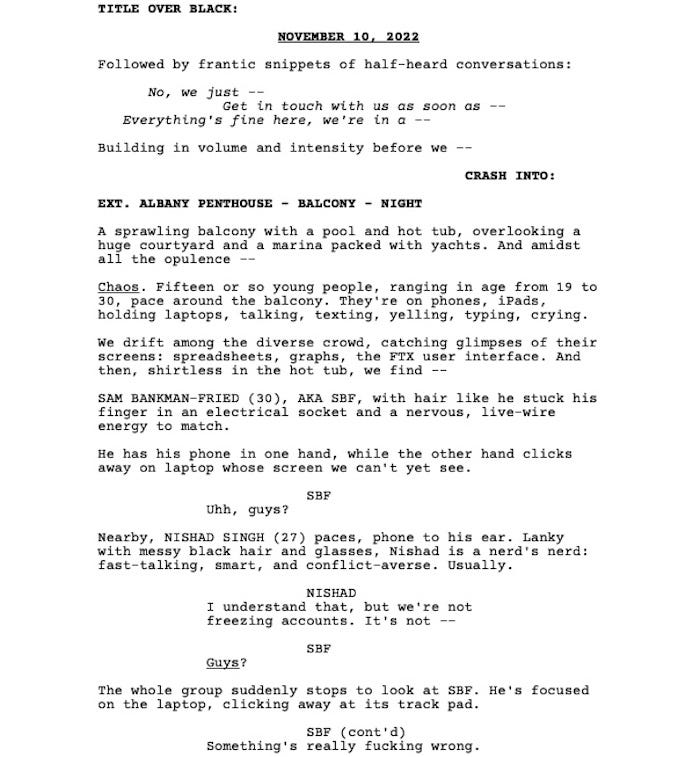
Scott: I’m still on Twitter and these flame wars that arise every, I don’t know, month or so over bolded slug lines. You stepped right in it with your bolded slug lines.
Jake: Man, I put image files in my scripts, almost all my scripts. I do texting by going to a fake text generator app, typing the words and then doing a screen grab. Why? I don’t know. I think it looks cool, man.
Scott: That page you were talking about, it’s page four, right? Where you’re doing these tweets from SBF what? And then he goes, HAPPENED. That’s the page.
Jake: That’s the day after he’d filed for bankruptcy, those were his first tweets. [laughs] When I knew I was writing the script, I was like, “I got to go screenshot all those before he deletes them. That’s incredible.”
Scott: You include images. I thought too, it was interesting because you’ve got these. Now, this is not untypical, these supers and chapter titles in a way, or sequence titles, I guess you would say if you’re a screenwriter, but you include the FTT valuation, which I thought was a very clever way of like, “OK, so we’re in the upswing here.” Do you remember what the thought process was on that?
Jake: It just felt like another way to give the audience information on what’s going on. I feel like I’m also a teacher and I feel like everyone’s brain works differently, and some people are going to understand all the crypto stuff and all the finance speak, and some people just need to see number go up and number go down, and that’s enough for them.
It’s serving the audience, and also I just think it’s a fun device, especially later on when Caroline accidentally comes out and names the floor of FTT that’ll wreck the company, and then you watch that number hover really close to it, and then you get to use it as a tool for suspense too.
Scott: One last little bit of business. There have been stories, just like “Social Network,” where they used those dual depositions in the present in order to jump back and forth between the present and the past. That conceit the narrative of a frame that you’ve got is not unconventional.
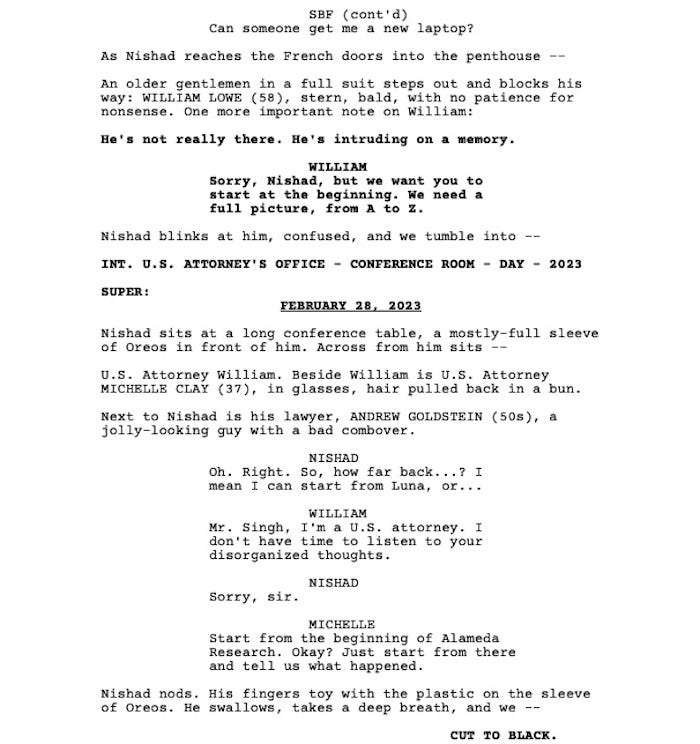
What is interesting is that you’ll have these moments in the past where these two lawyers, one or the other, or both, Michelle and William, just show up, [laughs] they’re there, in these moments. There’s even freeze frame things. Where did that come from?
You’re having fun, or it was an interesting way of plugging them in, or not having to go back to the present? I’m curious what your thought process was, because it’s a lot of fun.
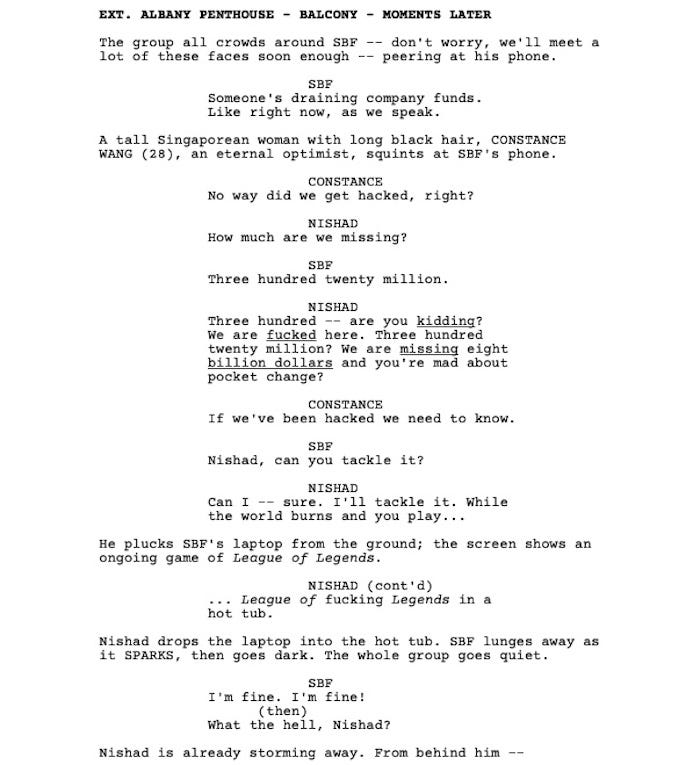
Jake: It’s all of those things. To me, the more fun you can have in a script that has this much pure dry exposition to get through, the better. Those tricks can be fun and funny, they can be little jokes. Some of them were just me venting my own frustration at the stuff I had to write, like the number of times I had to type “shitcoin” in the script.
They’re also a way to expedite things. Like, why cut back to a gray conference room when you can have a US attorney sitting in a hot tub in a full suit interrogating your character who’s trying to make out with somebody? That’s way more fun and interesting.
I’m fully aware we’ve seen the deposition before. I watched the Social Network like five times while I was writing the script. How do you do that differently? How do you spin it around in a way the audience hasn’t quite seen?
Scott: I thought that was a terrific little bit of inspiration on your part. Let me ask a few other craft questions. How do you come up with story ideas? Is it looking at the news or do you proactively try to generate story concepts? How do you do that?
Jake: I do it all. Yeah, I read a lot of news. I trawl through longform journalism websites a lot looking for inspiration, and I’m always listening to podcasts, historical podcasts, and current news, and anything deep-divey.
I do also write original stuff, and sometimes that’s a conversation with a producer that generates a story idea that we work on together, or sometimes it’s me getting mad about a thing or sad about a thing [laughs] and designing a story around that.
I think part of my job is just to always have my eyes open, and my ears open. You never know when the thing is going to fall out of the sky and land in your lap.
There are a lot of things that look like a thing and then aren’t. What I’ve really learned is that when I really latch on to something like I did with the NRA script, “Gunfight,” or with this, is to trust my gut.
I’m going to tell you maybe the saddest anecdote that I have about being a writer. This is my previous reps.
I was with my wife in Hawaii, now wife, then girlfriend. She’s from Hawaii, so we go visit every once in a while. She, in the morning, sends me this article on “Daily Beast.” She’s like, “You need to read this. This is a movie.”
I read the article in, it must have been 2019. It was about a guy in Oklahoma who owned a private zoo and had taken out a hit on a woman in Florida. I was like, “This is amazing. What an incredible story.” I sent it to my manager. I sent it to my agent. Their response was, “Animals are hard. No one will care.”
About eight months after that, Joe Exotic was the biggest television event of the early pandemic. Boy, I could have been out with a script right at the same time. That’s how you learn. It’s things like that that teach you to trust your gut when you really feel it.
Scott: I could put myself in the place of your agent and manager because there was that Cameron Crowe movie, “We Bought a Zoo” or whatever, that came out that just flopped, right?
Jake: Yeah.
Scott: They were probably thinking like that.
Jake: Animals are hard, man. No one wants to deal with tigers on a set. No one wants to spend money on a CGI tiger show starring a guy in a mullet, at least not until the Netflix documentary is a huge hit. I get it. But also, a great story is a great story. If you think it’s great, it’s probably worth tackling.
Scott: Let me ask you this. It’s interesting to say that you also write original material. It’s not just the historical things. Hollywood brands you. They tend to see you by what you’ve done. You go up for writing assignments, or that’s how they perceive you.
Have you experienced that as being stifling? Or do you feel like you’re so free to do material that isn’t just historically based content?
Jake: I haven’t found it stifling yet, I’d say. I do see people being put in that box, or whatever. What marks me, and hopefully what people remember isn’t just, “Oh, here’s a cool take on a true story,” but the tone of it as well.
I want to be light on my feet. I want it to be fun. I want it to feel like a party. That doesn’t have to be a true story. I will say that almost all of my work does also have some angle of social or political satire to it as well.
I can draw a line from “Gunfight” and “Adults in the Room” to a pilot I wrote last year that takes direct inspiration from various LA City Council scandals, but is otherwise entirely fictional.
I’m always drawing from the real world, even if I’m not basing things on real world stories. That also helps cover me a little bit. I don’t feel limited, but who knows what the future holds there.
If I ever want to write a high fantasy, three hour long epic, no one would probably be very interested in that from me.
Tomorrow in Part 6, Jake gives advice to aspiring screenwriters.
For Part 1, go here.
Part 2, here.
Part 3, here.
Part 4, here.
Jake is repped by Bellevue Productions.
@jake_disch
@jakedisch.bsky.social
For my interviews with dozens of other Black List writers, go here.