Interview (Part 5): Ian Shorr
My interview with 2022 Black List writer for his script The House in the Crooked Forest.
My interview with 2022 Black List writer for his script The House in the Crooked Forest.
Ian Shorr wrote the original screenplay The House in the Crooked Forest which landed on the 2022 Black List. Recently, I had the opportunity to chat with Ian about his creative background, writing a Black List script, and the craft of screenwriting.
Today in Part 5 of a 6-part series to run each day through Sunday, Ian talks about the experience of making the annual Black List and his thoughts about so-called screenwriting “rules.”
Scott: Your script, I have to say, man, you’re talking about a wild ride. It’s like a massive roller coaster through this specific realm of horror. It’s intense.
Here’s a question. How fucking hard was it to write this thing?
[laughter]
Ian: This was one of the harder ones I’ve ever done. One, it’s outside my wheelhouse. I’ve never written a period movie before. I’m good with world creation, but most of my world creation is stuff that I get to make up — the future, other planets, other dimensions.
If you’re writing something rooted in historical reality, there’s a lot of research that goes into that. Even more so when you’re dealing with something as loaded as The Holocaust. You have to come in from a place of respect. You can’t come in there having only gotten stuff from other movies. You have to hold reverence for the real people that went through this stuff, even if you’re just doing a crazy‑ass haunted house movie like this. Being respectful to history without turning it into a history lesson was the first thing that made it challenging.
The second is… you ever heard the term ‘gorilla in a haunted house?’ It’s a screenwriting rule that means “don’t double up on antagonists.” Being stuck in a haunted house is scary. Being stuck in a house with a gorilla is scary.” But if you combine them, one bad guy cancels out the other. The audience doesn’t know if they’re supposed to be afraid of the gorilla or the ghosts.
HOUSE IN THE CROOKED FOREST is, by design, a gorilla in a haunted house movie. Just replace the gorilla with Nazis. I had to figure out how to create a scenario where the two horrible antagonists didn’t cancel each other out, and it didn’t become just The Ghost Show or just The Nazi Show, but created a constant sense of escalating threat for the heroine.
So yeah, this was one of the harder ones.
Scott: Congratulations, it’s quite a piece of work, I’ll tell you. It made the 2022 Black List, but I should note, you made the Black List in 2011 with “Cristo,” 2013 with “Capsule,” 2017 with “Infinite,” 2019 with “10‑31.”
At this point, is it old hat to you? Like on Monday, the second Monday in December last year, were you paying attention to the rolling out of the Black List or not?
Ian: So much what we do as writers is invisible. It never makes it into the trades or the press, or gets any attention on social media. So anytime you get to see your name in the paper, that’s a fun day.
My experience with the Black List is if you get on it with a genre project, it lends your script an extra layer of respectability. Which makes it a lot easier to get a cast.
Whereas when we send the script out to people, we’re asking actors to commit X number of weeks to their life to a low budget, hard-R horror movie that’s going to shoot in some Eastern European middle‑of‑nowhere country in the dead of winter, for a fraction of the payday they’d get on a studio movie. So anything that can give the script a little extra attractiveness, it’s good to have that in your corner. Having it pop up in the Black List definitely does that.
Scott: Thanks again for the conversation about your script. I appreciate that. I want to get into some craft questions here because your script does certain things that are against the so‑called screenwriting rules. I always like to spotlight those because it’s just, I don’t like for people…I tell my students this, rules restrict, be creative.
For example, right off the bat literally the first paragraph. “Darkness blacker than the inside of your fist, all we hear is our own panic breath like being trapped in a coffin.” That’s great first couple of lines and immediately to that, you can’t use we see, we hear and all that stuff.
In the first page, “Our jittery POV. We hear heavy footfalls, our breathing gets stifled. Someone clamped a hand over our mouth to stop our scream and turns toward our hiding spot.” To me, that’s effective writing because you’re pulling the reader into that experience.
Maybe you could speak to that rule in general or what you were trying to accomplish by going in that direction of using we and our and on.
Ian: When I was teaching screenwriting, the thing that I’d always ask tell my students is: “What are you afraid of happening exactly? Are you afraid that if you write the words ‘we see’ that Syd Field is going to show up at your door with a gun? Will black helicopters besiege your house with Robert McKee coming down on a fast-rope if if you don’t type ‘fade in’ at the top of the page? I think that newer writers have a tendency to fetishize rules because it makes it seem less scary and random as a business. It means that if you follow enough rules, then someone will deliver you. And the thing that I wish I could tell every young writer is: a script that has wit and verve and audacity is always going to get more attention than a script that follows all the rules but puts the reader to sleep. That’s my soapbox speech for rules there.
To your point about that opening page, the intention there was I was saying earlier that I wanted to explore what it would be like to experience this horrible thing as a child since the movie is a two‑hander between Rivka and Hugo. I intentionally started the movie where the camera is the kid. We’re in Hugo’s point of view hiding with our mom in this ventilation duct and getting that sense of intimacy, like we’re being held and our ears being whispered into, and that there are these towering dangerous figures in the room outside of us who could spot us at any moment. I wanted to put the audience in the shoes of someone who is helpless, and I wouldn’t have been able to do that as effectively if I didn’t use things like “we see” and “we hear.”
Scott: First of all, when we run this as a series on the blog, I’m going to absolutely highlight that quote, because that’s what I tell my students all the time, same thing. Don’t be afraid. Audacity is a great choice of words there. Also too, that you’re speaking about emotion.
I had this conversation with Franklin Leonard. Franklin says, “People don’t go to movies for plot, they go because they want to feel something.” You used bold and italics and underline and any tool at your disposal, any of those typographical tools possible to highlight action, but also to highlight emotion. Could you talk a bit about that as well?
Ian: Absolutely. I’ve yet to use any emojis in my scripts.
[laughter]
Ian: I use a lot of bold, italics, underline, caps, double dashes, ellipses. I’ve been told that my scripts look like they’ve been vandalized. The thing that I’ve discovered is that a lot of those tools can be effective for creating emotional temperature.
In any given scene that I write, I ask “What do I want the audience to be feeling in the beginning, middle, and end of this scene, and what tools do I have at my disposal to guide those feelings?”
If I’ve got a scene that is supposed to be one of silence, stillness, and underlying tension, I’ll ease back on some of those stylistic tricks, but if I’ve got something that is supposed to be shocking, jarring, and full of kinetic energy, then I’ll play with any tool I’ve got available.
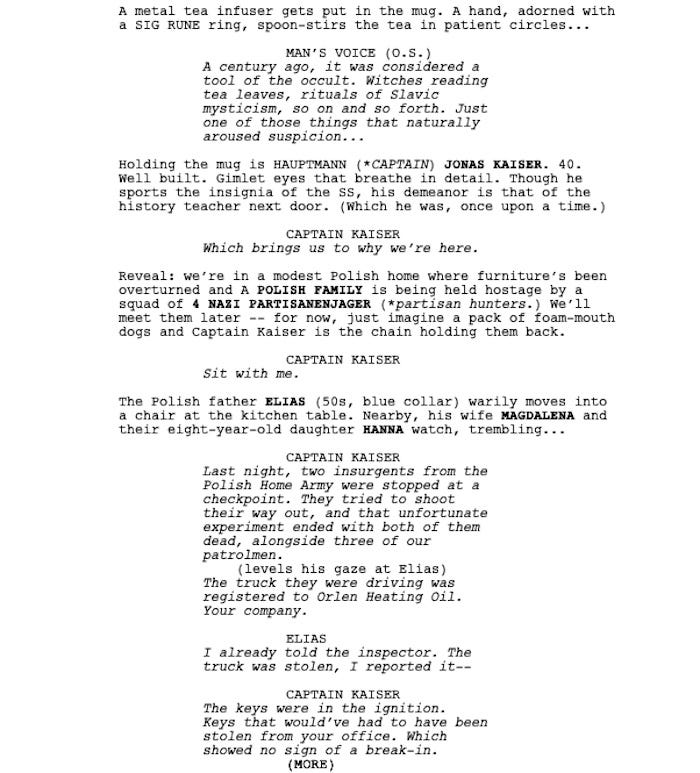
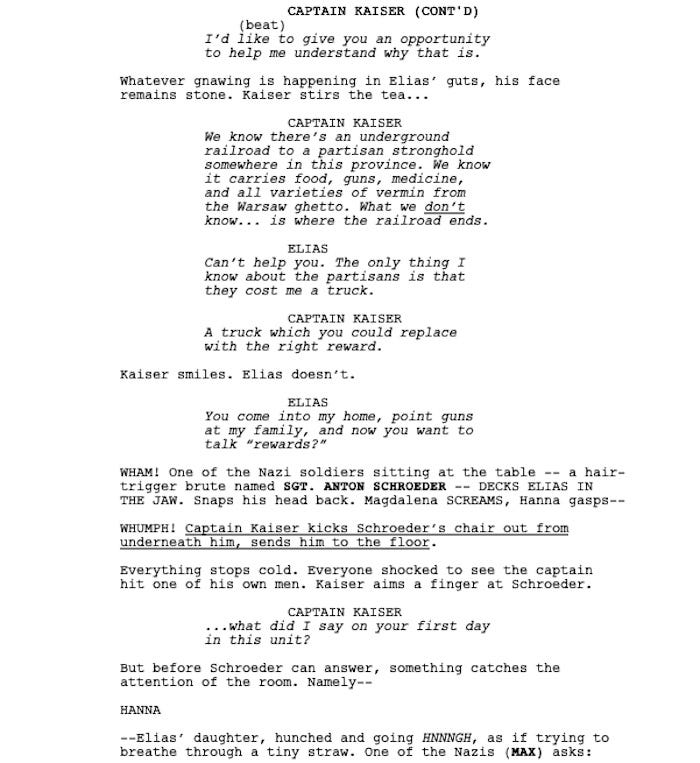
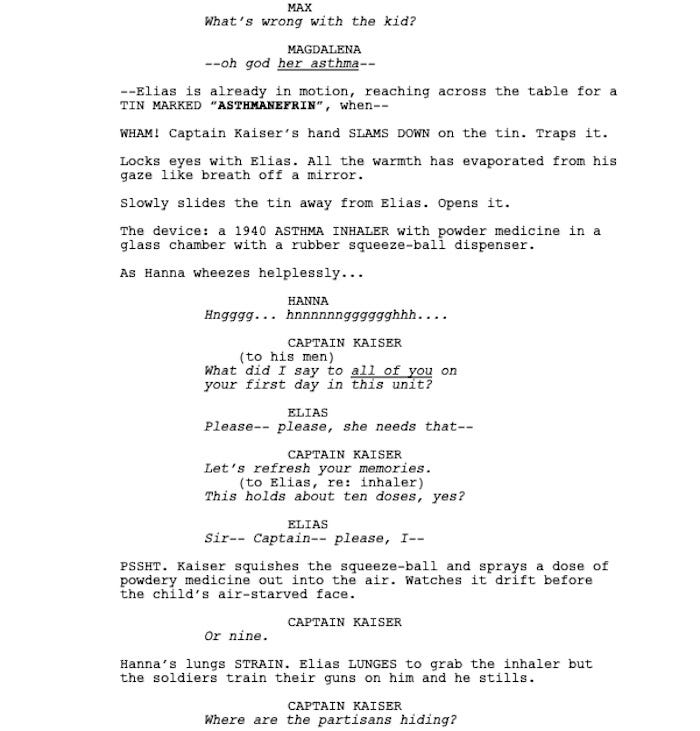
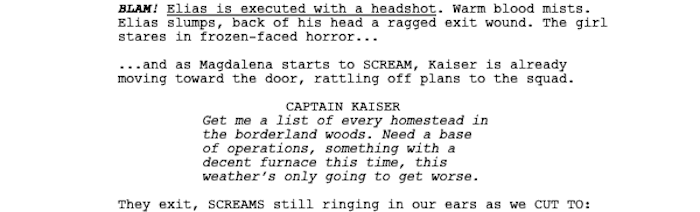
I asked Ian to select a scene from his script The House in the Crooked Forest. He chose the introduction of the story’s Nemesis: Captain Kaiser.



Tomorrow in Part 6, Ian offers advice on the craft of screenwriting.
For Part 1 of the interview, go here.
Part 2, here.
Part 3, here.
Part 4, here.
Ian is repped by UTA and Bellevue Productions.
Twitter: @IanShorr
For my interviews with dozens of other Black List writers, go here.