Interview (Part 5): Harris McCabe
My interview with the 2023 Nicholl Fellowships in Screenwriting winner.

My interview with the 2023 Nicholl Fellowships in Screenwriting winner.
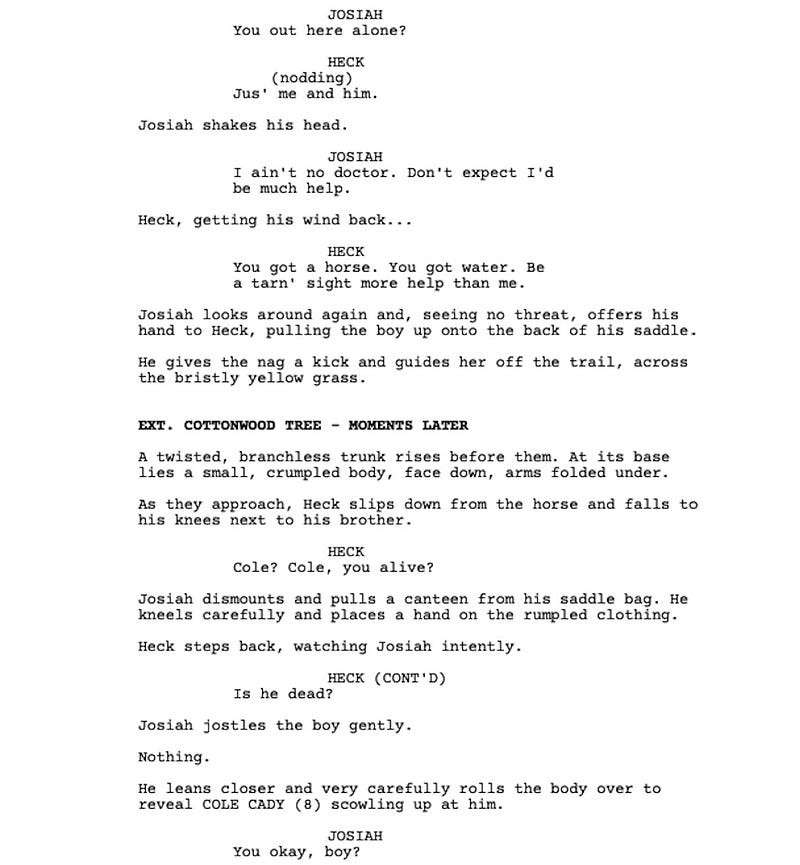

Harris McCabe wrote the original screenplay “Nat Cady’s Boys” which won a 2023 Nicholl Fellowship in Screenwriting. Recently, I had the opportunity to chat with Harris about his creative background, her award-winning script, the craft of screenwriting, and what winning the Nicholl Award has meant to him.
Today in Part 5 of a 6-part series to run each day through Saturday, Harris talks about his Nicholl experience.
Scott: It’s not just predestination. It’s not necessarily inevitable. In fact, you raised that point when the woman, Lenny, is that her name?
Harris: Mmhmm.
Scott: Offers them, “If you get rid of this revenge thing, you can hang out here.” That’s an option. Then later on, we see that replicated when Heck has an opportunity to kill Hoyer. And Hoyer has an opportunity to kill the kid, or take him in. They make choices.
Harris: Yep.
Scott: I’m going to talk to you about a couple more writing aspects of this. There’s this great moment in the middle of the story. This is after Lenny said, “You could stay here.” They debate this. As they’re talking about it, you feel like, “You know what, yeah.” Both of them are saying, “This makes sense.”
Then they just happen to stumble into this hanging scene that you were talking about earlier. What is so great about it is that’s a coincidence. As a writer, you go, “OK.” When I first broke into the business back in 1987, somewhere along the line, someone told me, “You only allow one coincidence that benefits you. That’s it, you can’t do anything.”
Harris: I’ve heard that. [laughs]
Scott: What you did was so great because Heck goes, “Wait a minute. The fact that they showed up, the guys that we’re going after just showed up here.” You’re basically saying, “I’m making the coincidence here as acting like fate.” Do you have any thoughts on that?
Harris: Then Cole being smart and pragmatic, immediately pushes back and says, “This isn’t a coincidence. We were looking for these guys. Of course, they’re near where we came to find them.”
It was a little bit of hanging a lampshade on that and calling it out a little bit. Trying to get away with what is a massive coincidence. Right when they’re about to go the straight and narrow, I throw these guys right in their laps, which was obviously a huge writer copout thing.
If you do it well, and you don’t do it often, you can get away with it.
Scott: Yeah. I always call back the Casablanca thing. Of all the lousy gin [laughs] joints in the world, she had to show up here. As long as you can name it.
A couple of other things I want to talk about. The dialogue. I didn’t live in 1882 in Wyoming. I have seen a bunch of movies and I read a bunch of books, but the dialogue feels really authentic to me. You lay in what I’m assuming is authentic jargon from the area, maybe not. Maybe you made it up, but it sure sounds like legitimate.
Could you unpack a little bit how you went about writing the dialogue and researching that, I suppose, too?
Harris: A lot of it is just I’ve watched a lot of Westerns. A lot of this probably is just me aping other movie dialogues. I read a Louis L’Amour book leading up to this. I read some contemporary accounts, news stories and dime novel-type stories, in the research I was doing.
This isn’t based in fact at all, but a lot of Nat Cady was based on a real guy who started off as a strike breaker and ended up making a lot of money working for cattle barons as a sheriff, basically as an outlaw for hire, as a thug with a badge. Then he got strung up by a group of citizens who were sick of his shit.
A lot of these people, Lenny and the other woman at the lodge…
Scott: Jon Jon?
Harris: Yeah, Jon Jon, were based on real people that I had read about, different real people. They were women who had their own entrepreneurships, and I thought that was really interesting.
I was reading a lot of contemporary news accounts or old things I found online that were from closer to the period. And I also did just look up all the jargon I could find. I love reading through dictionaries of slang and stuff like that. I was trying to keep it in that frame of late 1800s to early 1900s, somewhere in that area, but anything I could find from that period.
Sometimes I would love a phrase so much or a slang term that I’d be like, “You got to fit it in somewhere.” [laughs] I would write dialogue just to get to it, just to get it in there.
That’s one of the biggest changes on the second draft, was actually cutting out some things I loved. Just because you have these things that you love so much — these lines, these sequences, these words, or these scenes that work — you love them but they don’t fit, and you just have to say, “I love it, but it’s going to have to go to the boneyard because it doesn’t work.”
A lot of the jargon still made it in though. That authenticity, I think, really sold it.
I’m happy anytime anyone says that they appreciate the dialogue and that it sounded really effective and authentic because I didn’t do what I would consider an exhaustive amount of research, but I was trying to pay attention to that and trying to immerse myself in that way of talking, even if it was like Louis L’Amour, which is somebody from later trying to write in the period.
Scott: You mentioned Cormac McCarthy. I read that note. It has that feel. Actually, also, I don’t know if you’ve ever read the novel of True Grit, but Charles Portis has a similar rope.
Harris: Absolutely. They’re all back here somewhere.
Scott: I was going to say. Yeah, man, you’re a book guy. That’s great. Let’s jump to the Nicholl part of this. You use that maybe as motivation when you’re rewriting this or something. You always assumed that you were going to put it into the Nicholl?
Harris: No. Actually, I’m really dumb, and so are any of your readers out there who are writing scripts and not submitting them to the Nicholl. I’d been writing scripts for years and I don’t think I’d ever submitted one.
Honestly, most of the stuff I’d written probably wouldn’t have gone very far, but I also didn’t think this script would get very far. It’s only the fourth western, I think, that’s ever won?
A lot of times, you have an idea of what a Nicholl script is. It’s usually like a coming-of-age story or a drama, dramedy. The truth is that isn’t the case, especially recently. They’ve been honoring a lot of very weird, sometimes genre scripts.
I like working in genres. I like to be elevated. I like to really think about it and make it something original, but I am comfortable working in genres. Most of what I’ve written have been thrillers. I just assumed that wasn’t what they were interested in.
The year before I won was the first time I entered the Nicholl with the another script I wrote, a thriller, that I wrote in my script a month challenge, which I also thought was really good. I entered that because it was a little farther along.
I just entered it because I was like, “I think this is pretty good. It’s $50. Why not take a shot?” I didn’t know what to do with it otherwise. And it didn’t even make the first cut, but I got really positive feedback from the readers, which was confusing but also encouraging.
Then the next year, I worked on this and had it in a good place and said, “You know what? I know it probably won’t win, but I just want more people to read it.”
Every time it advanced a round, I was incredibly grateful, because like I said, I thought this was a writing sample that would be read by almost nobody. Every time another group of people read it and liked it, that was like its own little victory.
Scott: What was the Nicholl week like for you, that experience?
Harris: It was amazing. The thing that surprised me the most, and the thing that was my favorite part about it was meeting the previous fellows and getting welcomed into the family, and really understanding that it’s a very tight-knit community that is looking out for each other and giving each other advice. Everyone’s at different stages in their career.
Even people who have been in the industry a while may still be trying to get where they want to be. Obviously, the new people have less experience and less exposure, and are trying to figure this all out.
It’s like you got somebody who won last year taking you under their wing. You also got somebody who won 20 years ago offering to give you some advice, take you out to lunch, whatever. That was great.
They offered a lot workshops, which were great. Going to USC, we got a lot of instruction from professionals on how to do things, so some of it was repeated, but even the stuff that I’d heard before, it’s always great to hear it again and get reminded of these pieces of career advice. But also, a lot of it was new information as well.
The worst part was the ceremony because we had to get up and speak in front a room full of people, this huge theater full of people. Most writers are a little bit introverted. I don’t think any us were thrilled about the public speaking. For the record, we all nailed it, but it was definitely…
I think there were a lot of butterflies until we finished giving our speeches and got to sit back down, and then it was smooth sailing.
Scott: Did they do a live reading, too?
Harris: They did. They asked me to pick a couple of scenes. Then reading my script, I realized there weren’t a lot of scenes where characters had a lot of dialogue back and forth.
I can’t remember what the second scene I picked was, but I felt like I only had two options. The one that they chose was my first choice, which was when Heck wakes the martial up in the middle of the night with the axe and thinks he’s going to kill him, and then decides not to.
The actors were phenomenal. They did a great job. Every scene, was great. It was really incredible.
Tomorrow Harris shares some thoughts on the craft of screenwriting.
For Part 1, go here.
Part 2, here.
Part 3, here.
Part 4, here.
Harris is repped by Entertainment 360.
For my interviews with every Nicholl Fellowships in Screenwriting winner since 2012, go here.