Interview (Part 5): Haley Bartels
My interview with the 2021 Nicholl Fellowships in Screenwriting winner.
My interview with the 2021 Nicholl Fellowships in Screenwriting winner.
Haley Bartels wrote the original screenplay “Pumping Black” which won a 2021 Nicholl Fellowship in Screenwriting. Recently, I had the opportunity to chat with Haley about her creative background, her award-winning script, the craft of screenwriting, and what winning the Nicholl Award has meant to her.
Today in Part 5 of a 6 part series to run each day through Saturday, Haley talks about what being selected as a Nicholl Fellow has meant to her.
Scott: Let’s jump back to your Protagonist Taylor. It really is a character-driven story in that the plot is pinned to the choices Taylor makes and the actions he takes. This is not a unity arc. His arc is one of descent.
In that regard, Taylor stands in the tradition of characters like Jack Torrance in The Shining, Travis Bickle in Taxi Driver, or Charles Foster Kane in Citizen Kane.” Using the language of Carl Jung, each has a pronounced shadow, an impulse toward the dark side, and eventually their shadow swallows each of them. Does that resonate with you in terms of Taylor’s psychological journey?
Haley: 100 percent. It’s the first movie that I’ve ever written like this. I consider myself a really optimistic, hopeful person. A lot of people might think that that’s antithetical to the script that I’ve written. Even more so than the shadow, I was thinking in terms of the world that we live we live in now, where it feels like so many people who cheat to get ahead, really do get ahead.
We’ve seen this in politics recently. Names will not be named. I don’t want to pollute my interview with that person’s name. There are these people who do unforgivable things, and they’re never punished for it. The optimism of the script that I wrote is this person makes an unforgivable choice, and he is not forgiven. He is not redeemed.
I’ve gotten a few notes that are like, “Oh, can we change it so he wins, but he loses?” Or, “Can we redeem him?” No, we can’t. That would be the cynical ending. That people who cheat will get away with it, or people who cheat will win. The optimistic ending is if you cheat, if you lie, you don’t get to walk away with that trophy.
Scott: That’s why I was saying, a morality tale.
Haley: Exactly.
Scott: This guy has descended into the dark side. Never have the last three words of the script worked better than, “Smash to black.”
[laughter]
Scott: Again, terrific script. What’s the status of the project at this point?
Haley: Taking meetings. I just started working with management. I got a bunch of outreach after the Nicholl. There’s only so much that I can do on my own. I’m so lucky to have Sam (Warren) and Joe (Cavalier) over at LBI Entertainment helping me and guiding me now. And I recently signed with Verve on the agency side as well.
Some hands have been raised for it. Our plan is to hit the ground running in January, see who comes out of the woodwork, and try and get this baby going.
Scott: Do you have aspirations to direct at any point, or no?
Haley: People keep asking me that. It’s not something I would ever say no to. I definitely see it out there, and am intrigued by the prospect, but it’s not something I want to do immediately. The person that I keep citing as my directorial career path inspiration is Aaron Sorkin.
I would like to do what he did. Establish myself as a writer’s writer. Get as good as I can possibly get. Learn as much as I can learn. Then at some point, I’ll probably write something where it’s like, “Oh, this one is my baby. Please don’t take it away from me. I gotta direct this one.”
Maybe I’ll have some shorts or some episodic under my belt by then. That’s off in the distance. I want to get really, really good at writing first.
Scott: What was the Nicholl experience like? I know it was a little different this year because of the pandemic.
Haley: Of course, we wish we could have gone to the live read, had the banquet, et cetera. It was still so lovely. They put together a fantastic program for us during Nicholl week. They had us in Zooms all afternoon.
We met with some WGA people. We met with a bunch of writers and previous Nicholl fellows, people who had had their scripts produced, and people who have been surviving and thriving in the hamster wheel of Hollywood for the past 10 years. It was great.
My main takeaway about why winning the Nicholl is so special is not just the prize money and the recognition, which are great, but the network of people, a network of these…I think there are 171 Nicholl fellows, and we all have each other’s email addresses now. That’s really cool.
Everyone has been so kind and supportive. The previous fellows were like, “I’m so sorry that you had to do this in a pandemic. Please reach out if you need anything, if you need help, because we will help you.”
Scott: Did you have representation before the Nicholl?
Haley: I did not at the time that I won the Nicholl.
Scott: Congratulations again. I know some Hollywood folks who are really into cycling. Maybe one of them can champion this project and help get it made.
Haley: Thank you. Gosh, I would love it. I would love it. Both my parents, especially my dad, would be so happy.
Scott: Yeah, you can get them to have little parts in there in the background riding their bikes or something.
Haley: That would be so cute, actually. Note that. OK. I’m going to put that in my rider.
Scott: Let’s do a few craft questions and begin with this basic one: How do you come up with story ideas?
Haley: The example that I gave for this is a perfect one. Riding my bike, brain did a whoopsie, “Oh, there’s something there.” A lot of it is just sort of the brain soup, the content that’s in the brain soup, like a piece of mythology will collide with a character that I meet at the grocery store.
A lot of it comes from playing video games, reading books, watching movies, going to an art museum, going to a play, walking around in the street, and just trying not to really think too much. Just letting the little thoughts just sort of collide with one another.
Scott: I’m going through Stephen King’s book on writing again for my blog doing this weekly thing. He talks about, ideas are like fish floating past, and you stick your net out every so often, and you catch them. They’re there all the time. It’s just about at some point sort of dipping in there, and finding them.
Haley: I love that. There’s another really beautiful metaphor, I don’t know who said it, but it’s about — and I’m going to butcher it — it’s something like, inspiration is like a butterfly. You can’t force it to land on you, but you can make your brain a beautiful garden, where it would want to land.
Scott: Oh, wow. That’s nice. I like that a lot. You come up with an idea. Now you have to assess it. What are the elements that you do, in terms of saying, this is something I really want to write?
Haley: Oh, gosh, yeah, that’s a great question. I mean I’m going through that now because the Nicholl is…
Scott: You’ve got to write a script.
Haley: I’ve got to write a script. I have my story journal that they make us start at AFI, and it’s now like hundreds of ideas deep, but the one that I think I’m going to go with is the one that I feel like makes me feel something in my guts.
Whether that’s sadness or hope or anger. I think the one that I can sort of feel that kind of visceral fire for is usually the one that I go with.
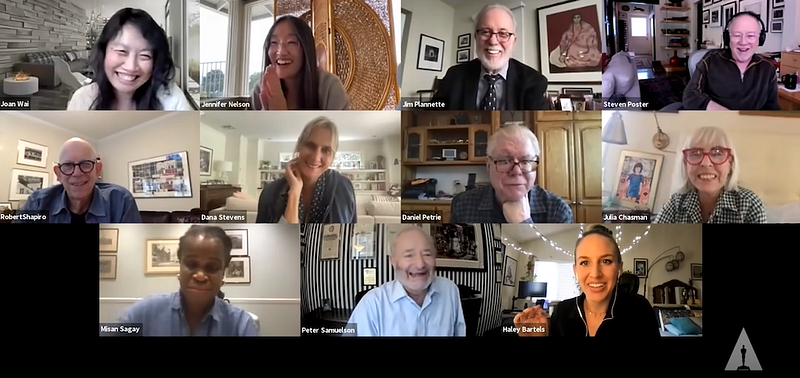
Here is a video clip in which the Nicholl committee tells the 2021 Fellows they have won this year’s award.
Tomorrow in Part 6, Haley answers some craft questions and offers advice to aspiring screenwriters.
For Part 1 of the interview, go here.
For Part 2, go here.
For Part 3, go here.
For Part 4, go here.
For my interviews with every Nicholl Fellowships in Screenwriting winner since 2012, go here.
For my interviews with Black List writers, go here.