Interview (Part 5): Gillian Weeks
My interview with 2022 Black List writer for her script OH THE HUMANITY.
My interview with 2022 Black List writer for her script OH THE HUMANITY.
Gillian Weeks wrote the screenplay OH THE HUMANITY which landed on the 2022 Black List. I had the opportunity to chat with Gillian about her creative background, writing a Black List script, and the craft of screenwriting.
Today in Part 5 of a 6-part series to run each day through Sunday, Gillian discusses how she landed on the specific comedic tone for OH THE HUMANITY.
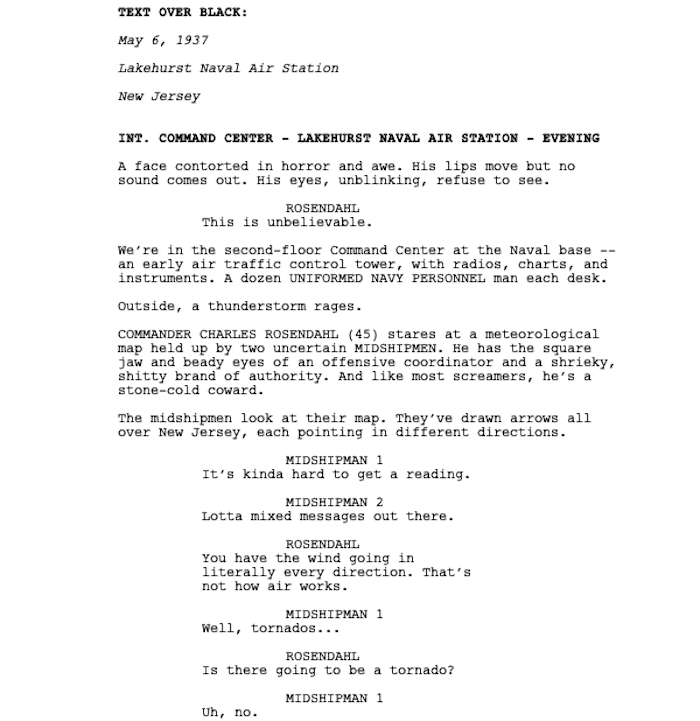
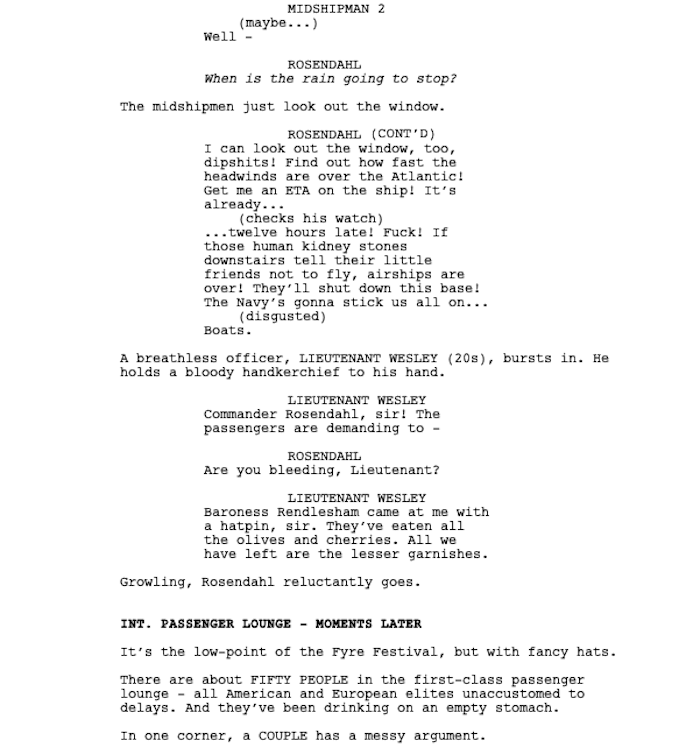
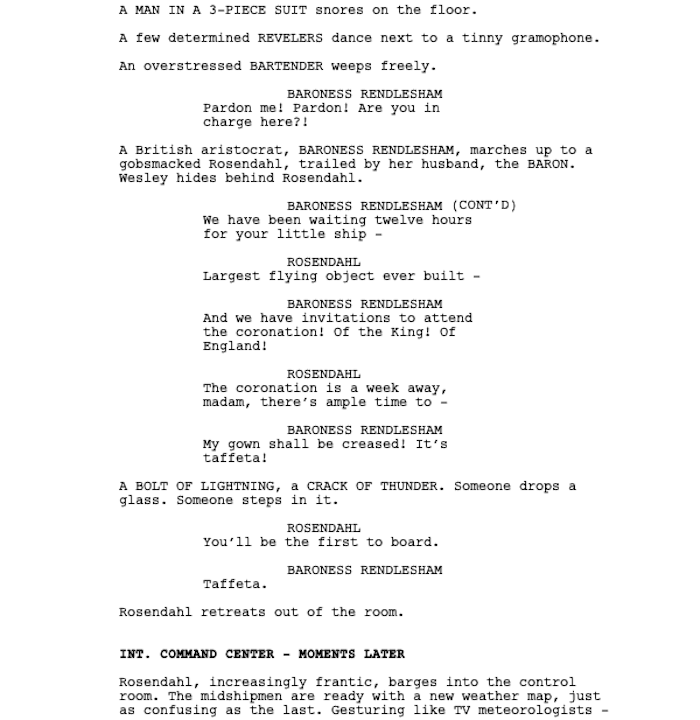
Scott: I want to talk about the comedic tone. It’s such a variance about humor. Your narrative voice. For example, when you introduce the nurse Rivero:
“Nurse Rivero, 40s Puerto Rican, the unfuck with a bold word supervisor.”
Then there’s slapstick moments:
“Karl and Hugo are wrestling over a swastika pin which Karl’s trying to force into Hugo’s lapel. Hugo gets poked.”
How did you sort out the comedic tone of this thing where you felt like there was a consistency to it? Was it a trial and error thing, or did you have that in mind right from the get-go?
Gillian: Two important things. Very directly on the tone — it starts as a comedy with a fair amount of laughs. Then, it’s like boiling a frog, where by the end of the movie, we’re in a pretty dark, earnest place. We’re talking about the Holocaust by the end. I wanted to slowly shift that over time so that we would accept the gravity of those moments at the end.
The other important thing to point out is how the script was developed. It all started with three sentences about this idea in a general meeting with some producers from 21 Laps.
Scott: 21…Shawn Levy’s…
Gillian: Yeah. I developed both the polio movie with them and this one, at that same time. I pitched them three sentences because it truly was all I had at that moment. They were like, “This is really interesting. Let’s keep talking about it.”
I worked with them hand-in-hand, over a long period of time, to develop it. They got the rights to book that it’s based on.
They felt that a pitch for this feature, without a director, wouldn’t sell. I would have to spec it. But before I spec’d it, I wanted to write a treatment. But instead of writing it as a dry document — because treatment are really awful reads — I set out to write it as if it was a “New Yorker” article. A lot of those descriptions that you just read out loud, those were from my treatment, because I wrote it in this very literary style.
Then, when I sat down to write the whole script, I wrote it incredibly quickly because I knew exactly what I wanted to happen in every scene and how it would feel, and the tone of it.
That’s not to say that there’s many drafts of it, but of all the things that I’ve now written, it’s probably seen the least amount structural change. Because we’d worked hard on that treatment, going into it.
Scott: When you pitched the three sentences, was the dark comedy aspect of it included in that?
Gillian: Yeah. At the end of my first general with them, Dan Levine, who’s the president of 21 Laps and a very smart guy, he said, “We’re sort of interested in very timely historical pieces. What else do you have?” I said, “Well, I’m pretty sure that Hindenburg blew up because of a bunch of bureaucratic bullshit from the Nazis. I feel like that could be funny.” [laughs]
That’s where we began. Then, we found the book.
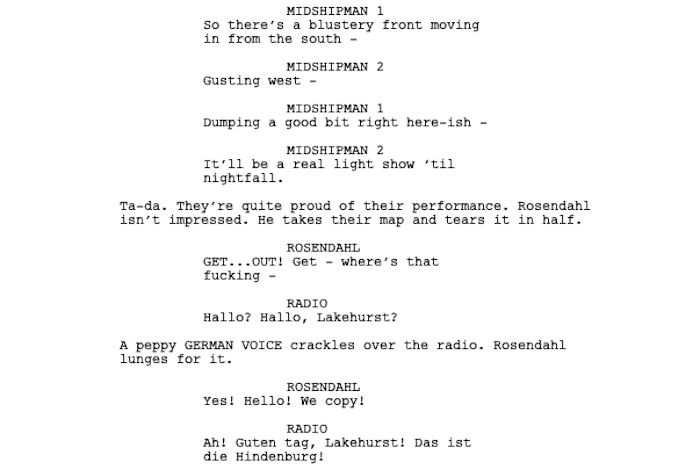
Scott: I want to talk about one more thing about your choices, and that’s the dialogue. You normally think, World War II, that era, German, they’ve got this sort of a vicious… [laughs] Goebbels is like, “The Reich has many enemies and sabotage is a far more appealing story than ‘Oops!’”
It’s like a bunch of Americans talking in 2023. Where did that come from in your thinking?
Gillian: Let me talk about comps for this movie and where it might fit in. One that lived most in my head was “The Death of Stalin” — I love Ianucci, and that film was extraordinary to me. The balance that he struck with the comedy and the truth of Russian mass incarceration and murder. I thought it was quite perfect.
The other one was Jojo Rabbit, another Black List script and the way that that also injected a lot of comedy into this very dark chapter. Those two were definitely in my head. Both of those scripts use modern language to depict that era.
I didn’t want to go too far. There were definitely lines in there that we pulled back where the language felt too anachronistic. It’s a tricky balance, but I feel like there’s now enough precedent, that people are used to watching historical pieces that feel a lot more modern.
Scott: Jojo Rabbit does provide a nice bridge for you.
Gillian: Yeah.
Tomorrow in Part 6, Gillian talks about the unique challenges of writing an historical adaptation.
For Part 1 of the interview, go here.
For Part 2, go here.
For Part 3, go here.
For Part 4, go here.
Gillian is repped by The Gersh Agency and Entertainment 360.
Twitter: @gillmw
Instagram: @thegillface
For my interviews with dozens of other Black List writers, go here.