Interview (Part 5): Filipe Coutinho and Ben Mehlman
My interview with 2021 Black List writers for their script Whittier.
My interview with 2021 Black List writers for their script Whittier.
Filipe Coutinho and Ben Mehlman wrote the original screenplay “Whittier” which landed on the 2021 Black List. Recently, I had the opportunity to chat with Filipe and Ben about their creative background, their script, the craft of screenwriting, and what making the annual Black List has meant to them.
Today in Part 5 of a 6-part series to run each day through Sunday, Ben and Filipe share their thinking why they included specific songs in their script and their appreciation for the movie (500) Days of Summer.
Scott: There’s all this conventional wisdom about screenwriting, and so much of it is just not wisdom. It’s just convention. “Don’t include song titles in the script.”
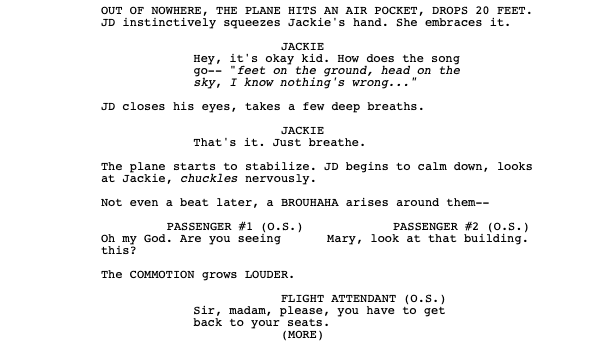
You got songs all throughout “Whittier.” You got, let’s see. It starts off with a quote from “Break On Through” by the Doors, Talking Heads, “This Must Be the Place,” Miles Davis, “Blue in Green,” Yoko Ono’s “Walking on Thin Ice.”
What was the thinking going on there in terms of using these songs? Thematically, you chose them for a specific reason and just sort of embraced it?
Filipe: Both Ben and I are tremendous lovers of music. I think it’s part of our identity in one way or another, how we relate and see the world. And we also believe in crafting a unique experience for the reader.
People talk a lot about music cues in scripts, that the music supervisor and the director will be the ones to choose them and all that. That’s fair enough, but we don’t see it quite that way. It’s different parts of the filmmaking process, and we’re focused on the writing. If you’re reading our script, we want you to experience what we’re experiencing. We want you to feel what we’re feeling. Of course, we’re not going to be lazy. If we put a song in the script, it’s not going to substitute atmosphere or feel or vibe. We’re still going to do our best to convey that through words.
Scott: The script you turned in for the lab, you have the links?
Ben: Yeah, we want the reader to have the option to listen to the song as they read the script with as much ease as possible. It’s the job of a screenwriter to bring the film to life as much as possible.
A lot of “convention” notes are just excuses to not give someone a real note. There’s no world that if someone actually thought a script was viable they would give two shits about a hyperlink or a photo that appears in it.
It’s about making the best thing you can.
Filipe: I think it’s also about specificity. Ben and I try to be as specific about details as possible without being overbearing. I think music plays a part in that. The script opens with “This Must Be The Place”, and it’s not just a vibe. It actually plays within the scene.
We could have simply written that JD is listening to a song, but that’s not as fun. Choosing the song allowed our characters to talk about it. It was a way that Jackie found to connect with JD. By engaging with him about David Byrne. If you just wrote he’s listening to music, we couldn’t have done that. For us, that’s more real, more like life.
Scott: I’m with you guys. If you got an asset, why not use it? Music is an asset. I tell my students, as long as there’s a point of dramatic connection or your understanding, it adds some understanding to the characters, go ahead and do it.
You should meet Scott Neustadter and Michael Weber because when they write, they talk music all the time. Have you met them?
Ben: No, we haven’t.
Scott: OK, because that’s all they do. Every day is talking about music. [laughs]
Filipe: I think we’ll get along. “(500) Days of Summer” is probably the most influential soundtrack of the past couple of decades.
Ben: Not only that, for our opening montage we studied the “(500) Days of Summer” script. We looked at it as a great example of creative inter-cutting and screen-splitting.
That’s another example of taking influence, almost out of necessity. Asking ourselves where to find creative montage influences and it just so happens that their postmodern rom-com was perfect for our neo-noir.
Scott: Real quick, I want to talk about your Black List lab experience, because that’s where I met you all. How meaningful was that experience for you, working with your fellow “labsters” and having that whole Black List support system?
Filipe: Transformational. It took our career to the next level. For one, we ended up finding a manager after the lab. Matt Rosen, who’s an incredible guy. And very, very creative. It’s so important to have the right representation, and we really found that in Matt, who was more than happy to take the swings we wanted to take.
He’s also one of the major reasons as to why we made the Black List, because he got us meetings with the people who ended up voting for our script.
The other great part of being in the lab is that we ended up forming a movie club, and a year and half later, we still meet every month without fail. Each person chooses a movie, and then we meet over Zoom and discuss it.
Scott: These are the lab people that you’re with?
Ben: Yeah, we have a movie club. We have one a week from Sunday.
Scott: Yeah, that’s awesome.
Ben: I think it’s good to hang onto the pearl moments in your career. By that I mean the special moments that can help get you through the tougher times. Working with our mentors, Beau Willimon; Jack Thorn; and Elliott Owen, were definitely examples of pearl moments and honestly, you too Scott. You compared us a lot to Shane Black and all the creative work he’s done, which was incredible to hear.
Having those positive moments with people you respect are irreplaceable.
We have a whole jewelry box from the lab. Sometimes when people ask or think about those events it is in the context of only focusing on what it did for your career. Which it did a lot of amazing stuff, but it also put a lot of renewable fuel in the tank.
Tomorrow in Part 6, Filipe and Ben talk about what it meant for their script “Whittier” to make the 2021 Black List and provide some thoughts on the craft of screenwriting.
For Part 1 of the interview, go here.
Part 2, go here.
Part 3, go here.
Part 4, go here.
Ben and Filipe are repped by Matt Rosen at Rain Management.
Twitter: @filipefcoutinho, @Ben_Mehlman
For my interviews with dozens of other Black List writers, go here.