Interview (Part 5): Filipe Coutinho
My interview with 2023 Black List writer for his script Patsy.
My interview with 2023 Black List writer for his script Patsy.
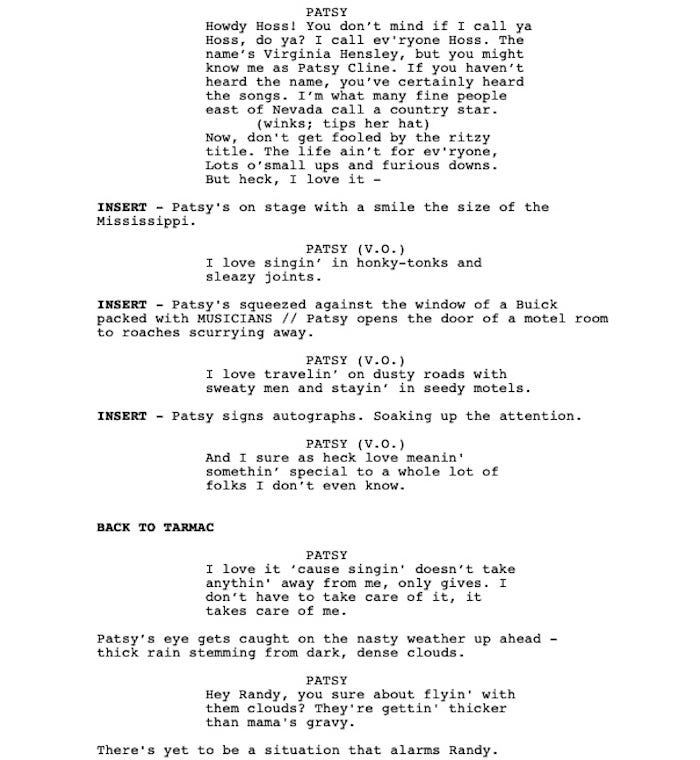

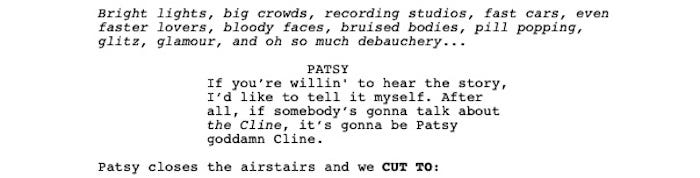
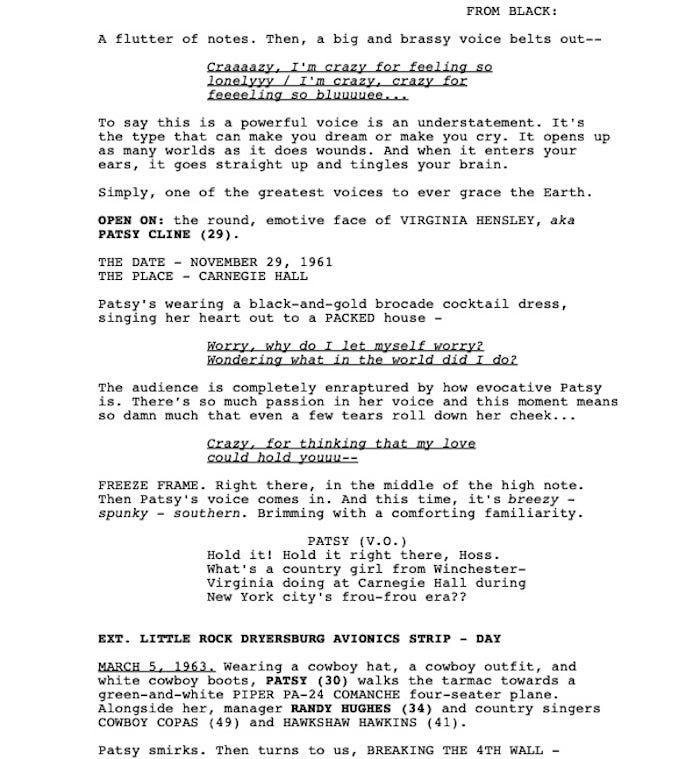
Filipe Coutinho has made the annual Black List three times: In 2021 for the screenplay Whittier (co-written with Ben Mehlman), 2022 for Jambusters, then in 2023 with the screenplay Patsy. I had the opportunity to chat with Filipe about his creative background, his latest Black List screenplay, and the craft of screenwriting.
Today in Part 5 of a 6-part series to run each day through Sunday, Filipe reflects on how music is key part of his creative process and shares advice on how to approach writing a biopic.
Scott: Next, let’s talk about what I call narrative voice. When we talk about “scene description “ or “stage direction,” the same thing, both terms sound so antiseptic. I’m reminded of that quote from William Goldman: “Screenplays don’t have to read like an instruction manual for a refrigerator. You can write them as a pleasurable read.” You got moments in your script where it’s like you’re saying to the reader, “Hey, we’re having a conversation here.”
For example, this excerpt of scene description:
“In fact, this would be a good time to tell you that Patsy, LOVES SEX, more than that, she loves fucking. She’s very good at it, too.” And so, maybe you could talk about that narrative voice that emerges in your scene description.
Filipe: I think I was trying to keep up with Patsy’s energy. Not overshadow her, but service her energy. I try to bring a distinctive narrative voice to every script, but there are still things that are uniquely mine. I just felt like this was merited, especially being a period piece. It can be the type of script that a lot of people would not be interested in and I was hoping that if the writing feels fresh, and it moves, and it has personality, then maybe it’ll keep people reading. I do think, again, it’s all in the service of who Patsy is in this story.
Scott: Trying to keep up with her energy. It wasn’t just an arbitrary choice on your part. It really was more reflective of her personality. Maybe that also extends to this, the last of these three points.
When you describe her as she’s turned 19, you have her earlier on, you say early 1952:
“Patsy, 19, five foot four, brown hair, sparked with brown eyes is now a woman every man would take a second look at. She wears jeans, dangling earrings, a tight‑fitting sweater with a gaudy color, red lipstick on her lips and lots of makeup. Her drawing card is a smile that’ll hog‑tie any man around.”
My friend, Brad Riddell, screenwriter and teacher, tells his students: “Screenplays are actor bait.” As a writer, you’re trying to attract actors to roles.
Obviously, Patsy Cline’s life is compelling, but even the way you introduce her character in scene description spotlights her appeal to a prospective actor.
Filipe: Yeah, I also want to give credit where credit is due, and that description is a mesh of several things that I read in the books about Patsy Cline and how other people talked about her. For me, the job was also how to best describe this person based on the people who actually knew her and how they thought of her.
Scott: I got two last things. One on the script, and then I have a couple of craft questions for you. You mentioned bittersweet when you talk about the ending and it is bittersweet. Do you think it’s a tragedy or is it something else?
Filipe: I like to say that I think Patsy Cline lived more in 30 years than most of us will live during an entire lifetime. I come from a country, Portugal, that has a poet who used to say that, “It’s not about how long you live. It’s about the intensity with which you live.”
I understand that. We all want to live as long as possible, but we never know when it’s our time to go. We hopefully try to make the most out of it every day. I can say with confidence that Patsy made the most out of her every day. I’m hoping that the script’s final scene shows that. And that’s why I have those flashes as “Sweet Dreams” is playing, as an homage to a life well-lived, despite everything.
I think that Patsy did the best she could with what she had, and she was unapologetically herself. She was an amazing person. I really admire her as a human being. She was the best friend someone could have. She was a great daughter, a great mother. She tried to be the best wife that she could be. I admire her relentlessness and joie de vivre. I’m hoping that those final moments, despite the tragedy that ensues, will get people to take something positive from her life.
Scott: It’s an excellent script and I hope it gets produced. Let’s end with a couple of craft questions. When you were approaching this story, how did you break this story? Did you use cards? Or some other form of higher technology?
Filipe: [laughs] I don’t use cards. I use virtual cards, if you will, but not from any screenwriting software. I use Google Drive a lot, and notes. What I do is, as I’m reading something, I’m taking notes. In this case, I actually went further. I summarized the entire Ellis Nassour book. Then I started building the structure. I would be like, “I want to show her going on the radio for the first time. I want to hit the Arthur Godfrey show. I want to show the accident.” Basically, I started by structuring the big moments, where I want to start and end, and then I slowly filled in the blanks.
My process is very chaotic. It suits how my mind works. It’s very organized, but in a way only I understand [laughs]. If I gave you my notes, you’d be like, “I don’t know what to do with this.”
Scott: You mentioned earlier that you wouldn’t have written this script “Patsy” unless you had a unique angle on it or ‑‑ I’m paraphrasing ‑‑ something that you wanted to say. That conjures up the idea of theme to me. Theme. How do you work with that?
Filipe: I think a lot about it because I think it’s the most elusive thing in screenwriting. It’s the thing that actually tends to change the most. This is a little different because again, it’s an adaptation. I’m looking at someone’s life in its entirety. It’s something that already exists. Something that’s already in front of me. I’m looking at an incomplete puzzle. All the pieces are already there, and it’s my job to figure out how they connect at a thematic level.
By the time that I tackled the actual writing of the script, I knew that my north star was always going to be Patsy’s voice. Every scene in some manner has to do with how either she loses her voice, or superimposes it, or tries to gain it in some way. That was the process.
Scott: I’ve known writers who’ll create a soundtrack for the project. They’ll put together various songs. Given “Patsy” is such a music-heavy project, I’m curious: Did you create a soundtrack to accompany you in your writing?
Filipe: Absolutely. I can’t write without music. I’ll create a new playlist for every new script. It’s just a very easy way for me to get back into the feeling of a project.
I’m someone who needs to have a certain feeling in order to write in a certain tone, and because I tend to write different things, sometimes it’s very helpful to have a specific vibration in my ear. Also, music with lyrics doesn’t bother me and it doesn’t distract me, which I know isn’t the case for a lot of people.
In this case, I have a Patsy Cline playlist, which is mostly comprised of Patsy Cline songs, but it also has a lot of other country tracks. I also have a larger country music playlist, which is comprised mostly of classic country, from the early days all the way up to the late ‘60s.
I would alternate between those two playlists while writing this script. Whenever I have to do a rewrite of that script, which I’m sure will come, I will fire that up. [laughs] I’ll get back into that mood, into that feeling. Anything that can help me transport back into that world.
Scott: All right. here’s the last question. For writers out there, they’ve got a historical figure and they think this character would make for an interesting movie. What advice would you have for them in doing essentially a biopic? Are there any top of mind the things that they should be concerned about or maybe even one piece of advice about how to approach a biopic?
Filipe: I think the number one thing is, which is true to not just biopics but to any story, why do I want to tell this story? I really do think that, more than it being a cool thing to do, more than it being a famous person that you have access to, there has to be some sort of personal connection.
I would just advise people to try to do a little bit of armchair psychology on themselves and to understand why they connect with the person they want to depict? What do they say about you as a person or as an artist? Why do you want to embark on this journey? What do you bring to this story that will help other people see this person in a different light?
For me, it’s all about the personal touch and the personal connection. And to bring it all back, just make sure you’re really passionate about it.
For Part 1 of the interview series, go here.
Part 2, go here.
Part 3, go here.
Part 4, go here.
Filipe is repped by Rain Management.
Twitter: https://twitter.com/filipefcoutinho
IG: https://www.instagram.com/filipefcoutinho
Letterboxd: https://letterboxd.com/fifeco/
For my interviews with dozens of other Black List writers, go here.