Interview (Part 5:) David L. Williams
My interview with 2022 Black List writer for his script Clementine.
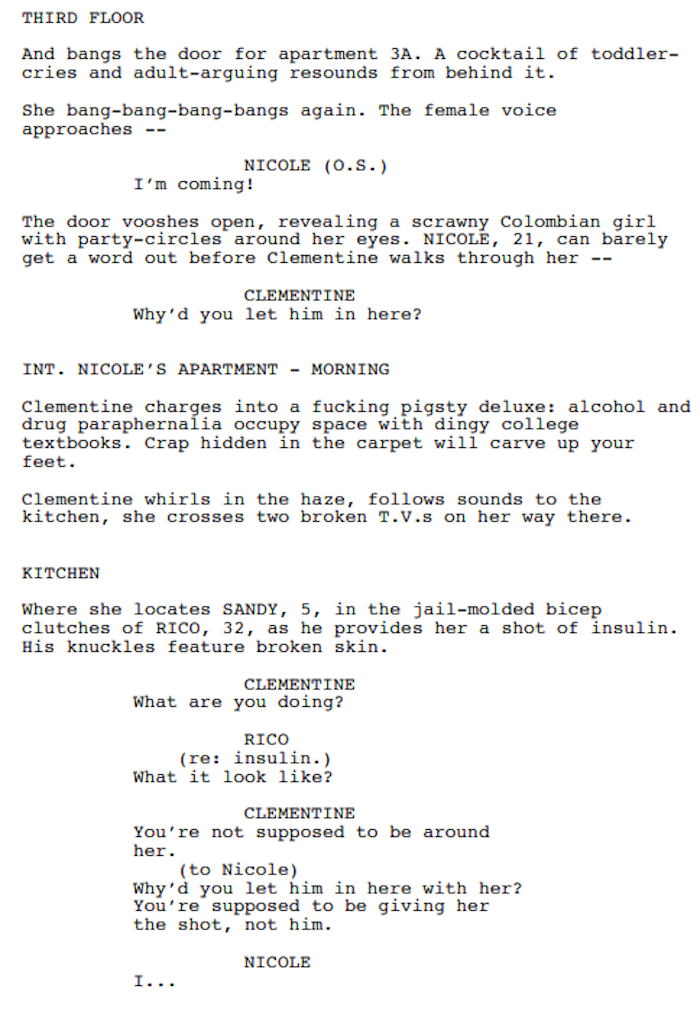
My interview with 2022 Black List writer for his script Clementine.
David L. Williams wrote the screenplay Clementine which landed on the 2022 Black List. I had the opportunity to chat with David about his creative background, writing a Black List script, and the craft of screenwriting.
Today in Part 5 of a 6-part series to run each day through Sunday, David answers some screenwriting craft questions.
Scott: Again, congratulations on the Black List. I highly recommend people, they get a hold of the script Clementine through the nefarious underworld of screenplays floating around out there.
David: [laughs]
Scott: I’d like to ask you some craft questions. Apart from reading your friend’s script, and, all of a sudden, having a what‑if idea like, how do you come up with story ideas?
David: Great question. It’s not that fascinating. It did just come to me. There are cases where, especially before I got signed, and I was by myself floating through space, say I had four or five ideas that I really liked. Whichever one was the simplest, is the one I usually gravitated towards.
Whichever story I felt like could tell itself, it’d be a canvas that allows me to complicate the characters and the situations a little bit more. That’s how I come up with ideas. It’s pretty rare that I ever sit down and go, “Man, I need to come up with story ideas.” They just show up, and I go from there. I see if they’re a good fit for me, if they’d be easy to tell, and fun to write. That’s also a huge factor, because I love the feeling of writing.
I’m very passionate about putting words into a screenwriting software, and making a screenplay exist. Whichever story gets me the most excited is the one I gravitate towards.
Scott: I have all these little screenwriting mantras that I’ve come up with over the years that I like to bother my students with. One of them is: Screenplay. Simple plot. Complex characters.
David: There you go.
Scott: You know what, it’s to your credit, Clementine, having that simple plot nowadays, when there’s…first of all, it’s really hard to get original material made, as you know, right now in Hollywood, because Hollywood’s addicted to preexisting content.
To have that simple thing that they can market, they’re like, “Hey, this is what the movie is about.” Boom! To get through the noise to consumers. I’m assuming you know that the story concept, or you think or believe, the story concept’s pretty damn important to the success of a spec script or a project.
David: Totally. 100 percent.
Scott: How do you go about breaking a story?
David: Great question. What I’ve realized is that sometimes it might be different from script to script, but I am in the camp of people who don’t outline very much. I don’t dislike outlining. If someone asked me to do it, if my reps or an exec, I’ll happily do it. I have no issues whatsoever with outlining.
When it comes to doing my own original stuff, and this is just a weird thing about me, it almost feels like the more I know about the intricacies of the story, the more I lose interest in it.
One of the only things I try to figure out is the mood and the tone, because I’m a very visual person. Sometimes, just like with Blade Runner, it was really the aesthetic that really drew me in.
I’m always thinking about, “OK, what’s my tone? What’s my feel? What are the movies that are in the same wheelhouse? Am I leaning more towards Drive, or am I leaning more towards Green Room or something like that. Then I try to sort out who my protagonist is. I try to sort that out as well, and also the side characters, how quirky do I want them to be, or that kind of thing.
Then, once I have those elements, I start thinking about the act breaks pretty early, especially the break between act one and act two, what really sets the story in motion. I know that a lot of people struggle with that too, but that’s one of my strengths, is act two. That’s what I look forward to doing the most, is really exploring the conceit.
I’m really big on the story beats, the general beats of the story. If I have a really good sense of how I transition from one beat to the next, if I even know the first, say, 30‑something pages of the script really well, I’ll start writing, I’ll start sorting it out as I go. This is the case for a lot of the scripts that I write.
Clementine happened super quickly. It happened in a day, I had the whole story sorted out. Usually, it could be days or weeks, sometimes months. Now that I’m busier, it can be…I do know what I’m going to write next, it might be a couple of months before I get to it. I sort out the act breaks after I know what I want to write, and I know the protagonist.
I do everything like it was in beats. I try to get from one beat to the next. When I’m writing, I jump back in the middle of the story beat, and then I try to get through the next one. Maybe I’ll cover two or three story beats in a day. It’s a step‑by‑step process for me.
Scott: Do you ever find, you go, “Story beat, story beat, story beat. Oh, this is a dead end. I guess that didn’t work.”
David: Yeah, that definitely happens. When that does, I’m happy to step away. I take a step back and I just let it come to me…I always feel like it’s going to sort itself out. I don’t try to rush things or force things. Also, I typically don’t go with the first idea. It’s usually the fourth or fifth or sixth idea by the time it’s being written, because I want to make something that feels unexpected.
Scott: “Let’s kill my protagonist on page 60 and see if…”
[laughter]
David: Seriously, man.
Scott: Do you use index cards? Word doc? How do you organize your thoughts?
David: Fantastic question. You know what’s funny, I don’t use index cards, I don’t use any whiteboards or any cork boards or anything. Even this is rare, but on occasion, I do write some character bios, but it’ll be one or two of the main characters, typically.
Basically, everything is in my head, all of the time. It’s in my head until I start writing the actual script, which might be crazy. The thing about it being in my head is, it’s like, if I forget it, it probably wasn’t worth remembering. If it somehow stood the test of time with my jumbled mind, there might be something to it.
This is also why the simpler, the better. A lot of times I get caught up trying to tell very intricate stories and try to outline them. When it’s only in your head, you don’t have a choice but to simplify them. For me, it is all in my head.
There is one exception where, again, it’s also rare, but I can think very clearly of the moments when I’ve done this, where if I don’t know what happens exactly in my first 10 pages, 10 or 15 pages, I won’t start the script, no matter what. I have to know, down to every minute detail, what’s happening in those 10 to 15 pages.
There are occasions where if it’s too foggy, I will sit down and try to outline the first few scenes. That will allow me to sort that out and then I’ll start the script.
Scott: Do you have an interest in writing TV?
David: Yes, totally. That’s why Roberto Larios is on my team, he’s a TV agent [at Verve].
Scott: You may have to adopt a little bit different approach there, because…
David: You’re right. I’m working on a pilot right now, and my manager and Roberto asked for the outline. These pitches that I’m developing are all written. I’m adaptable. I can handle it.
No, it’s a fair point, especially in TV. They want to see outlines for everything.
Tomorrow in Part 6, David provides some advise to aspiring screenwriters.
For Part 1 of the interview, go here.
Part 2, go here.
Part 3, go here.
Part 4, go here.
David is repped by Verve and Gramercy Park Entertainment.
Twitter: @storytellerdave
Instagram: @davidgem
For my interviews with dozens of other Black List writers, go here.