Interview (Part 5): Daniel Hanna
My interview with the 2021 Nicholl Fellowships in Screenwriting winner.
My interview with the 2021 Nicholl Fellowships in Screenwriting winner.
Daniel Hanna wrote the original screenplay “Shelter Animal” which won a 2021 Nicholl Fellowship in Screenwriting. Recently, I had the opportunity to chat with Daniel about his creative background, his award-winning script, the craft of screenwriting, and what winning the Nicholl Award has meant to him.
Today in Part 5 of a 6 part series to run each day through Saturday, Daniel shares his thoughts about having been selected for a Nicholl Fellowship in Screenwriting and the short film Shelter, which he wrote and directed.
Scott: I’ve got two more things to talk to you about the script, and that’s one of them is how you approached it thematically. There’s something I thought you did that was interesting from a structural standpoint. Again, if you think about conventional wisdom, whatever that means, about screenwriting, oftentimes more of a convention than wisdom.
There is this idea, end of Act Two, All Is Lost, a major reversal. You did something interesting. What happens at the end of Act Two is Petra does a confession, she tells the story of what happened to her. It’s not really a huge reversal.
It’s a reversal in the sense that she’s being honest about it, but it happened in the past. It’s not like it’s happening right now. That’s not your conventional All Is Lost. With what you’ve done or what the script is, at least, the way I interpret it, is you pushed that All Is Lost into the Final Struggle, the end of Act Three.
Where you’d having this present experiences horrific situation involving Midnight, and the past that are bouncing back and forth. I don’t know if A, that resonates with you. B, whether that was something that was intentional, or C, whether it was something you felt. You knew that ending all along, or how that emerged. Do you have any thoughts on that?
Daniel: That’s a great observation. I also love your statement “more convention than wisdom.” That’s a great way to put some of that formula stuff. Where it came from really is at one point, very early draft, I had a different ending. I had a much more tragic ending.
It was always still the same climax and reversal and low point because Petra is at a moment where she’s on the verge of blowing up everything that she’s done, everything she’s trying to achieve and completely regress. If that were to fully play out, she’d be a tragic character structurally in every sense. She’s going right up to the brink of that.
Because I had toyed with these different outcomes for her, the script has a little more of a tragic structure. In a way, where you would normally have the end of the second act and have the low point, you have the opposite, her achieving most of what she needs to achieve, because of the impending tragedy to come. She has to reach a high point so that when she gets hit with these new obstacles she can be thrown into a spiral again.
That makes it a bit of a structural hybrid, I guess. But your audience doesn’t know if your story is a tragedy or a comedy in the Shakespearean sense. If you reverse engineer everything and change everything based on changing the ending, that is putting convention over wisdom in the sense of you’re not taking people on this story’s own singular journey. It would make it too formulaic.
Scott: That’s what’s so impressive about it is that it does shift the convention for the character and her journey. It’s like let’s be character-driven here. The character drives. You don’t know how it’s going to end.
I have to ask you about this because this is where that ankle bracelet, the beep, beep, beep thing. I don’t know whether you were thinking this at all, but it reminded me of that crazy scene in Boogie Nights where the three guys show up to make a drug deal. The firecracker dude, the beeps were playing. Was that an homage, or were you thinking…
Daniel: It’s not an homage, but I love that. It’s like a nonstop escalation. I take that as a big compliment. That’s such a great scene.
Scott: When you’re at Cannes, and the French reporters ask you, “Was this moment an homage to Boogie Nights? You say, “Oh, yeah, I was thinking that all along.”
[laughter]
Daniel: All along.
Scott: The second thing I wanted to ask you about because this story could have so easily fallen into melodrama. It could have been such a theme heavy approach, we’re talking about abandoned animals and kill shops.
First of all, let me compliment you on how you avoided veering into melodrama. Second, how cognizant were you to avoid, “I’m going to hammer people over the head with we should take better care of our animals.”
Daniel: First of all, thank you. That’s always a fear in writing something like this definitely is that you don’t push it over. Some of it comes from rewriting, too. It comes down, I guess, to taste and a metaphorical gag reflex, so once it gets a little bit maudlin or a little bit preachy, you feel like you’re going to gag and you cut it back.
That’s why Molly was so challenging, too. It’s because, in order to try and justify her worldview, it was easy to go “let’s have Molly give a speech of the five reasons why having a no-kill shelter won’t work and will actually be worse for the community or for the animals” in order to try and justify who she is. But that’s preachy.
So it’s working it over and over and over, cutting it back too much, and then adding back one line, etc.
Scott: It’s very nuanced, even the very ending. The last image is nuanced. Anyhow, congratulations on that. Speaking about congratulations, let’s talk about the Nicholl experience. What was that like?
Daniel: It was fantastic. They are, first of all, the nicest people involved in that whole committee. One of the other fellow mentioned this, too. They tricked us twice because when they announced we were finalists, and then winners. Both times I thought I was going to be interviewing, justifying my script or defending my thesis, that kind of thing.
Both times we get on individually, and they would say, “Well, you are finalists,” or, “Oh, you won.” It surprised me every time. Obviously, I was so thrilled to just make the finalists. First of all, I couldn’t believe it because it’s so competitive. With this script specifically, getting to talk with the people that made the decisions and that thing, it really…
This was a hard script to write. It put a lot of wind in my sails and made me feel like it has some real value. Then, we had a week of conversations. Then Destin [Daniel Cretton] too. That was amazing. I watched Short Term 12 when it first came out, which was a Nicholl-winning script.
For me, that was the connection. This guy wrote the script, and he got the perfect platform. He got a little bit of money. He started his career, made a different feature first with the Nicholl winnings, as I understand it.
Scott: I Am Not a Hipster.
Daniel: Exactly. If you look at Short Term 12, too, it’s a tonal inspiration. It’s a drama in a difficult world that has a lot of humanity and interesting characters. It’s a different approach and different stories, obviously, but I thought this is a good balance that he struck and that shows that you can live in the real world, and you can still have some levity and still have some of that when dealing with a difficult subject matter.
Scott: What’s the status on “Shelter Animal”?
Daniel: I have a new manager now, Joel Millner, and we’re pitching it. We’re looking at companies and looking at people interested in dog or animal stories, especially, actresses and producers.
Now that we got the stamp from the Academy, we wanted to get it read. Like you mentioned, there’s some really strong female leads in this that I think could be a blast to have three and four amazing women duking it out in the story.
Scott: I know in the conversation you had with Destin, you said, “Let’s just assume you’re going to direct this.” Is that still the assumption here? You’ve gone out there, it’s like…
Daniel: For me, I very much want to direct it. I directed a short film version of it, too. I wasn’t sure if you knew about that.
Scott: No.
Daniel: That was a few years ago. For me, I really want to…
Scott: Is that on YouTube?
Daniel: It’s on Vimeo. I’ll send it to you.
Scott: Please do.
Daniel: I would love to direct it, but we’re aiming really high first. If some huge, amazing director, if Steven Soderbergh wants to shoot and edit and direct it as he does, then I would maybe turn it over. If not, then I want to.
Here is the short film Daniel referred to: Shelter.
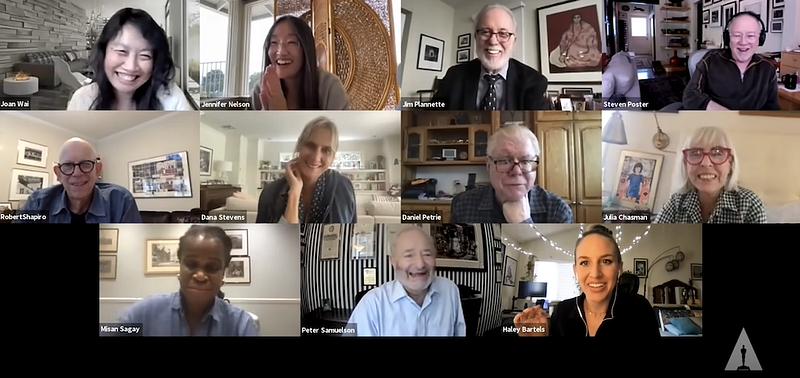
Here is a video clip in which the Nicholl committee tells the 2021 Fellows they have won this year’s award.
Tomorrow in Part 6, Daniel talks the craft of screenwriting and provides advice for aspiring screenwriters.
For Part 1 of the interview, go here.
For Part 2, go here.
For Part 3, go here.
For Part 4, go here.
For my interviews with every Nicholl Fellowships in Screenwriting winner since 2012, go here.
For my interviews with Black List writers, go here.