Interview (Part 5): Chris Parizo
My interview with 2023 Black List writer for his script Kazan.
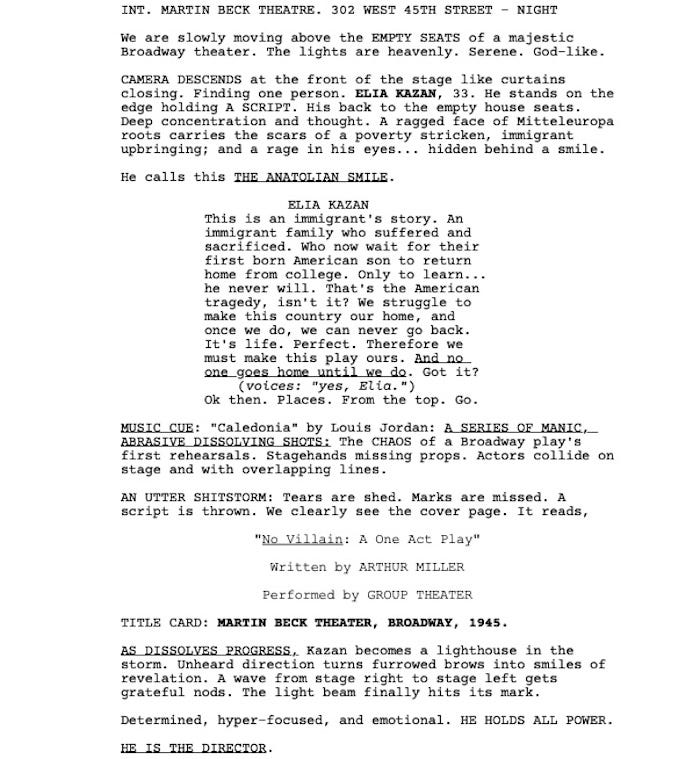
My interview with 2023 Black List writer for his script Kazan.
Chris Parizo has made the annual Black List two times: In 2020 for his script Viceland, then in 2023 with Kazan. Recently, I had the opportunity to chat with Chris about his creative background, the craft of screenwriting, and the challenges associated with writing a biopic like Kazan.
Today in Part 5 of a 6-part series to run each day this week, Chris answers some screenwriting craft questions.
Scott: It really is just such a tragic chapter, and not only Hollywood history, but American history. The script you’ve written, the way it ends, because they get together again and they have it out, these two guys. Let me read this exchange between the two of them in your script.
Kazan says, “I beat the Communist Party. I beat McCarthy. I dodged the Blacklist, and I won. I won it all.”
Then Miller says, “McCarthy didn’t create the Blacklist. Hollywood did to protect itself from outsiders like you. You sided with your oppressor, and they awarded you for doing what you always do as you were told. You destroyed careers, ravaged friendships, ruined families.” And Kazan is quick to snap back “Who ruined yours?” The story really is tragedy, isn’t it? It’s almost like Charles Foster Kane.
Chris: It’s a man who gets everything that he wants, and loses everything that he needs and doesn’t realize that until the very end.
He loses all the people who got him there, and all the people who stood by him. Through all of it, he loses them all in the end to get the golden statue. Then when he looks in the statue, he sees his distorted face. And is capable of kicking his best friend down even more when seeing him at rock bottom. One last time to ensure his place at the top.
Scott: That’s great.
Chris: There’s a little Velveeta cheese in there. I think for me that was the end. That was the moment. That was where Miller got to be able to say the Hollywood machine created the blacklist to protect itself. It didn’t need to exist.
It was literally just everyone getting on their knees to McCarthy and saying, “Please don’t cause problems. Don’t ruin me!” Kazan was just a puppet in this whole time period. He did the dance. He sang when he was told to sing. He thought he was standing up for himself, but in the end, he was doing exactly what he was told to do. He got his reward for doing it, like a mutt.
Just like the entire Hollywood industry was at the time. Protecting itself.
Scott: It’s it reminds me of that Bible verse, “Beware the man who finds the kingdom, but loses his soul.”
Well, it’s a terrific script. What’s the status on it? It might be a little dicey, I think, because you’ve got Nick Kazan and Robin Swicord…
Chris: I kept that in my mind. Obviously, John and I were very aware of dealing with Hollywood royalty, the names that were attached to this and the family lines that are still doing this.
“At Close Range” is one of my all-time favorite movies, and directed by one of Kazan’s kids, I think he directed it or did he write it? Directed it. I can’t remember. Sean Penn, Madonna’s music, it’s amazing, but so in my head. I was like, “I do need to honor this guy. And damn him at the same time” The script, I think, is it’s on people’s desks. We’ll have to see.
I tell John that I don’t want daily updates. I want to get that golden email someday.
Scott: At the very least, what you call in Hollywood, a great writing sample.
Chris: Thank you.
Scott: Let’s segue into some craft questions for you. You did mention that you’ve been working on or exploring doing some more biopics. Is this a case where, like Hollywood does, they tend to brand people. You did a biopic. “Oh, so you’re Mr. Biopic now,” or is this more reflection of the fact that you really like writing?
Chris: I don’t mind. If I get pigeonholed as a biopic writer, I’ve got no problem with that. It is my niche. I’m going all the way back to my literary analysis. The research is my favorite part. I enjoy digging into a person’s life and trying to mine out a three-act story structure.
Someone said, I think it was Jon Silk, the producer and a friend of mine now who I met through Viceland said, “God doesn’t write in three acts. That’s why you have to.” That’s what he told me. I was like, “Yeah. That’s it.”
I really enjoy adapting. I really want to be an adaptation guy. I don’t come up with good ideas on my own. Every now and then I’ll get a little one that I think is interesting. For the most part, I want to be the person that people send IP to and say, “Hey, what would you do with this?”
I don’t want to waste my time, or my manager or agent’s time, coming up with scripts that people don’t want to make. I want people to hand me packets of things saying, “How would you do this and we want to make this?” I’m like, “Let’s do it like this. Let’s take it in this direction.”
If there’s a great nugget or a great story out there that needs to be told or people should know about, I’m all about that and it doesn’t bother me to be that person.
Scott: I was very impressed with a lot of the script, but two things I wanted to talk about in terms of craft. You’ve got these time jumps, a bunch of them.
You mentioned that Act One is maybe two years. Act Two is maybe five weeks. Act Three is maybe three to three years. Those transitions that you do, they’re seamless. A lot of them are, the standard pre-laps and that sort of thing, but there’s a lot of visuals that you…
You don’t shy away from that so-called rule. It’s not like camera angles, but it does feel very directorial in some respect, because there’s a lot of visual writing there. You maybe talk about your philosophy on that and how you use that to help make these transitions seamless.
Chris: My method if I have a method — I don’t know if I have a method of writing — is I sit at my desk all day long playing games and reading articles, and then go play Xbox for a little bit. Then when I lie in bed trying to go to sleep at night. I start visualizing the movie and I lay in bed for an hour-and-a-half or two hours just picturing the movie. Every night. Until I see it. Like it already exists.
Even before I start writing it, or an outline, I’ve watched it a hundred times in my head, and I start to think about, how do I move from 1947 to 1952 without the typical newsreels or the, “Oh, here’s all the major events,” and how do you break that cliché?
Sometimes those are the last things I write because I don’t know yet. I don’t know how it’s going to work, but for the most part, what’s just really important is to make sure that when that scene ends, we are moved into the exact opposite.
The way that Kazan moves from Act One to Act Two is, Kazan tells Miller he’s leaving for California, and Miller’s left looking out at the New York skyline at night, and he cries.
Then the next thing is, I think it’s DeMille in his darkened office and complaining about the immigrants to LA and who are infiltrating his beautiful…
Scott: Domain.
Chris: Yeah, who is storming his castle, and he’s got a stuck curtain and he’s trying to move the curtain to let the light in while talking about pushing people out.
Then finally when he rips it down and the light pours in, it’s Hollywood and you’re just like, “Oh, here we are,” and then Kazan’s at the top of his game essentially. I always try to go from sounds or go from opposites, like light to dark, quiet to loud.
Those are just simple ways of letting your audience know that you’re moving somewhere else or moving forward, or something like that.
Anything but the calendar being ripped off the wall. Anything besides that.
Scott: Maybe the sound thing is a reflection of the fact you were in a band for six years and you love music clearly.
Chris: I put music in every script. Every script I write has music. “Mutt” was all about like ’80s and ’90s, left-of-center college radio, and then Viceland was punk and hardcore.
That’s another part that I really enjoy about screenwriting, is I make a playlist about that time period, and I just listen to it constantly. I guarantee you, they’re public. If you go to Spotify and search “Kazan soundtrack,” you can find all my songs are in script.
Scott: All right. I’m going to check that out.
Chris: All those are in there. Sound is big. I love music, and I love doing stuff like that. Finding new music through writing.
Scott: I’m happy to hear this. Yet another person is basically saying, “These so-called rules,” because that’s one of them, right? “No, you can’t include actual song titles in scripts, because they got to have the…” It’s just bullshit.
Chris: It is bullshit. Anything you can do to get the tone across, do it. Just do it. The song that’s playing when Miller shows up to Kazan’s House in LA is this wonderful song that I had never heard before called, “If I Knew You Were Coming, I Would Have Baked a Cake,” which is the perfect unspoken feelings in that room.
You just read the title, or hear it from the screen, and think, “Oh, I know how everybody in this scene feels.” They’re all like, “Hi, great to see you. Why are you here?” Music, man. Break every rule you can to get that tone, to get that feeling on the page. Break them all.
Scott: One of your fellow 2023 Black List writers, Filipe Coutinho, who I actually worked with as a mentor in a Black List feature writers lab, his script, “Patsy,” which is about Patsy Cline, he actually embedded hot links in the script where you can go and click on it and you can hear Patsy singing “I Fall to Pieces” and other songs.
Chris: Oh that’s so cool. I had a script set up over at Baha Productions that is a horror take on “Spinal Tap.” It’s a documentary about a band who ‘s like the opposite of the Grateful Dead. People don’t follow them. They go nowhere. People go to them, and they don’t come back.
I put hotlinks in that script to comparable music because I didn’t know if anyone in Hollywood would know what I was talking about when I described the music as “grimy, sludgy, Norwegian cacophonic death metal dirge on quaaludes.”
All that stuff’s fun, and I’ve seen scripts now where they actually put visuals in to show you the setting and pictures of characters, which I would never do, but none of the rules are set in stone. So if some screenwriter decided to do it, fuck yeah.
Format’s going to change. Just like the English language and literature, it changes over time, with the time, and things change. Scripts will do the same. Especially with technology. It will have to.
I have a feeling in a couple decades, a screenplay will be an AI-created video format or something that you’re watching versus reading. Who knows?
I have no idea, but the way we do it now will be dead. Me too, probably.
Scott: This idea that there are these rules… No. There’s expectations, conventions, but rules are so restrictive. I hate that word when it’s applied to any creative activity including screenwriting.
Chris: Movies are going to be filmed in virtual reality. There’s going to be a time where we’re going to be wearing headsets and be in theaters with friends all around the world.
That’s going to happen.
We’re going to be looking around like this with our friends, and at a horror movie where the killer’s sneaking up behind us, that’s how we’re going to find out, when we turn around. And we’ll have to scream for everyone to turn around.
The seeds are already out there for that format. The new Apple VR headset has a movie theater built into it. You can put it on and see it in a movie theater like this. It’s all going to change.
If we stick to sluglines and fade-in/fade-out, and, “Don’t put that on there, they’ll stop reading it.” This format is temporary. You have to keep up with it. If we don’t keep up with the tech, we’re going to get left behind.
But then… sheet music hasn’t changed in centuries, so maybe I don’t know what I’m talking about.
Tomorrow in Part 6, Chris offers his best piece of advice to aspiring screenwriters.
For Part 1 of the interview series, go here.
Part 2, go here.
Part 3, go here.
Part 4, go here.
Chris is repped by Bellevue Productions.
chrisparizo.com
https://www.imdb.com/name/nm8446483/
www.slamdance.com
For my interviews with dozens of other Black List writers, go here.