Interview (Part 5): Charmaine Colina
My interview with the 2024 Nicholl Fellowships in Screenwriting winner.

My interview with the 2024 Nicholl Fellowships in Screenwriting winner.


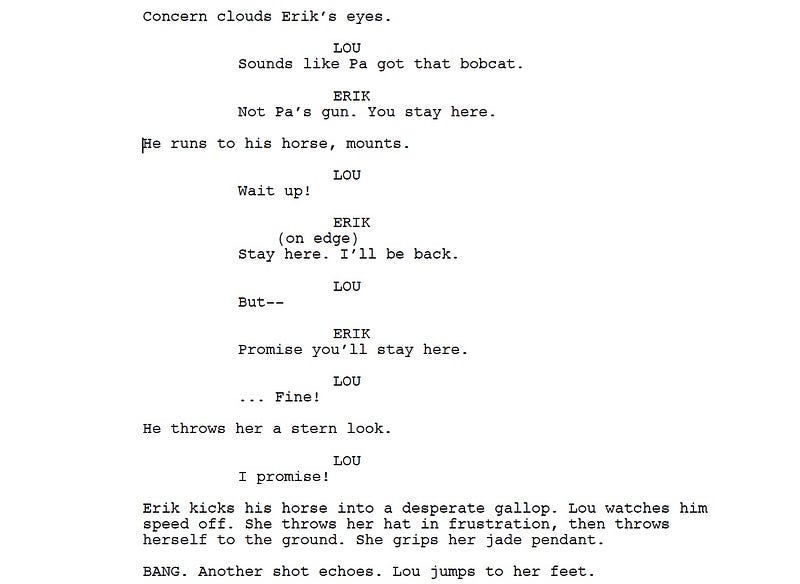
Charmaine Colina wrote the original screenplay “Gunslinger Bride” which won a 2024 Nicholl Fellowship in Screenwriting. Recently, I had the opportunity to chat with Charmaine about her creative background, her award-winning script, the craft of screenwriting, and what winning the Nicholl has meant to her.
Today in Part 5 of a 6-part series to run each day through Saturday, Charmaine talks about her experience as a Nicholl-winning screenwriter.
Scott: You got this little interchange on 42 where Seth indicates, “You take care of the house and the children, the cooking, the cleaning, the washing,” then she says, “Woman’s work.” Seth responds, “Well, you are a woman.”
That mistaken identity dynamic raises the question of Lou: “Who are you?” And my theory is that every story asks that existential question of the Protagonist, a question of self-identity.
Charmaine: Oh, yes. It’s also influenced by my struggle with identity as a child, as an immigrant from another country being in the United States. Lou, from the time she’s nine until the end of the story, she’s always hiding who she is, disguising as somebody else, pretending to be someone she’s not. It’s not until the end when she’s finally who she really is.
Scott: Yeah. She’s got to get in touch with aspects of her personality, which she has either repressed or just hadn’t had the opportunity to express. But then there is the complexity of her decision because as it turns out, she’s no longer just a killer seeking revenge. The mayor is the grandfather of these children. He’s also this nice guy. He’s handing out candy to kids and stuff like that.
Was that always a dynamic you wanted to play with, to add that level of complexity, that the bad guy is not like coming off as your stereotypical single dimensional Nemesis?
Charmaine: Yes, because I’ve always been intrigued by the idea that you might cross paths with a horrible person, but they love their dog. It’s like you can think someone is so bad, but then they could be somebody’s beloved grandpa. Somebody’s father. I like that complexity and also the struggle this causes for Lou.
It’s like, well, OK, she’s got to be super strong because she might have to kill this man who seems like a good person. Good people make very bad mistakes and try to make up for their wrongs. This begs the question, are we ever truly forgiven?
There are different themes at play. There’s grief, but there’s also forgiveness, and then who decides that? How many good deeds do you have to do to make up for something you did that was horrible? Are you ever truly forgiven, and who gets to decide that?
Scott: That brings up another key character, Reverend Walsh. Describe that character and how they play in the story.
Charmaine: This is where the PTSD of veterans of the Civil War comes into play. Many veterans were lost after the war was over. I see the backstory for Mayor Haney and Reverend Walsh as former soldiers who ran with a gang made up of Civil War veterans, like themselves, who felt lost in their lives after the war ended.
They committed horrible crimes. But later, they found God. They found salvation and tried to change their ways, lead a life of good. But when you’ve done so many bad things, can you ever truly make up for what you’ve done? That was Mayor Haney’s motivation. Make up for all the bad he had done by helping others by being a kind and generous person. For Reverend Walsh, God has forgiven all his sins, washed him clean. He gets lost in the idea of salvation. But then Lou shows up and ties him back to the sins of his past.
Scott: Now you’ve got the mistaken identity dynamic and it’s like a ticking bomb because we suspect at some point the real mail-order bride is going to show up. And that’s a character named Kate Reilly. Could you talk about that revelation and its impact on the plot.
Charmaine: Kate Reilly, yes, the real mail‑order bride. As we’re there at the party on the eve of Lou and Seth’s wedding, everything is happy and wonderful, so something bad has to happen. It can’t end there. In most movies that we see, it’s that, oh wow, this is great. This is amazing. Everybody’s happy. No, the other shoe’s going to drop, and then I thought, oh, of course, the real Kate has to come back.
At first in my mind, she doesn’t come back, she’s gone back to Tuckahoe, New Jersey, and that’s kind of it, but I thought, no. If we’re going to complicate this, because you always want to give your characters obstacles, what would be the worst thing that could happen right now?
Lou and Seth have found finally found love and happiness. The kids are happy. The whole town is celebrating, Seth and his father have reconciled. And Lou has finally let go of her anger and quest for revenge. Then Kate shows up and everything unravels.
Scott: You’ve got so many twists in the story, and I mean that in a good way, and there’s a lovely twist in the end, a melancholy, bittersweet resolution to the story. Did you always have that in mind?
Charmaine: I had always envisioned Lou eventually making it to the Pacific Ocean, but I wasn’t sure if she would be the only one who’s there at the end. I grappled with that. I had written different endings.
Then I said, you know what? If this is a movie I’m writing, a story I’m telling, I want a happy ending. Because you can have the bittersweet where she winds up alone, or you can have the alternative. Lou finds finally finds peace and happiness. She has gone through so much. Can she just have a little joy in her tragic life?
While things have come full circle with Lou finally reaching the Pacific Ocean, I felt it was very important for her to have that closure. But I also wanted this new chapter to open up for her.
Scott: As I recall from reading, it’s like you establish the Pacific Ocean as Lou’s goal and then there she is. You go, “Oh, OK, great. She got there, but then where’s Seth and kids?”
Charmaine: I know. I thought about The Shawshank Redemption — one of my favorite movies — and the Zihuatanejo ending. How did Andy get there? What will it be like for Red and Andy now? I wanted there to be questions at the end of Gunslinger Bride like, after Lou flees and gets to California, how did Seth know where to find her? I want people talking about that.
As a writer you think, “Am I going to show that? Are we going to have a little bit more? Is there going to be a montage of her sending a telegraph and Seth getting it and Arnie helping?” I thought, no. She goes and somehow the family has reunited with her. The audience can put that together in their brain, how it all happened. The important thing is that Lou and Seth were able to reunite.
Scott: It’s a wonderful read and well deserving the Nicholl award. Let’s talk a little bit about that. What was that like going from the time where you’re getting calls from the Nicholl committee and the rest of it.
Charmaine: As a writer, every year when you’re on a lot of these writing websites, you get the emails announcing and congratulating this year’s Nicholl Fellowship winners. You’re just thinking, “Amazing! I am so happy for these people,” because you know that was a longshot, even with a great script. What are the odds? Thousands of writers enter their scripts, and I was one of them.
I just wanted to see how far my story would get, never thinking this could be something that I would win. Around 5,500 scripts enter the competition. So, when I got an email about making the quarterfinals, I was thinking, “All right, I’m good. If I got to the quarterfinals, that’s an accomplishment.”
Then when I got the next email about the making the semi-finals, the top 150 or so scripts, I thought, OK, this is getting a little crazy, but awesome, wonderful. But it won’t go any further. So I thought!
Scott: The Nicholl committee does this little thing too, where it’s like, “We need to be on a Zoom call …”
Charmaine: Oh my God, the stress. I thought I was going to throw up. When I received the request to take part in a zoom call because the committee had questions about my script, I thought this can’t be good. My mind spirals. It just goes and goes and goes.
But when I found out I was actually a top ten finalist, it was like, oh, that just, [breaths]. OK, I’m a finalist! I’ve already “won”. Just being a Nicholl finalist is like winning. If I don’t go any further, I’m good. A couple of weeks later when I was called into another zoom and told I was a Nicholl Fellow, I burst into tears. And of course it was all recorded on the zoom. It was amazing but also surreal. I never thought this would happen. And then it did!
Scott: What about the Nicholl Week in LA?
Charmaine: Oh, that was incredible. The Nicholl team, oh my gosh, Joan Wai, Chris Kartje, and Vaughn Arterberry, they do such a wonderful job of planning and communicating with the Fellows for the different events. We had a big celebration at the Beverly Hills Hotel where the Nicholl Fellows all gave speeches. I was standing next to a giant gold Oscar statue. I had to pinch myself. It was like being in a dream. I met many Academy members, writers, producers, cinematographers. An incredible experience.
My mom, she’s 86, was there, my husband, my sister, some of my teacher friends. Even though I know my dad was there in spirit, it was one of those moments I just wish we could have shared.
Yeah, it felt like a dream. It was exciting. It was adrenaline. It felt like those big moments in life, like my wedding day — that goes by in the blink of an eye — and I want to hang on to the great memories. We have some fun photos of the night. It was truly an honor to be there.
Scott: Well, it’s nice that you’ve got your Fellow cohort from this group to help you remember.
Charmaine: Yes, wonderful group of people.
Tomorrow in Part 6, Charmaine answers some screenwriting craft questions.
For Part 1, go here.
Part 2, here.
Part 3, here.
Part 4, here.
For my interviews with every Nicholl Fellowships in Screenwriting winner since 2012, go here.