Interview (Part 5): Charlie Wachtel and David Rabinowitz
My conversation with the co-writers of the movie BlacKkKlansman.
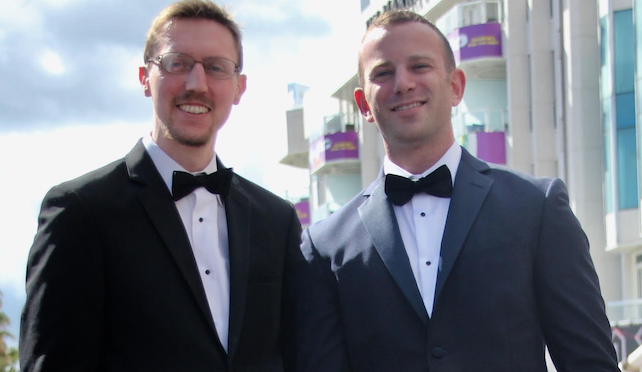
My conversation with the co-writers of the movie BlacKkKlansman.
The provocative movie BlacKkKlansman opens in North America this weekend. Directed by Spike Lee and starring John David Washington and Adam Driver, it was originated and co-written by screenwriters Charlie Wachtel and David Rabinowitz.
Today in Part 5, Charlie and David answer some of my questions about the craft of screenwriting.
Scott: Now, you mentioned, and I thought it was interesting when I asked you, what did you see in “BlacKkKlansman” the book, Ron’s life story there, that incident and period of time in his life that was a movie? I think it was David who was talking about how even the title itself, you should just see the marketing, the potential there. How important do you think it is, for a story concept, to have that kind of hook to it, that commercial viability?
David: Extremely, extremely important.
Charlie: Extremely important, yes.
David: We talk about this all the time, for better for worse, if we’re talking about pursuing any idea, we need to know what the marketing hook is going to be. That might be a little cynical, but it’s just the reality of working in this business.
Charlie: You’ve got to have a strong concept. It’s a necessity. You could be an incredible writer, but, if you pick the wrong concept…The goal is to get a movie made, isn’t it?
It’s better to spend the time coming up with a solid concept that is fresh and marketable than to just jump into a story that’s either been told before or it’s not a story that a commercial audience would have interest seeing.
Scott: I thank you both for saying this because I tell writers this all the time. That you can spend months, even years on a script and, if you don’t have a strong story concept, it’s likely a waste of time. Other than your learning experience in writing.
I’d be curious about your prep writing process, how you break a story. You say you do a very, very specific outline. What’s that process look like? Do you have an organized thing? Do you start with character development, research? Could you give us a book feel what you do there?
Charlie: Yeah. We start off with a character breakdown. We want to get a feel for how many characters are going to be in the story, who are the key characters, and what their roles are in the story. We’ll give them a full description, we’ll give them an age, and now we know the pieces that we can play with. Then we’ll go into the outline.
David: I would even say simultaneously and, honestly, it’s different, probably, a little different for every project, but simultaneously, we’re looking at the outline from in a very zoomed out macro sense, starting with the act breaks and the major incidents of the story, and, at the same time, working on that character list. One affects the other.
Charlie: Research. Maybe it’s the nature of the projects we’ve worked on, but everything that we’ve done, we’ve done extensive research for. We wrote a spec recently that, last year, we decided to go to Cuba for because a lot of the script took place in Cuba and we’re like, “We’ve researched so much about Cuba.
“Now, let’s actually find out how accurate all of our research is and get the experience of going there.”
David: Although I wouldn’t say that we spend a lot of time researching before writing. It’s still all a simultaneous process.
Scott: A couple things I’ll take away from there. One, I’m always grateful to hear when writers say character is the starting point. So much of the screenwriting gurus tend to focus on story structure as plot. Well, how do you get to the plot? It’s character in action.
The second thing is, I guess that writers should basically pick places like Cuba, Fiji, and Tahiti for a start to go do research.
[laughter]
David: Exactly.
Scott: Okay, another one. How do you go about developing characters? You say you do these character breakdowns. How do you do that?
Charlie: I think it starts by figuring out what you’re trying to say, what the themes of the story are, what do you want people to be talking about after they’ve seen your film? You have to then use these characters to represent different attitudes and different approaches to whatever subject matter you’re dealing with.
David: It’s also, you’re looking at the story and you’re like, “OK, what objectives are needed to drive this story forward and what character makes sense?” We’re looking at it from multiple angles simultaneously. What does the story need? What does the character need?
Charlie: Which characters are going to represent the obstacles that stand in the way of what the protagonist is trying to achieve?
Scott: Screenwriters put that hat on where we’re looking at the characters in terms of their narrative function.
Charlie: Absolutely.
David: Exactly.
Scott: There’s that, but then there’s dialogue. I guess with BlacKkKlansman, probably some of that may have just come from Ron and the book and whatnot, but more generally speaking do you both feel like you have an ear for it or are there ways you have developed your ability to write dialogue?
Charlie: I think we have a good ear for it. Dialogue is the one thing that you want to sound natural, of course, unless you’re trying to stylize it. Usually, for our preference, for our style, was to be as naturalistic as possible and whatever is best for that character. The dialogue can change a lot of times.
If the dialogue is hitting me or David the wrong way, we’ll have a discussion about it and we’ll try to get to the root of why it’s hitting us the wrong way. It’s usually a function.
David: Yeah. That reveals itself in the swapping process. If he writes something that works for me, I’m not going to touch it. If it doesn’t work for me, I’m going to change it until it works, and vice versa.
Charlie: Then, if we decide to go to war and we can’t make up our minds, we keep changing each other’s work, then we’re going to have to sit down together and have a state of the union.
David: Talk about it.
Charlie: Talk it out.
Scott: What about writing a scene? Screenwriting is fundamentally scene writing. What are your goals when you write a scene?
Charlie: I think starting off with what is the point of the scene and why is it necessary to tell the story that we’re trying to tell? Screenwriting is all about rewriting, paring down, taking out scenes that you don’t think is necessary. You have to find ways to justify the inclusion of a scene in the same way.
On a more fundamental level, it’s what characters, the focus of the scene, what is their goal, and what’s standing in the way of their goal?
David: It’s just like this thing with dialogue. If something’s hitting one of us the wrong way, then we’re going to change it, and we’re going to change it until we’re both satisfied.
Scott: Let’s wrap this up with the inevitable question. I’m sure you’ll be getting it now every time you go to any conference, festival, or whatever. What advice can you offer to aspiring screenwriters about learning the craft and breaking into Hollywood?
David: For me, it’s nothing fancy. It’s write. Write as much as you can. Quantity leads to quality. Show your work early and often, and embrace feedback.
Charlie: I’ll say what I’ve told others before, which is, try to know the space of what you want to write as best as possible, be it…If you want to be as focused on sci-fi, watch as many sci-fi movies as you can and figure out what’s possible in that genre and maybe what has even been done before.
The same goes with reading scripts. Read as many scripts as you can. Aesthetically, if you hold up one page and see that there’s a lot of white space and you hold up something that you’ve written and there isn’t a lot of white space, you probably want to write closer to the one that has white space.
That’s something I wish somebody told me and made a little bit more clear in college. It took me a few years to actually really learn that concept myself.
Scott: Here you are, the movie’s coming out and I guess it’s fair to say that despite all the odds against success in this business, you’re an example of people who can do it, who can be outside the business then break in, right?
David: Correct.
Charlie: Absolutely.
For Part 1 of the interview, go here.
Part 2, here.
Part 3, here.
Part 4, here.
Twitter: @therealcwach, @BlacKkKlansman.
For 100s more Go Into The Story interviews with screenwriters, TV writers, producers, filmmakers, and industry insiders, go here.