Interview (Part 5): Byron Hamel
My interview with the 2021 Nicholl Fellowships in Screenwriting winner.
My interview with the 2021 Nicholl Fellowships in Screenwriting winner.
Byron Hamel wrote the original screenplay “Shade of the Grapefruit Tree” which won a 2021 Nicholl Fellowship in Screenwriting. Recently, I had the opportunity to chat with Byron about his creative background, his award-winning script, the craft of screenwriting, and what winning the Nicholl Award has meant to him.
Today in Part 5 of a 6 part series to run each day through Saturday, Byron shares his thoughts on winning the 2021 Nicholl fellowship.
Scott: That brings me to the ending, which I don’t want to give away the specifics. It’s both inevitable, but surprising, the final thing that goes on. You feel like it has to happen that way, but there’s this whole thematic thing going on with Felicia and Jamie that’s quite interesting where it feels like, at first, she’s presenting this robot mode as a survival technique for him, something to grab on.
There’s even a moment that’s like Frankenstein’s monsters where she’s like, “Whoa, whoa, whoa, you got to be careful with this stuff because it can undo you,” and all that, and then she presents this book of…I forget the title of it, but basically, you have a choice, right?
Byron: Mm‑hm.
Scott: Older Jamie says this thing toward the very, very end. He goes, “Bad men are everywhere, but you don’t have to become one. You can choose your own adventure.” That was the name of the book, right?
Byron: Yeah.
Scott: That’s the evolution. That’s for Jamie. The existential thing is you can choose who you need to be.
Byron: Do you remember those books, “Choose Your Own Adventure?”
Scott: Now that I’m thinking about it, yeah, because I have my own kids.
Byron: They weren’t just books to me. They were agents of freedom. And that’s still my relationship with stories today. Lore is the way. It is the path. Sometimes deadly. Sometimes freeing. Sometimes oppressive. But it moves you from one place to another. The “Choose Your Own Adventure” books were especially important because you called the shots. They were my first experience with choice in story.
In my real life, I didn’t know I had a fucking choice. And because I didn’t know, I didn’t have a choice. My mom was always taking me to these different places with these horrible guys, and this stuff was happening to me. I was being moved around a chessboard, and this was the era of my life. I moved out of her house in grade 8. Because I discovered choice. And this was through stories.
It was after reading a “Choose Your Own Adventure” book that — I was about 10 or 11 years old, this scene in the shower in my screenplay really happened where he was torturing me with hot and cold water. And I stood up to him. He wanted me to be scared. To cry. But I turned off the pain. I walked out of the shower, naked, staring at him. Because even if he kills me, fuck him. And just like in the story, he became afraid of me. Like I was the monster. The reason that I use a robot there in that scene is because I didn’t want to put a kid through that shit. You know, like some kid actor. That’s horrible. The trauma of that. I know because I lived it. But it also works for the scene because it was a moment of transformation for me in real life.
I was like, “Fuck you. I will kill you before I cry here. It’s not happening.” I transcended this horrific water torture, and I beat him. But it didn’t last. My courage didn’t last for long either. I’m glad it didn’t. I’d be dead. He did, another time, stalk me around the house with a machete after that, [laughs] but I tied the two events together in the story to heighten the threat.
Scott: It’s a hell of a story, congratulations. Let’s talk about the Nicholl. What was that like when you found out you had been selected as a Nicholl fellow?
Byron: I have to be very guarded about my emotional reactions to things and that has everything to do with the complex PTSD. Getting too excited about things wears me way the fuck down and it’ll knock me right out. I got kids to take care of. I got work to do. If someone’s like, “You have an exciting event coming up,” I’m like, “No, I don’t. I don’t have an exciting event coming up. I’m going to mark this on my calendar. I’m going to make sure that I shave before that Zoom call.” That pretty much is how I went about it. Then my girlfriend who lives in Oklahoma has anxiety. She knew this was happening. Because she believes in me. She knew I was going to win but she had to confirm it to relieve her stress about it. She’s like, “Oh, my God. Now I need to know. What’s happening?”
I’m like, “Chill out. You got to stop talking about it. You can’t do that to me. I don’t want to go there. When or if I find out if I win, then yeah, let’s do some celebration and all that stuff,” but for if I don’t know yet, I just accept it, and prepare to celebrate somebody else’s win. I’m going to keep working nose to the grind and spending time with my kids and all that stuff.
If I get too excited, too angry, too happy, doesn’t matter what the emotion is, it’ll knock me out. I got to be very careful. I need that energy. I’m a limited person. I stay level.
Scott: Moving into some craft questions in terms of your writing process. You said you wrote five features and two pilots since the pandemic. I’m assuming that there’s a creative drive, but then there’s also more of another aspect that’s pushing you toward the writing and into that commitment.
Byron: Again with the girlfriend. [laughs] Honestly, she loves my stories, and she loves to read them. I feel like, as a gift to her, I want to get it done. She gets really excited about my work. So I want to get it right for her, with a really good presentation and stuff like that to impress her.
She’s an accountant in Oklahoma, so she’s not involved in writing movies yet. We’re both fascinated in an animal way with geology. We like shiny pretty rocks but don’t really care much about the science. Her main art is painting right now. She paints these tactile pours with gemstones and epoxy. Beautiful stuff. We’ve produced some unscripted TV together, and a short film. I think she brings such a magic to the process. She loves stories as much as I do, and has her own idea for a thriller now, which I think is and extraordinary idea. I may be more passionate about it than she is, because if it were my idea it would be done already. She’s working on it and everything, but it’s her first script, and she works full-time doing joyless number organization. I’m teaching her how to write a screenplay, and if she lets me, that might end up being a co-write. There’s so much joy and sharing in our relationship.
I absolutely love being a storyteller too. It helps to have an eager reader, but it’s not just her. I’ve always done it, but just in different ways. Docu‑drama and things like that. Unscripted stuff. I hung out with a group of bikers for a year and followed them around. These are Guardians of the Children. These are bikers that protect abused kids. I hung out with them for a fucking year filming their stuff, and I made a documentary out of it. You hope that those golden moments happen. When they don’t, it can be frustrating. You think of these little ‘what if” ideas and you’re like, “Man, if that was my story, I would have put this here and that would have been so powerful.”
Writing a fictional story gives me the chance to make sure that I get that scene that I never got when I was working in documentary.
Scott: That was going to be one of my questions for you: How do you come up with story ideas?
Byron: They’re always coming. I don’t know. Like I said, I’m always inputting thousands upon thousands of movies, and TV series, and video games. Two of my favorite game developers right now are Quantic Dream and Dontnod. Powerful, inclusive, immersive games. I get ideas from everything. I love paintings, sculptures, books… I go to museums. Salvador Dali. Big on him. I’ve been to many of his touring exhibits back when I had time to tour the country. I have plans to visit Figueres and Barcelona just to see his originals. I watch people on the street. I love people. Lot of ideas come from that love. And I hate people too sometimes. Antagonists have to come from somewhere.
I read a lot of books. I said I have a reading disability. So it’s mostly audiobooks for me. They’re more convenient too because I can input stories while I cook or clean or shop. Single parent home here. I mostly listen to great thrillers, wandering heroes… Love me some Lee Child. I relate very much to that character Jack Reacher. I love Sci-fi, horror, adventure, and I love a good autobiography. Will Smith’s “WILL” and Max Brooks’s “World War Z” are incredible audiobooks. Beautiful productions. For screenplays, I have an app that reads them to me too if I want to read somebody else’s work. I honestly haven’t read a lot of other people’s screenplays yet. But when I do, it’s with my app. I even edit my own writing with that app reading it out to me.
Gotta have that app. If I sit and try to read your script, I’m at it for five days. I refuse to use my time that way. The app brings it somewhere between two and three hours.
Coming up with original stories couldn’t possibly be a problem for me. I don’t understand when people go, “I’m out of stories.” I’m like, “Are you fucking kidding me?”
Right here, if I look at my own life, I’m like, “OK, here’s a golden story. I take shit and I turn it into gold from this story of me growing up with this killer, this fucking asshole.” Then, I have another story about when I was the only White kid in the hood, which is a fucking awesome story. How can you not see amazing stories from your own life? The story of a friend. Or a mentor you loved.
I got this other one where my uncle took me fishing in the Atlantic Ocean. When I say took me fishing, I did a season of commercial fishing with him for Arctic char and salmon gillnets on the Labrador sea, and he taught me what strength was. I didn’t know what strength was at the time, but now I can tear a motherfucker in half. Not that I’d want to. But he taught me how to access that. And how you can’t fight the ocean. And boy did I used to try. I learned how to flow that summer. Everyman physics. Zen. Gratitude. That’s an awesome story I want to tell. I don’t know how people can’t find stories. It’s completely baffling to me.
Scott: Let’s talk a bit about your story prep process. How do you go about breaking a story?
Byron: If I have a good idea, I try to write a brief summary of what that story would look like. We’re talking five paragraphs, maybe. If I can break five paragraphs down into a good logline, then it’s worth writing. If I can’t, then it’s probably not worth writing.
To me, the logline is so fucking important. I don’t want to start a project if I don’t have a good logline, because I’ll just have to change it later. If I don’t have protagonist, goal, obstacle, good twist, I’m not interested in writing that story.
Considering when I start being hired to work on other people’s ideas, no matter what somebody comes to me with, if that story doesn’t have those things, I will have to add those things, or the story is a piece of shit. I mean, I’ve seen it work. But I’m not a huge fan of chaos in my writing.
That said, once I start writing, it’s like, act one, act two is all I get with my index cards. I do the full set of index cards, act one, act two. And I usually make those from a beat board that breaks down a full circle story focusing on the protagonist’s journey. I don’t fucking know what act three is going to be, but the general idea is in the circle on my beat board.
But then, you know, in the writing, the characters have their own ideas. They wanna go where they wanna go. So act three to me is always subject to change until I actually do the writing. I have a plan, but sticking to it isn’t always the best idea. In that way, I like a little chaos.
Scott: That’s actually an interesting approach. For TV, you never go to script until they’ve broken the entire thing down. Then there are writers I know who are like, “Why would I want to write something if I know the ending? I want to be experiencing like a reader does.” You get the best of both worlds. [laughs]
Byron: It’s so fun. You’re telling yourself the story. The story is coming to you from the fucking ether of your mind, your being, or whatever is surrounding you, and the conglomerate of the input that you’re taking in. Somehow, you’re being told this story. It’s just you, but something is telling it to you.
Funny enough, I’ve heard Quentin Tarantino, who to me is a God-level filmmaker, mention that he writes like this too. With the fluid third act. That made me happy. I think I’m on the right track. Tarantino, but for drama. I’ll take that job. Fuck yes.
For me, it’s like, if you create really good characters, they take it on. That makes the writing easy. And it makes it come automatically. You have this idea of where that character is going to go, and the character goes, “Nope, I’m going to go over here.” You see this same thing later in the process sometimes when a great actor has your script and is like “No, that’s not what I do.”
Guess what? I think that’s fucking great. As the writer, who should be pissed off that an actor is taking my work and changing it, I think it’s awesome. I love actors. I love the idea of collaborating that way, and to that point where someone takes it, has a better idea than me, and makes it their own. If they’re good. Fuck ’em if they’re not. What right do they have to be on set if they’re not good actors? As an actor myself, I’d work entirely from the script, because I don’t think I’d be good enough to venture away from it.
But if you’ve hired Viola Davis, let her be Viola Davis. If you’ve hired Kathryn Hahn, what are you going to do? “No, stick to the script, Kathryn Hahn.” Why? You pay her because she’s fucking awesome. I want to see that done with my work.
Directors too. I want Guillermo Del Toro to look at my script and say, “I have a better idea. Let me have it. I want to work on this.” I want that.
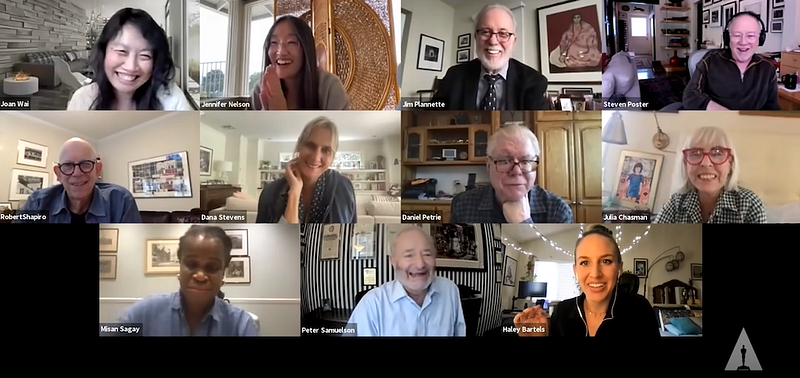
Here is a video clip in which the Nicholl committee tells the 2021 Fellows they have won this year’s award.
Tomorrow in Part 6, Byron talks the craft of screenwriting and provides advice for aspiring screenwriters.
For Part 1, go here.
For Part 2, go here.
For Part 3, go here.
For Part 4, go here.
For my interviews with every Nicholl Fellowships in Screenwriting winner since 2012, go here.
For my interviews with Black List writers, go here.