Interview (Part 5): Bill Holderman and Erin Simms
My in-depth conversation with the co-writers (Holderman and Simms) and director (Holderman) of the comedy Book Club.
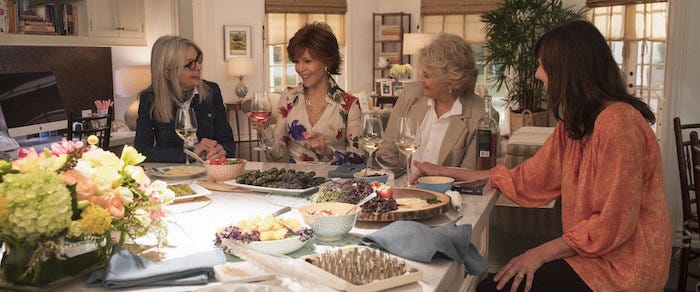
My in-depth conversation with the co-writers (Holderman and Simms) and director (Holderman) of the comedy Book Club.
“Four lifelong friends have their lives forever changed after reading ’50 Shades of Grey’ in their monthly book club.” That’s the logline of the Paramount comedy Book Club which opens in theaters across North America beginning Friday, May 18th.
Recently, I had an hour-long conversation with the co-writers of the movie: Erin Simms and Bill Holderman. Bill also made his directing debut with the film. Today in Part 5, Erin and Bill reflect on what the process of making Book Club taught them in the way of screenwriting lessons:
Scott: If you look back, Bill, you directed it, co‑wrote this. Erin, you co‑wrote this, produced it. What did you learn as screenwriters through this process?
Bill: I think one of the things this process has taught, and it’s a lesson you learn over and over again, it’s to stay nimble, stay fluid, and don’t get caught up in not wanting to change things just because you don’t want to change them.
Even through the post process, sometimes when it looks like an insurmountable hurdle or an obstacle, sometimes that reveals something even better. It’s just a matter of taking the time and absorbing those moments when you get notes where you’re just like, “Oh, this is the end.”
Taking the breath and saying, “All right. Well, how can we address this and improve on where we were as opposed to have this somehow hurt us”? Luckily the foundation of those ‑‑ the note beneath the note ‑‑ have been really helpful and have continued to make the script, and then the movie, better.
Erin: Really, what I noticed is it’s when you are stuck, the only thing that actually worked was just stopping and going to read a book or do something completely different. Bill and I did a lot of walk‑and‑talks where we get off the computer, take a super‑long walk, and just talk things through.
It’s amazing how ideas come to you when you do something completely different. I’d pick up a magazine or watch an awful reality show. Something about cleansing the palate, cleansing your brain a little bit was very helpful.
Bill: That’s Erin’s process. Mine was to go to a coffee shop and just drink coffee and stare at the computer until something happened.
Erin: I really have to sidetrack on something else. The other thing is that I’m sure there’ll be scripts sometimes that are easier. This happened to have been a pretty hard one. It’s a lot of characters. There was a lot of stuff happening.
It’s not for the faint of heart. You’re going to feel like you cannot keep doing this so many times. You actually really can. It’s amazing to me that we even made it. It’s the same thing as making a movie. Producing a movie is absolutely nuts.
Bill: Not only can you, you have no choice. If you want to get to the end zone you have to keep marching forward.
Erin: You have to keep going. It’s the same thing in life. It’s the same thing with this movie, the theme of this movie. You’ve got to keep going.
Scott: Do you plan to keep writing together?
Erin: I’m retired now.
Bill: Yeah, we’re about to retire.
[laughter]
Bill: Yeah, I think so. We haven’t really thought about what’s next necessarily. I think we’re still very much deep in the final stages of battle of this movie.
Erin: We’re still in the editing room, so it’s hard to think about the next thing.
Bill: It was a productive collaboration and it’s one that we’d love to replicate again if we find the right material.
Erin: We support each other. We don’t necessarily have to write together. Bill might find something he wants to write on his own. We both love to produce movies. It’ll be shapeshifting according to whatever the project is.
Scott: Here you are, mere weeks away. I know you’re still in post, but the movie’s going to open wide. I’m assuming it’s tracking big, because it’s got a lot of theaters. It’s going to open wide on May 18th in North America. Could you describe what you’re feeling? Can you project out to what you may be feeling when you’re walking down the carpet for the premiere?
Erin: We’re opposites on this one. I cried every day of production, literally. I just was so excited and seeing these actors, my favorite actors in the world, saying our lines was the trippiest, most amazing thing. I was always bursting into tears.
Every time I see our poster or our billboard just went up on the side of Paramount, I just can’t believe the whole thing. Could not be more grateful. We love this movie so much. It could have died so many times. It’s kind of hard to digest, but it’s happening. I keep saying to Bill, “Look, we can’t miss this now.” Because we’ve been working so hard, time just flies by.
I don’t want to miss this phase. I want to be on the red carpet and I want to really remind myself to just stop and enjoy this moment. It’s the first time and that only happens once. For me, I’m very happy. That’s why I’m crying. I’m very happy.
Bill: That is the right, pure, and beautiful answer. I think I’ll be worried about the projector, make sure the sound is going to be OK in the theater, and troubleshooting all the things that could possibly go wrong because that’s just my personality.
Erin: We’re still producers at the end of the day.
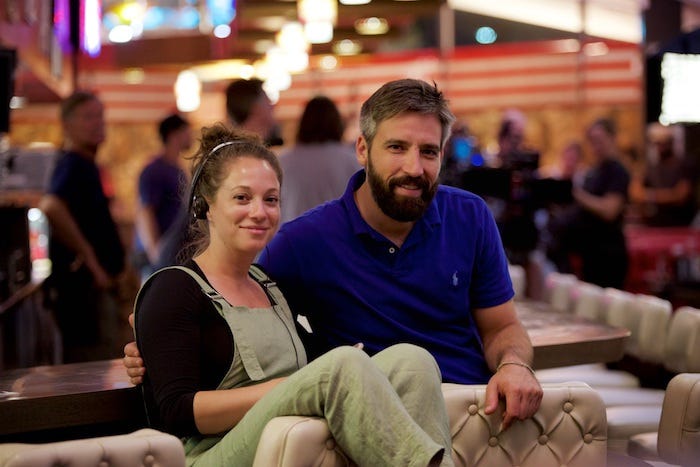
Scott: You’ve dealt with screenwriting in an interesting way. You’ve been on the development side of things, directing, producing, and screenwriting as well. Any advice you offer to aspiring screenwriters about learning the craft and breaking into the business?
Bill: I would say, having worked with and been on both sides of those meetings, I think it’s really important for writers to not be defensive and to be open to the collaboration, whether you think the notes from development executives, from studio executives, or from actors, wherever you’re getting notes, do not be defensive about them. Find the truth in the note that works for you and go for it. If you’re hearing the same note over and over again, it probably means you have to really do something and go take a hard look at it.
Writing is a solitary craft, but the way that the film business works is there’s a solitary part of it, then there’s a very collaborative part of it. You have to fine‑tune the skills in both of those arenas because, ultimately, you want people to want to work with you. It’s a really important component to having a long career.
Erin: I have lots of advice, but I can think of two things. One is, I find people don’t read enough scripts. Read as many scripts as you possibly can.
Bill: Oh, that’s so true. Even still.
Erin: I learned more reading bad scripts than, probably, I did good scripts. You can really start to see what’s going wrong and it’s really, really helpful. I would say read all scripts, good and bad.
The other thing is I find people are not willing to start at the bottom. As a writer, go be an assistant. Go be in the mix. Be a development executive. Get yourself in there. You can have a job and still write on the side. We both did it. It’s so good to immerse yourself. Take that crappy job wherever. Just get in the mix. Learn the language.
Bill: Building on that, Erin had an acting background and then we were both producing. It’s just all of those other aspects that make up the moviemaking community and the moviemaking family. If you have a connection and can understand all of those other jobs, you will be a better writer. You just will.
If you understand moviemaking and filmmaking, if you understand all of the components that go into it, your scripts will be better.
The last thing I will say, which is something that I really, really strongly believe. I think, from a development side, you can make a script that will make a great movie, and you can make that same script be really fun to read or just so‑so fun to read. Make your script fun to read. Make it a page‑turner.
If that means finding a way, if it’s a comedy, to put in humor into the action lines, not in an obnoxious way, if you can get your script to a place where it’s a page‑turner, you will get it made. I think everyone should go back and read their scripts and then read scripts that do get made.
Oftentimes, even at that level, even though it’s a blueprint for the moviemaking process, it is its own finished product in its own right and it should be incredibly enjoyable and easy for development people to read.
For Part 1 of the interview, go here.
Part 2, here.
Part 3, here.
Part 4, here.
Erin and Bill are repped by WME.
Twitter: @200bill, @Erinsimms9.