Interview (Part 5): Alysha Chan and David Zarif
My interview with the 2024 Nicholl Fellowships in Screenwriting winners.

My interview with the 2024 Nicholl Fellowships in Screenwriting winners.
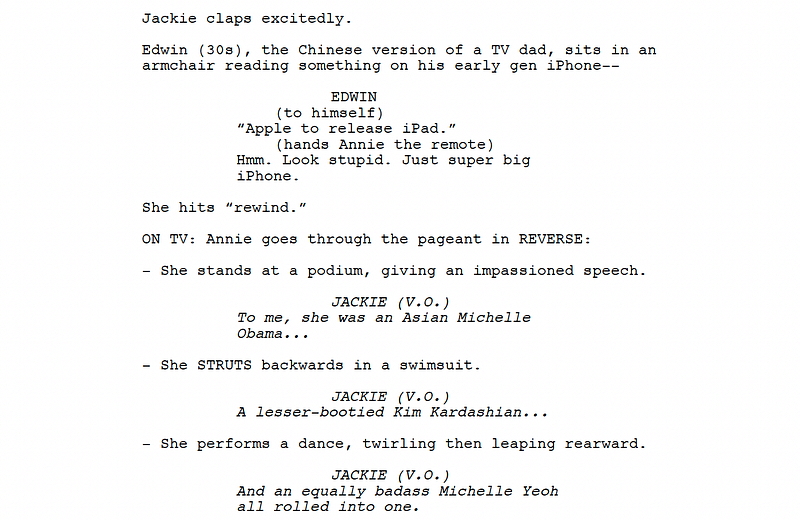
Alysha Chan and David Zarif wrote the original screenplay “Miss Chinatown” which won a 2024 Nicholl Fellowship in Screenwriting. Recently, I had the opportunity to chat with the couple about their creative background, their award-winning script, the craft of screenwriting, and what winning the Nicholl has meant to them.
Today in Part 5 of a 6-part series to run each day through Saturday, Alysha and David talk about their Nicholl experience.
Scott: Well, speaking of family, you make a huge story decision: Annie returns after she dies. It’s sort of like The Sixth Sense, Play It Again Sam, or Harvey, movies where there’s a character the Protagonist sees, but nobody else does. What was the thinking behind this choice?
Alysha: We felt it would be really hard for the reader to care about Annie if she died after just 15 or so pages, never to be seen again. ‘Ghost Annie’ was essentially a way to help the audience connect with her since we had so little page space to develop her as a living character.
Scott: What I’m hearing you say, “How are we going to possibly get the audience to feel an emotional connection to Annie and, consequently, to Jackie’s journey?” Then you hit on this idea: “Annie’s going to come back.” Was that a challenge for either of you?
Alysha: It was. Having it fit tonally and making sure it didn’t feel gimmicky.
Scott: There’s this one reference in the script where Ghost Annie says, “I could fly over to this person’s house,” but that was the only reference to sort of the metaphysical. Otherwise it’s just Annie being Annie, but I thought that was really clever. I enjoyed it a lot.
I do want to mention this thing that was set up earlier, Edwin, the father, talking with Jackie about their shared grief related to Annie’s death. He says simply, “Tomorrow … better day.” Cut to the last line of the script where Jackie says: “It’s finally tomorrow.” I love that line, it just rounds out Jackie’s arc. Could you talk about that runner involving the word “tomorrow” in dealing with the experience of grief?
Alysha: I think I asked a family member about a Chinese saying that conveyed a similar sentiment, and we adapted it from there. We included it to provide a shared expression of grief between Jackie and Edwin.
Scott: It’s a terrific last line and a fitting way to cap off a wonderful screenplay.
Let’s switch gears from tomorrow to yesterday and talk about your Nicholl experience. We’ve already talked about the honeymoon, but let’s go back even before that, to how you knew about the Nicholl.
Clearly, David, you’ve been in the business, and Alysha, I’m sure you’re aware of it. Was that a target, like, “OK, we’re going to get this script done and get it in by May 1st?”
David: No, not at all. We submitted to the fellowship as an afterthought. For us, it was testing the waters. We figured if we made the quarterfinals, then we’ve got something, we should keep writing. And then we did make the quarterfinals, and then the semi-finals. I remember saying to Alysha, “This is it for us. This is as good as it gets. Let’s celebrate.”
Alysha: We had a nice dinner and ordered wine. About a week later, we got a very cryptic email from the Nicholl committee that said, “We have some questions for you. Will you please be available for a Zoom at this time?”
David: I said, “OK, this can’t be bad news. Hollywood does not give you bad news to your face.”
Scott: That’s right.
David: Then we celebrated a little more. But in short, it was never our lodestar. We felt we wrote a fairly non-Nicholl-type script. Early on, someone told us this could be something for The Disney Channel. And I guess that stayed with me.
Scott: Oh, I don’t know. It’s in the spirit of The Farewell which was a big hit at the Sundance Film Festival, I believe, back in 2018 or 2019. This [Miss Chinatown] is, I think, perhaps more mainstream or commercial or whatever those terms mean. What’s the status of the script at this point? I think you mentioned you got representation out of all this?
David: We did. We found representation before submitting to the fellowship.
Scott: Based on this script or something else?
Alysha: This script.
David: We’ve had a manager for a few months now, but we’ve only just recently started sending the script to production companies. So… fingers crossed.
Scott: Well, this seems like a no-brainer to me, but unfortunately, I think a lot of the people that run studios don’t really have brains.
[laughter]
Scott: Anyhow, congratulations. I really enjoyed reading the script. I’d like to ask you a few craft questions. I’m assuming you’ve got other projects you’re now developing.
David: We do.
Scott: Do you generate ideas largely from your own personal experience or are you coming up with story ideas out of your imagination?
Alysha: Well, the next idea that we’re really excited about is inspired by something that happened to us, a very specific snafu that occurred early on in the dating process.
Scott: Is that a comedy or a drama?
David: It’s a Christmas movie. A Christmas dramedy.
Scott: Dramedy, all right. OK, so you’re not the kind of people that intentionally say, “Hey, let’s come up with a story idea today.” It’s more like something that emerges from your own personal experience.
Alysha: Yeah, but also, we’re always reading — articles, books, even the labels on snacks. It might sound cheesy, but inspiration can hit anywhere. You could be on a walk, and suddenly, an idea just clicks. Oh, and by the way, stay away from veggie crisps — they seem healthy, but they’re packed with simple carbs and sugar.
[laughter]
Scott: Let’s move into prep writing. How did you all break story on Miss Chinatown? What’s your process like?
David: Well, so far, our process is we get a big cork board and a bunch of index cards, and we lay out the story beats then fill in the details.
Alysha: Then we sit with our laptops and use Final Draft’s Collaboration feature and very painstakingly go through the writing process. It really is chipping away at an iceberg with a toothpick.
Scott: Are you showing the script to anybody or is this just you assessing it, like stepping back and assessing what you’ve got?
David: I have some close reader friends who are very generous with their time. They helped guide us through drafts.
Tomorrow in Part 6, David and Alysha answer some questions about their approach to the craft of screenwriting.
For Part 1, go here.
Part 2, here.
Part 3, here.
Part 4, here.
For my interviews with every Nicholl Fellowships in Screenwriting winner since 2012, go here.