Interview (Part 5): Aaron Chung
My interview with the 2019 Nicholl Fellowships in Screenwriting winner.
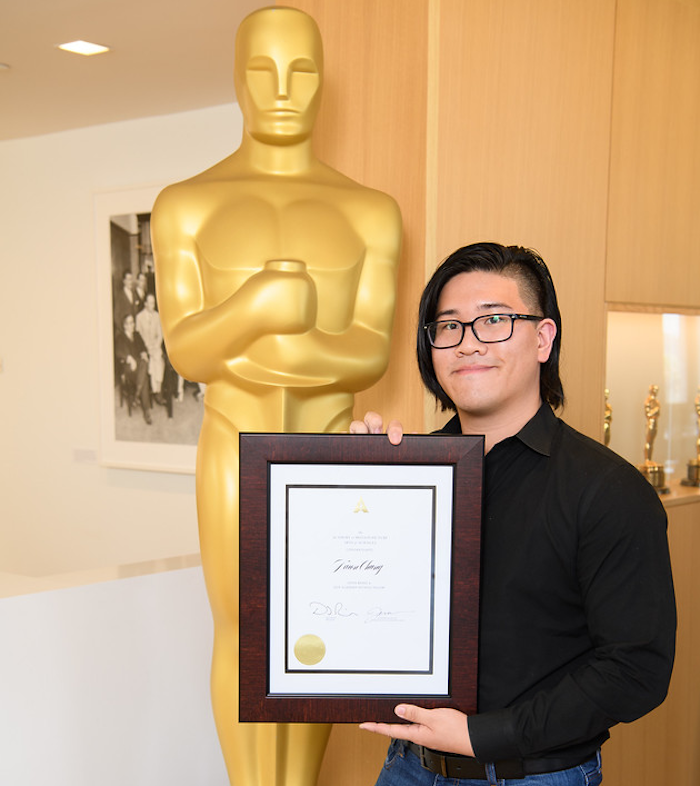
My interview with the 2019 Nicholl Fellowships in Screenwriting winner.
Aaron Chung wrote the original screenplay “Princess Vietnam” which won a 2019 Nicholl Fellowship in Screenwriting. Recently, I had the opportunity to chat with Aaron about his background as a screenwriter, his award-winning script, the craft of screenwriting, and what winning the Nicholl Award has meant to him.
Today in Part 5 of a 6 part series to run each day through Saturday, Aaron Aaron recounts what it meant to him to be named a Nicholl Fellow.
Scott: Last thing I want to talk to you about with regard to Princess Vietnam is how your story manages to thread the needle in terms of melodrama or, to use another metaphor, could’ve easily fallen off the razor’s edge into a pit of overwrought emotions, but you avoided that. How concerned, if at all, were you about not lapsing into the melodrama?
Aaron: People always treat that word as such a horrible thing. I don’t have a bad opinion about melodrama. Melodrama, as manipulative as it can be, can also be a gateway to let people understand what a character or a human being is feeling.
As much as that flood work of tears can often roll their eyes, it can also emphasize that, “This is sadness. This is pain.” As opposed to avoiding melodrama, I would say that I observed how I and the people around me and people I grew up with would often react emotionally.
It’s surprising to me the amount of people who constrain themselves and fight. Even I, myself, fight my own emotions. I can’t just let myself cry or get mad. I have to fight it back and stifle it, but 9 times out of 10, it always fails. As these very vulnerable creatures, we always have to let ourselves feel. I love that about humanity.
In that way, I wrote the drama, the script to be like that, to be constrained and tightened until finally they can’t keep it in anymore. To me, it feels more real.
Scott: The thing that struck me the most was where the characters ended up were definitely emotional places, but there was an honesty about what they were saying to each other. Sometimes screenwriters will say, “The best dialogue is subtext,” but sometimes it’s like, No, saying what’s right there, just like that monologue excerpt that I quoted earlier when she’s talking at her father’s grave. That’s very simple, very honest emotion.
Let’s transition into some wonderful Nicholl experience for you. As I understand it, is it true that this was the first screenwriting competition you entered?
Aaron: I won’t say it was my first. It was definitely my third, but it was my first time submitting to the Nicholl Fellowship. I think somebody misquoted me on that, but that’s OK. I guess it’s part of crafting the fantasy of being a winner. This was my first time submitting to the Nicholl Fellowship. It was my first time also submitting the script in any competition.
Scott: What was it like, the whole Nicholl thing?
Aaron: Surreal and still surprising.
Scott: What’s the status of the script on? You just said the latest rewrite. Is that something that you’re doing on your own, or is that under the direction of a producer, or an agent, or a manager?
Aaron: I did it on my own, mainly because when I got the news that I became a semifinalist of the Nicholl Fellowship, I thought that was it. I reread the draft, that one. This is one of the curses of being a writer. I’m sure you understand. I didn’t like what I was reading.
I was like, “Oh man, this is…Yeah, I’m going to be here in the semifinals. I’m not going to advance. I got this far. Let’s rewrite it. We work it and make it better for next year.” Then, lo and behold, I won.
I’m still glad I rewrote it because now I know I am, in the comfort of my own mental health, that there is a better draft that exists.
Scott: Have any managers or anybody reached out to you?
Aaron: I’m still going to meetings. I’m about to decide on a manager this week. As of this interview, I’m going to decide on one this week.
Scott: Congratulations on that. We’ve got time for maybe some craft questions. People enjoy reading about how writers create a process. You’ve written across all these genres. I would imagine if you’ve done genres like action or comedy that perhaps the stories have a bit more in the way toward like a high‑concept type thing. How do you generally come up with story ideas?
Aaron: Good question. How do we all come up with story ideas? First, it has to boil down to either character. I have to envision a really strong character first and then craft the story around them and what they’re going to do, or it would be an issue that I would see today that’s happening in our society, in politics or anywhere in the world.
I want to tackle it in a way where…It comes back to my intentions of going to connect everyone to our problems. I want to tackle these issues that are happening in our world, put a mask of entertainment over it, have to be fun but also be meaningful. I will say that will be my personal mission statement for writing.
Scott: How do you spend time in prep? I know you said you outline. You made that reference earlier. What aspects of breaking a story do you tend to devote the most time to? How do you get to that one?
Aaron: I’m going to tell you something that I think a lot of people should not listen to…should not take my advice on this. I hate outlining. [laughs] I hate the prewriting phase, but it’s so useful. I know it’s so useful. Any aspiring writer out there needs to outline. I do it reluctantly, but I do it.
To me, the way I write, I’m a very transformative writer. Things that I write in my outline will not happen on the page. I would always keep coming up with new ideas that I want to try out or feels better than what I’ve already written.
I’m in this constant state of rewriting. Sometimes, it’ll take me a while to finish something. Most of the time, it’ll push me through to the end. That’s the reason why I just cannot outline for the life of me.
Scott: I tell my students, I say, “Look, there’s a difference between breaking a story and finding a story.” Break the story in prep, but once you move into the writing phase, you want to feel your weight through each scene and open yourself up to the possibility where the characters are going to take you. Does that feel like the way you do things?
Aaron: That’s mainly the reason why I have to outline is, as I said, to find the story. It’s to figure out the trajectory of my character arc, where they start with and how they are going to end with. It always boils down to how is the character going to grow as opposed to what are the scenes going to be like.
Scott: Right. There you go. Now you’re talking my language.
Aaron: Yeah, exactly.
Tomorrow in Part 6, Aaron gives some suggestions on what a writer can do to try to break into the business.
Aaron is represented by MGMT.
For Part 1, go here.
For Part 2, here.
For Part 3, here.
For Part 4, here.
For my interviews with every Nicholl Fellowships in Screenwriting winner since 2012, go here.
For my interviews with 53 Black List writers, go here.