Interview (Part 4): Wendy Britton Young
My interview with the 2024 Nicholl Fellowships in Screenwriting winner.
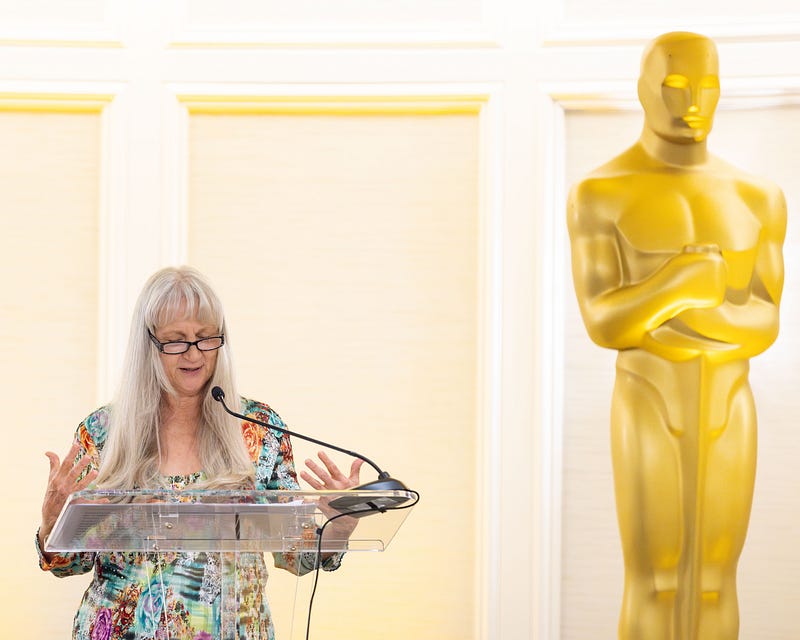
My interview with the 2024 Nicholl Fellowships in Screenwriting winner.
Wendy Britton Young wrote the original screenplay “The Superb Lyrebird & Other Creatures” which won a 2024 Nicholl Fellowship in Screenwriting. Recently, I had the opportunity to chat with Wendy about her creative background, her award-winning script, the craft of screenwriting, and what winning the Nicholl has meant to her.
Today in Part 4 of a 6-part series to run each day through Saturday, Wendy discusses other key characters in her script including the meaning of the lyrebird.
Scott: I want to talk about another character, the lyrebird. There’s a description here. “A book is open to a page describing the superb lyrebird. Sitting at her desk, Mea’s eyes read, hyper focused:”
“Shy, solitary, ground bird, lyre-shaped tail feathers, extraordinary ability to mimic.”
“Next to Mea are brushes, palette, and her notebook. Mea stares trance-like, her brush dips black, touches the paper,” [ then there’s an animation.] “Mea paints herself as a lyrebird.”
That connection, you had that eight years ago.
Wendy: I saw on Facebook a clip of a lyrebird. It’s an absolutely mind-blowing mimic — any sound. It will mimic car alarms. It will mimic chainsaws. It will mimic other animals. You don’t often hear its own call, and so that’s kind of symbolic of Mea, struggling to get her voice heard.
The mimic thing is important because there’s a thing with some Asperger’s folks, and especially in young women I think, where they imitate the speech or the behavioral patterns of those around them to get by in social interactions.
Scott: Oh, she does mimic. There are times where she just literally will say a line that someone said because I think she thinks it’s socially appropriate.
Let’s talk about some of these other kids. It’s so easy to fall into stereotypes, but you’ve got this kid Pandora and some of these other girls, sort of like you would think, “OK, the mean girls.” Right? Pandora’s got a little bit more to her than that. Maybe you could describe that character. What’s going on there?
Wendy: Yeah. I was pretty intentional about that. I wanted to have somebody that first appears to be a mean girl. But she’s more clueless, and self-absorbed. She thinks she’s helping when she quasi-diagnoses Mea, repeating stuff she’s learned because she wants to be a psychologist. So she’s just kind of insensitive, but in her mind, she’s helping.
When Mea’s at this party where she doesn’t fit in and she wants to kiss this boy, Pandora thinks she’s gonna grant her wishes, like an adolescent fairy godmother. She tries to be helpful in her own way.
Of course, Ivy only sees her through a certain lens, and assumes that she’s always trying to be mean in some way.
Scott: That’s going to be Ivy’s default mode no matter what, is that she sees the world as a fearful place in terms of Mea. It’s kind of interesting. It’s like Mea’s got a certain lack of understanding of the social interactions of “normal people” or whatever, but Pandora’s got her own sort of lack of understanding of…Right?
Wendy: Exactly. Which is funny, and true.
Scott: Yeah. So they’re kind of two sides of the single coin. She’s thinking, she’s talked to, “Oh, she’s ASD.” She knows all this stuff, but she’s like, “Oh, I think I could help her. Hook her up with this boy, and that’ll be…”
Wendy: “Do you need a hug?”
Scott: No, no. The touching thing… Now there is a boy that is pretty much of a — I guess you could say — jerk. Doyle, who is the rival. You mentioned in the Lyrebird there’s this scholarship.
We’re going to talk about the guy who’s creating it in just a bit, but there’s this scholarship, it’s a wonderful opportunity, it’s like the kid selected for it will go to London and Paris and Florence. It’s all paid for18 months, it’s two years of college credit.
I could see where I could go, “Oh, this is absolutely what we need to do,” and so there’s like six students going to be vying for this, including Mea. Maybe you could talk about Doyle as, I guess, sort of the nemesis character in terms of the scholarship.
Wendy: Yeah. Doyle’s problem is that he’s been like the star of the show his whole way through school. He’s really very good. He’s kind of head and shoulders above everybody else, and so he thinks, “Well, I got this all tied up,” and then somebody steps in who he thinks shouldn’t be there.
He has this story in his head that the only way she could beat him is if somebody feels sorry for her and elevates her because of her differentness. That’s a hard pill to swallow.
I did make it rough for him, but I gave Mea a little insight into him when she breaks into his house and looks at the books next to his bed. They were about this artist and that artist, and then the last one is a self-help book called “You Are Not a Teen-Age Loser.”
Scott: He sort of got that anti-woke thing going on, I think. She would be a DEI selection. Right? Because he is really good, but as pointed out by — I think it’s Reed — the guy we’re going to talk about. He says, “She’s got voice. You’ve got technique. She’s got a unique voice.”
Let’s talk about this guy, Reed. This is how he’s introduced:
“Doyle sucks up to art celeb, Reed Benedict, 35, boyishly cool in a sleek black Buck Mason shirt. He’s enjoying life in the spotlight, but here to give back. Which is also really cool.”
By the way, he lives in Malibu. So as soon as the guy comes back to his hometown, I was like, “OK. This is going to be an interesting dynamic.” Counterpose him to Jake, because they kind of play off each other a bit. How would you describe Reed in contrast to Jake?
Wendy: Well, Reed was Jake’s student, and he was a hometown kid that did well. Reed has talent, but he’s also made some shallow choices. So there’s tension, I think, between Reed and Jake because Reed is chasing, not just success, but a shallow lifestyle.
I think Jake is disappointed in him. Reed really does care what Jake thinks about him because he was his mentor too.. I didn’t put this in the script, but I think Reed donated this plush art wing, and that’s how this dingey high school has a really great art studio.
So in a way, Jake is beholden to him, but also disapproves of his lifestyle. But Reed is also perceptive. He reads Ivy’s mail. And he is giving back with this scholarship, but also he’s trying to raise his profile. So he’s three-dimensional as well.
Scott: Yeah. All the characters are that way. He comes back, and then as soon as there’s an intersection between Ivy and Reed, I’m like, “OK,” and Jake figures that out, “Now, you don’t want to do this, Reed.”
In a way, the similar sort of thing, like the scholarship is this Call to Adventure for Mea. Reed is in a way kind of a Call to Adventure for Ivy, because they do end up having a romantic liaison, and that has implications for her, and it has implications for Mea. Was that always in the cards for you, that romantic liaison between the Reed character and Ivy?
Wendy: Yeah. I did write him in that way because it was pretty obviously a betrayal of Mea, who crushes on him. But she’s kind of crushing on everybody. Anybody who comes into her sphere–she’s just trying to work that out.
Reed does make her feel special–he’s the big famous guy, and he thinks she’s special. So she quickly claims him as off limits for Ivy, which is frustrating for Ivy because, like I said before, this is her go-to place. She knows her way around guys, and here’s one that’s pretty famous.
Scott: And interested in her.
Wendy: Yeah.
Tomorrow in Part 5, Wendy reveals what her experience was like winning the Nicholl Fellowship in Screenwriting.
For Part 1, go here.
Part 2, here.
Part 3, here.
For my interviews with every Nicholl Fellowships in Screenwriting winner since 2012, go here.