Interview (Part 4): Ward Kamel
My interview with the 2024 Nicholl Fellowships in Screenwriting winner.
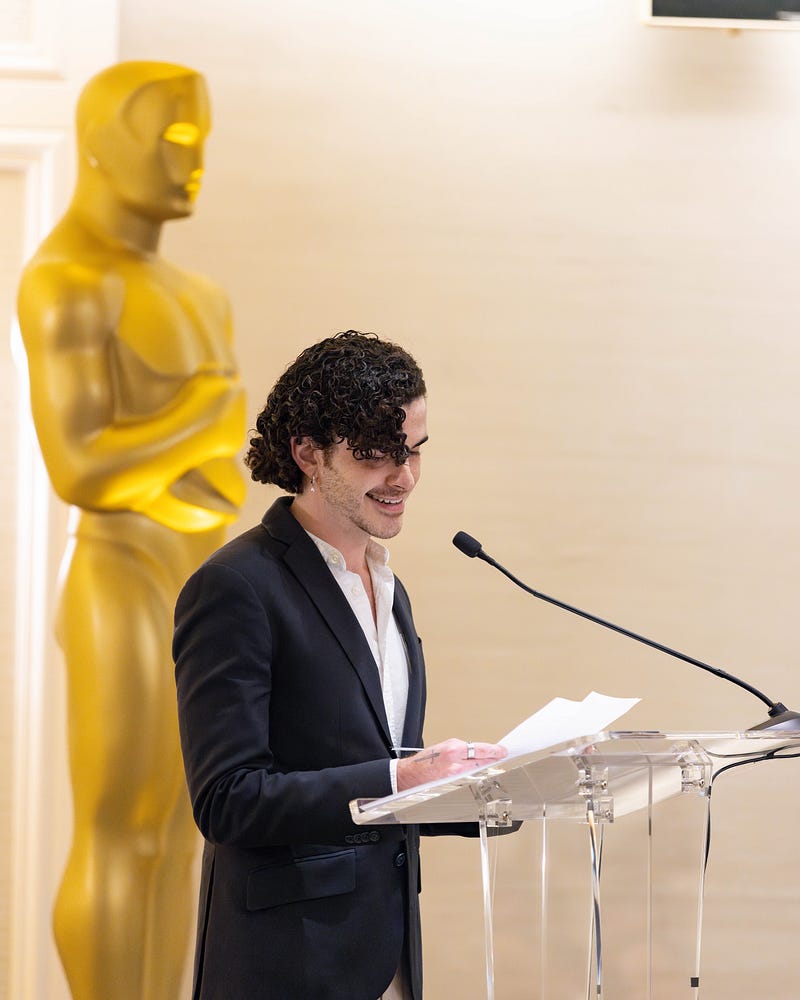
My interview with the 2024 Nicholl Fellowships in Screenwriting winner.
Ward Kamel wrote the original screenplay “If I Die in America” which won a 2024 Nicholl Fellowship in Screenwriting. Recently, I had the opportunity to chat with Ward about his creative background, his award-winning script, the craft of screenwriting, and what winning the Nicholl has meant to him.
Today in Part 4 of a 6-part series to run each day through Saturday, Ward talks about some of the other key characters in his script and how he was inspired by the myth of Orpheus.
Scott: Let’s talk about some of these other key characters Manny meets when he goes to Dubai. First, there’s Nora, who is Sameer’s mother. How would you typify her? You mentioned earlier that she’s an antagonist or maybe also a mentor figure. She does go through an interesting bit of an arc in the story. Talk a bit about Nora’s situation.
Ward: To me, Noora’s like the matriarch of the family. She holds a lot of power, at least in the residence that Manny ends up staying in. She’s sort of running the show to an extent because, and maybe we’ll touch on this later, but because the patriarch, the dad, is a little bit out of the picture. He doesn’t want to get his hands “dirty” with a lot of this. He’s moved on with the second marriage.
She, I think, is also Manny’s litmus test for whether or not he’s being accepted. She’s the only person that he really cares about pleasing because very early on in most of act one, we established this dynamic that Sameer was protective of his mother from Manny.
This was, I think, a flaw that Sameer had. I think it’s cruel that he would do this, but you see this happening a lot in these especially queer immigrants and diaspora. You want to compartmentalize these two worlds.
I think Noora’s arc is this journey where at the beginning, I do think that she wasn’t entirely aware that her son did have this loving partnership with Manny. I think she did think that it was a little bit more of, oh, his roommates and maybe a little bit of don’t ask, don’t tell.
Then once Manny is there and when she sees how much he’s fought to grieve, and especially when he has this massive display of emotion at the actual burial, she’s starting to take a step back and realize, “Wait a minute. I think that this man loved my son. And I think more importantly, my son loved this man.”
She’s going through her own difficult journey of accepting Manny as her son-in-law, which is a very, very foreign concept for a traditionally conservative Muslim matriarch woman. Like the idea of seeing him as a bit of a son is difficult for her, but we see her try and we see her get very, very close.
Then that doubles the tragedy of then when she realizes, when it’s finally revealed that Manny was unfaithful. It almost happens right as she begins to accept that her son did love him, and so it ends up being this really hard-hitting…
Like, it’s a very inopportune time for her to have just accepted that her son loved this man so then also the very next thing that she finds out is that this man cheated on her son. In a way, that final interaction between her and Manny is the ultimate validation that she actually did accept that they had a loving partnership because of how mad she is at Manny.
Because there’s almost an argument to be made here that if she’s only upset about it because she actually buys that Sameer and Manny loved one another — if they hadn’t, then the “cheating” wouldn’t be such a big deal to her, right? She believes that the love was real. She finally hops on board and so then is rightfully furious when she finds out about the affair.
Scott: Right. Like, midway through or maybe a little bit after she says, “I know your plane’s supposed to go tomorrow. You want to hang out?” She does have an arc. She goes from antagonist to mentor because she provides a key piece of information where he ends up. She says family is very important. You should get in touch with your mother. That’s a mentor moment.
What about Sama? She’s the sister, Sameer’s sister. Talk a bit about that subplot, the relationship between the Manny and Sama.
Ward: I’m not embarrassed to say that I very much pulled from my relationship with my sister. My sister’s the best. She’s one of my best friends. I definitely informed a lot of who Sama is. I would say that in the entire script, Sama, and maybe this is going to point out how much I care for my sister, but I would say that Sama is the only person that really is truly not flawed at all to an extent in the entire script.
She’s the straight character. She’s straight, obviously not meaning not queer/straight, like she does everything right. She is super accepting of Manny. She’s an ally, she’s a queer ally. It’s clear that she’s the only person in the family that actually knew Manny beforehand and it had a level of a friendship.
She is in Manny’s corner, she’s fighting for him the entire time. She’s also giving us the lay of the land. She’s a little bit of that playing that role, the character. She’s sometimes even literally translating what we’re seeing. Also, acting as a bit of a litmus test for Manny, although not quite as much because he already knows that she’s on his corner.
Because of that, her being the person that he confesses to and then her reaction to that confession, being like, “Well, I don’t accept this. I don’t accept this apology,” is what leads us to the low point for him when he goes out on his night out.
Scott: You talk about Sama being a kind of perfect character. Sameer’s father is the exact opposite. This guy is bigoted and it’s all about him. He’s embarrassed and humiliated by this gay guy showing up at his son’s funeral. They have a physical altercation where Muhammad, the father, literally pushes Manny: “You, go away. You shouldn’t be here. You shouldn’t be here.”
Sama intervenes and takes Manny to a hotel bar and they’re having a conversation. There’s a guy, Southeast Asian guy, and there’s a little bit of business in the bathroom where potentially Manny could have followed this guy’s offer to engage in some sexual activity, but he doesn’t. That’s when he goes back and says to Sama, he finally confesses about his affair with Eren.
I’m wondering what happened there. Maybe it was just leading up to that point he was ready to say it, but there’s something it seems that goes on in that bathroom where he declines the opportunity to have sex with this guy that then triggers him to basically maybe find the courage or inspiration. Does any of that make sense, or maybe you could unpack that?
Ward: No, no, 100 percent. Again, I like to think pretty structurally and in my mind, where we are right now, what you’re describing in the script is where what I would call close to the end of sequence six. The end of sequence six, the way that I write to is that’s the end of act two. Then the end of act two is marked by this low point. This is the dark night of the soul.
In my mind, a really good dark night of the soul occurs right after the protagonist could have gotten really, really close to actually graduating and really, really close to changing. But since this script ends up being a bit of a tragedy, we kind of…
I think what happens in that bathroom is that in more ways than one, Manny really sees himself regressing into this past version of himself where he would have been the person to have taken this advance.
Also, we put him through the wringer at this point that it’s not even just that he’s flawed, that he’s very promiscuous. You would understand maybe why someone in his position at that point would crave some level of intimacy and crave this idea of being seen for who you are, which is being seen by a fellow queer person in this moment where all you’ve done for the past few days is be invalidated.
But then in seeing that, I think everything bubbles to the surface, especially also after seeing Muhammad engage in some activity that reminded him of himself because Muhammad has this moment where he’s being sexually inappropriate with this maid earlier on.
All of that has corralled him to accept that he’s just going to have to take the beating and confess. Then as soon as he does that it backfires in his face, and it’s like a little bit expected that it would. Then he goes on this bender where we find him towards the end of that bender being at the dark end of the soul.
Scott: Yeah, including which he ends up with that Southeast Asian guy in an alleyway and they’re making out and these two locals say, “No, no, you don’t do that around here.” The Southeast Asia guy runs off, but Manny gets assaulted. Manny’s physical injuries intensifies the Act Two All Is Lost turning point.
I’d like to talk about the ticking clock you’ve set up in the script: the broken phone. Sama tells Manny someone’s going to upload the content of the broken phone into another iPhone. And there’s this big question: If Sameer did learn about Manny’s affair with Eren from Manny’s phone, then perhaps the car crash wasn’t an accident, but intentional. That Sameer might have been so upset learning about Manny’s infidelity, he committed suicide.
There’s a lot at stake with this broken phone … ticking clock … did Sameer know or not … did he respond to it to Manny …
Ward: Yeah, that certainly was the intention. In fact, I think since I’ve sent it to you, I’m still drafting this film because I intend to make it. I’m really adamant to get it in as good of a place as possible.
Something that I am working on is in that scene, making it a little bit clearer that actually what Manny is really confessing isn’t just that he cheated, is that he thinks that he killed Sameer because he thinks that Sameer found out. You know what I mean?
Like there is this feeling that ultimately this whole time, that’s what he was really actually very anxious about was that Sameer had found out, had been in this horrible mindset and maybe suicide is a big term, but that at least it contributed to the fact that he had crashed and he’s carrying all the guilt with him.
Then, exactly as you described, all of a sudden this phone becomes huge, well, did Sameer send anything before he crashed? Did Sameer indicate at all in any way whatsoever that he was OK, that he wasn’t OK?
Manny sees that the phone is about to be fixed. Sama says something along the lines of like, oh, it’s going to be fixed tomorrow. That contributes to him wanting to get ahead of it, to say like, “Well, now my back’s up against the wall. There’s no going out of this.
“If I don’t confess and then tomorrow they fix this phone, and then it turns out that Sameer had sent an angry paragraph that hadn’t been delivered because the phone was broken or something like that, then Manny’s going to get caught.” You know what I mean?
It’s a day late and dollar short but he thinks it’s better than nothing to at least get ahead of it. But then obviously there’s this twist later on that in fact, when the phone gets delivered, it’s clear that Sameer had no idea that the cheating was a thing. He hadn’t gone through Manny’s phones or hadn’t suspected it, and that it truly was just an accident.
Scott: Yeah, it is. Like a little bit of a MacGuffin, I guess you’d say, because the phone that exists is this thread, and then doesn’t really play out that way. I don’t want to give away the ending of it too much of what happens in Dubai.
Again, there was that one little setup that Nora said about family is important and you should because he’s been disconnected from his mom. His mom got caught up with some guy who was a conspiracy theorist and that might’ve influenced, so there’s been this distance. He doesn’t even know whether she’s with that guy anymore or not.
That idea of going to New Mexico, was that always there? When you had that half-written script, did you know that that was going to be essentially the Dana Ma or did they come up later on?
Ward: Yeah, they came up later on. I think the way that it came up was the same way that this idea of infidelity/guilt came up. Because to me, what this film ended up being and what I’m really trying to do with it is examine this idea of guilt and forgiveness.
We meet this character at a moment in his life where he’s very guilt-ridden, and then he has this potential opportunity to scrub away some of that guilt by confessing and then he can’t. It’s robbed of him.
He goes on this journey to try to be forgiven by his in-laws or at least be able to let go of some of that guilt by confessing to them. But then he’s sidetracked by this attempt to prove that actually what he had was real. In doing so, it makes it so that his confession is all the more brutal to them.
Then finally, when he does confess, the kind of gut punch is that they can’t really forgive him. They’re not going to be able to forgive him. Where he’s left and where I hope that we leave him is that the only real call to action for him moving forward is for him to forgive himself.
I felt like the visual and the arc of, how do we see that someone is starting to get ready to forgive themselves? To me, that means that they’re forgiving those around them and that they are letting go of any grudges that they have.
That’s the first thing you need to do in your journey towards self-forgiveness. You can’t forgive yourself if you have a grudge on someone else, or if you’re incapable of forgiving someone that you feel has wronged you.
For the first time in this entire script, we see him actually step outside of himself because in a lot of ways, he is acting narcissistically for the majority of the film. He’s putting his interests ahead of everyone else’s.
We need to see him at the end move away from that. The way that it manifests is that he actually takes Nora’s advice and says, “OK, well, you know what? I’m going to forgive my mom.” And hopefully, that’s a step towards some level of self-forgiveness and self-acceptance.
Scott: Yeah, one of those stories where the end of the story is really the beginning of this character’s journey toward wholeness. I was very interested in, is this mom’s a singer? There’s a lot of music in the script, people singing and whatnot.
Of course, Manny is a trained singer as well, but does not sing until the very, very, very, very end in New Mexico. He sings with his mom and Ricky, her boyfriend, he plays along on guitar.
The English translation: “Where will I go without my beloved? What will I do? Where will I go? What am I going to do without my beloved? Where will I go without my beloved?” That feels completely relevant in terms of Manny’s lost his lover. “Eurydice, Eurydice, oh God, answer me. I am surely ever faithful to you.”
“Ever faithful to you,” which is not true. It sums up very nicely in an ironic, not in a funny way, but ironic in a nuanced way about who, where this guy is in his journey. That song, you clearly gave a lot of thought to that moment. I’m assuming that when you thought of that song, that music, that was like, “OK, this is where I’m going to do this.”
Ward: It’s a funny story about how that came about. Very early on in the drafting process, I like to think of myths, even if it’s a Shakespearean reference or if it’s just a straight up reference from the Odyssey or the Iliad, or even a lot of Muslim theology or biblical stories or pre-Islamic Arab storytelling, I just like to be able to anchor myself in some hero myth or a piece of folklore.
I feel like if it’s withstood the test of time, then there’s probably something we can learn from it. Very quickly, the thing that stuck out with this script was the Orpheus myth.
The myth of Orpheus descending into the underworld, and fighting for a chance to save his wife and then being given one last opportunity to bring her back up above the surface as long as he’s told he can’t look back. He needs to keep looking forward and then at the end he fails.
I’ve had this myth in mind a little bit just as an inspiration, like something on the poster board of my brain as I’m thinking about the story. Obviously, there’s like this direct link with death, but it is such a hero’s journey. It’s a hero’s journey into this really hostile world.
Similarly to the one that Manny takes — this idea that in order for him to be able to save his lover, he has to look forward. I think what a lot of Manny does when in my mind, the idea that he needs to save Sameer is he needs to preserve his love for Sameer and his memory of Sameer and have it not be tarnished by this idea that his in-laws are grieving him in a way that’s really untrue to who Sameer was.
But he’s just incapable of looking forward because in a very literal sense, the movie often looks back at how he got here. All of that was in play as I was thinking about this movie. I also am a big classical music nerd
I was just trying to find the piece that I resonated with that he could sing at the end that wasn’t just this like tragedy. Like I didn’t want it to feel, at least melodically speaking, like a sob song.
I also obviously cared a little bit about what the lyrics were and what the piece was in a larger sense. And I stumbled upon this Orpheus opera that Gluck wrote, an Italian composer, many, many years ago. It’s based on the Orpheus myth.
This is the song that occurs at the end of the opera, it’s not quite the end, but the end of the myth as we know it is that Eurydice dies, and because Orpheus looks back at her and then he laments her with this song that’s in the script. The song itself, I picked it first because of the actual musicality of it, less so than the lyrics of it.
It just felt like a really beautiful mix of, it’s a major scale song, right, it’s not minor scale. Which to me matters because again, I don’t want to hit you over the head with the final note of the film being this like really sad piece of music, but at least melodically speaking, it doesn’t sound very sad, especially for a lamentation.
It fits a voice register of someone who could be like a mezzo-soprano, because I’m thinking of what singer is Manny? Is he actually an opera singer? Probably not. Then I was like, “OK, cool, this song is great. I like how it sounds. It’s familiar to me. It’s familiar enough that a lot of people probably recognize the melody.”
Then I read the lyrics and I was like, “Oh, this is it. Are you kidding me? This is absolutely perfect.” Then I even wrote it earlier on because I already had a flashback where they do go to the opera and that was the piece they were watching was Gluck’s Orpheus. I checked the New York Met had done it in the past. It’s canonically true that this opera has been staged at the Met at one time or another.
Tomorrow in Part 5, Ward shares what it was like to learn he was a Nicholl winner and his experience during the Nicholl Award week in L.A..
For Part 1, go here.
Part 2, here.
Part 3, here.
For my interviews with every Nicholl Fellowships in Screenwriting winner since 2012, go here.