Interview (Part 4): Vanar Jaddou
My interview with the 2020 Nicholl Fellowships in Screenwriting winner.
My interview with the 2020 Nicholl Fellowships in Screenwriting winner.
Vanar Jaddou wrote the original screenplay “Goodbye, Iraq” which won a 2020 Nicholl Fellowship in Screenwriting. Recently, I had the opportunity to chat with Vanar about his creative background, his award-winning script, the craft of screenwriting, and what winning the Nicholl Award has meant to him.
Today in Part 4 of a 6 part series to run each day through Saturday, Vanar talks about the importance of action sequences and grounding them in the characters’ experience.
Scott: I was reminded of the movie producer Larry Gordon. He produced 48 Hrs., Die Hard, my movie K-9. He’s a big action guy. He told me once, when you write these kind of movies, you need to have something go whammo, that’s what he said, every ten minutes. Something big has to happen.
As I was reading “Goodbye, Iraq,” I know you look at it as inverting, subverting genres and whatnot, but it does have an action component to it, absolutely. You’ve got chase scenes and cars with machine guns. You’ve got people jumping over chasms. You’ve got hand‑to‑hand combat. You’ve got chemical warfare, missile strikes.
Was that construction of frequent action set pieces something you had in mind? I know you talked about how important entertainment is to you, so I’m imagining that yeah, you did have that in mind, or did that action arise as you were plotting and then writing the script, or maybe a combination of both?
Vanar: Going into it was something I already knew that I was going to do. When I started writing…Everyone’s process is different. For me, you need to put pressure on the protagonist and all the other characters any chance you can get. You need to see what they’re made of in a very short amount of time.
The audience doesn’t want to sit around waiting. Things have to happen fast with increasing tension and escalation. Those are the moments where real drama is born. Where real schisms can come into play is during those moments of truth, those conflicts.
I definitely consider myself an action writer. My favorite films are the big blockbuster movies that are high concept. Conceptually, they’re brand new and innovative, original, and they’re very, very entertaining, but of course, they have to all have heart, and they should be discussing something deeper, some important global topic, even if it’s just subtextually. I think that formula is what’s missing a lot in movies nowadays. But it has to be organic and part of the story. You can tell when someone is trying to jam in something, “oh let’s just throw this diversity card in there!” or whatever it is.
I pride myself on being able to write big commercial scripts like that that are just as literary as they are cinematic, and I don’t think many of those exist to be honest. Action is something that from the get‑go, it was always a part of the process. I did have a plan the whole time that, just like you said, things have to happen every 10 pages or whatever it is. There has to be those moments.
Scott: In fact, while we’re talking about action, let me read a little bit of your action description, which is quite vivid as I said earlier to you. It’s a very visceral script. There’s a moment where Sayeed has found Noor and the father. This is how you describe it.
“Noor takes off into the woods. She’s fast, real fast. Sayeed swivels.” Now I have to note, a bunch of double dashes separating this: “fathers ‑‑ daughters ‑‑ daughters ‑‑ men captured ‑‑ boot to the head ‑‑ boot to the face ‑‑ girls carried off ‑‑ screams — screams.” Then the next scene opens with “Nauseating nonstop forward motion. Rasped breathing.”
That’s obviously quite visceral, quite active. I know you mentioned the Gilroys. I know that Dan Gilroy’s Nightcrawler, that script had that double dash thing going on. Were there some scripts you studied that you were inspired by with that staccato writing style?
Vanar: That’s a good question. Maybe subconsciously, I was. Nightcrawler is a really good script. Funny enough, the dashes are something that I always used going back to writing in middle school.
It was a type of punctuation that I was always infatuated with. For me, every word, every sentence is something that I want meticulously crafted.
I know a lot of writers don’t think that way. That’s OK. I’ve heard a lot of even professional screenwriters say a script, a screenplay should be a blueprint. Don’t worry too much about the prose and that. For me personally, I never approach it that way. I want to immerse you completely in the world.
The punctuation, for example, there’s a reason for every stylistic element on the page. If you look at it like that, all the room on the page is extremely valuable, I only want to fill it with the most carefully selected words, then I think you get a better end result.
Technique, it’s not just about having a mastery of story and characters, and conflict and all that. To me, it’s just my personal opinion, but it’s also having a mastery of words. Of language. Language creates experience. Maybe that’s what stood out to the Nicholl committee, I don’t know.
Besides the story. I want you to feel like you’ve picked up and you’re reading something of mine. I want to create that particular style and way with words that you’re probably not going to see in most scripts. That’s part of your voice. That’s part of what will define you as a writer.
Scott: You mentioned the key word there, “feel.” I would agree with you. People who say that screenplays are fundamentally a blueprint to make a movie…At some point they are, as a production draft, but there’s the selling script. You’ve got to get people excited. You’ve got to get champions. You’ve got to get actors. You’ve got to get directors and people who are going to advocate for the project. That, by and large, is about getting them emotionally involved in the thing so that they’re excited about it. Word choices are big. I thought you do that quite well.
In fact, on the feeling part, I want to jump to something here on that, because it really is a father‑daughter story. There’s all this action going on. I was reminded as I was reading this, Joseph Campbell says that the hero’s journey, which takes place in the outer world, that’s the realm of the events that happen and the plot, is really at heart an inner journey.
There’s the transformation which takes place within the characters. You’ve got this epic journey ‑‑ Iraq to Turkey to Greece and eventually the United States. This couple, if you will, this father and daughter, each of them go through a shift, a transformation, a change. Could you articulate that? What did Noor learn about her father? How did her relationship change with her father?
Vanar: For one, she learned that her father is not the man that she thought he was. She maybe always had some kind of inkling as to what he might be capable of, what he might be hiding, but in this culture at that age, that’s never something that you broach with your father.
With the situation they were thrown into, she obviously became a lot more outspoken as the journey progressed. It gave her that courage to start asking the questions that maybe she always wanted to ask, but never had the heart to. By the end, her father is more of a hero to her than she initially thought to start. It comes full circle, and then even goes beyond that.
In her eyes, all the things that he sacrificed, just going through that journey with her father by her side, what he sacrificed for her personally, there’s this certain level of maturity that she got to by the end that she didn’t have to start. It was only going through all those tribulations that she was really able to appreciate everything that her father has done for her and is trying to do for her.
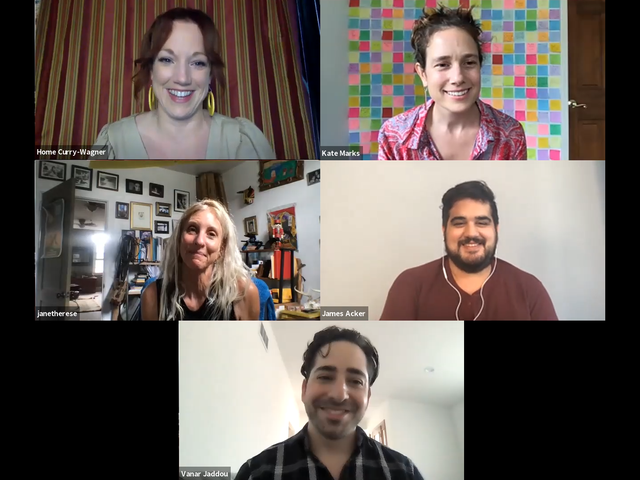
Here is a video of the moment Jane and her fellow writers learned they had won the 2020 Nicholl Fellowship in Screenwriting.
Tomorrow in Part 5, Vanar reveals what he felt when he found out he had won a Nicholl Fellowship in Screenwriting.
Vanar is repped by Bellevue and APA.
Instagram: @vanarjaddou
For Part 1, go here.
For Part 2, go here.
For Part 3, go here.
For my interviews with every Nicholl Fellowships in Screenwriting winner since 2012, go here.
For my interviews with Black List writers, go here.