Interview (Part 4): Scott Beck and Bryan Woods
The co-writers of A Quiet Place go deep into their background, creative process, and the evolution of their hit horror movie.
The co-writers of A Quiet Place go deep into their background, creative process, and the evolution of their hit horror movie.
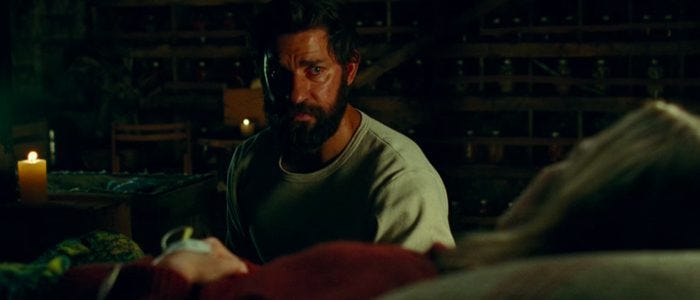
As of today, the Paramount movie A Quiet Place has grossed $240M in worldwide box office revenues. Given the movie’s reported $17M production budget, that represents a ginormous ROI, but the movie is not only a success financially because critics have given the film an enthusiastic thumbs-up: Rotten Tomatoes (95%), Metacritic (82%), IMDb (8.1). Thus, it’s no surprise Paramount has announced a sequel is in the works.
Where did this movie come from? Who came up with the central conceit of the story? Who wrote the original screenplay which sold as a spec script?
The answer is longtime friends and filmmakers: Scott Beck and Bryan Woods. As it turns out, the two have been Go Into The Story followers for several years and with thanks to Joshua Caldwell, I ended up grabbing an hour of the writing duo’s time for an in-depth interview. It turned out to be not only a fascinating conversation, but also an inspiration for anyone who aspires to cinematic storytelling who resides far outside of Hollywood’s pearly gates.
Today in Part 4, Bryan and Scott discuss why they decided to break so many of the so-called screenwriting ‘rules’ when it came to screenplay format and style:
Scott Myers: I’d like to go back to that family tragedy, to that event because it is handled differently in the movie. In my mind, I could see how both of them would work. In the movie, it’s you’re still dropping us in media res. We’re in the middle of this post‑apocalyptic environment.
There we are, and these people are tiptoeing around, but unlike your script, the movie visualizes the tragedy. You actually see it, as opposed to it being referred to in backstory. In your minds, thinking about that, how do you… I guess that’s actually an interesting question from a screenwriting standpoint. You have those two choices. What was the argument for doing it the way that’s in the movie versus how you originally scripted it?
Scott Beck: In the movie, what helps is that it keeps things very contained. It keeps things in a relatively contained time period, but it also shows the stakes of the world. Whereas the intent behind the original spec draft…We’ll use it as an example since the backstory evolved over time.
That original spec draft, it was about showing the family suffering a tragedy before this cataclysmic event happened around the world and showing that the family problems were deep‑rooted in addition to having the origin story behind our issues of father and daughter as well as her hearing impairment.
It’s trying to bite off several different elements, but, again, what I think the final form of the film does is it just keeps things very simple, very clean. From an audience perspective, certainly gives you the expectations that all bets are off in terms of who these characters are and their survival possibilities throughout the course of the film.
Scott Myers: I think it also does something else, too, which you mentioned, that some people might say, “Well, why in the world would they get pregnant in this post‑apocalyptic environment? Particularly where noise is a big deal because babies make noises and childbirth and all that.”
The fact that we do experience that visceral way the loss of a child, you could see why the couple would say, “You know what? Let’s try again. Let’s fill that void.”
Scott Beck: Yeah, that makes sense. Again, for us, it comes down to the idea of hope and trying to rebuild from something that’s terrible, that we personally feel is a very inspiring message and certainly something that, hopefully, helps the narrative thrust behind these characters move toward a more thoughtful place than just everybody being in a very dark place, considering the circumstances.
Scott Myers: I have this theory about stories that, at the core of the protagonist’s journey, there’s this existential question, “Who am I?” It stands to reason that, if the whole point of a story, in some respects, is to service a character’s transformation, then, because they’re changing, that question of identity becomes a key one. Sure enough, in the movie, the wife asks the husband twice, “Who are we?” I’m curious as to your thoughts.
Bryan: Of course, absolutely. You hit the nail on the head and beautifully said. I don’t know that I could say it any better, but that’s always a big part of it, is “Who am I?”
Scott Beck: Yeah. I think great stories have arcs because you want to see how the character is reacting to what’s happening in the story. Sometimes some of the best films show that characters don’t change, but that has its own poignancy and power to it as well.
I think, yeah, you’re always rooting for some sort of transformation to see, in a self‑reflexive way, how would you actually react to these circumstances? Would you actually change and evolve in those circumstances?
Scott Myers: Yeah, that’s what Joseph Campbell said about “The Hero’s Journey.” The whole point is transformation.
Scott Beck: Exactly, yeah.
Scott Myers: Another one of the Zero Draft Thirty Facebook group members, Dee Chilton, asked, “Would Scott and Bryan have had the confidence to have written that original script in that way, which I loved reading, given it breaks so many, cough, screenwriting rules?”
Of course, you had an agent and a manager at that time. Were you aware of these so‑called screenwriting rules and that you were going against convention in a lot of ways that you do in the script?
Scott Beck: Of course. I think, to answer that specifically, for this script we knew there was no other way to do it. I would say even if this was a few years ago, before we were repped, we probably would’ve written it the same way just by virtue of it’s a silent film. What we thought was most important is to convey the visual experience on the page as much as possible.
Bryan: You could say it was born actually out of a lack of confidence.
[laughter]
Bryan: We wanted to make sure that producers and studio heads would read the script. Normally, dialogue is the easiest thing to turn the pages because it takes up the least amount of space, it’s blocked down, it’s easy to turn the page and read dialogue. Producers and studios hate reading blocks, and blocks, and blocks of description.
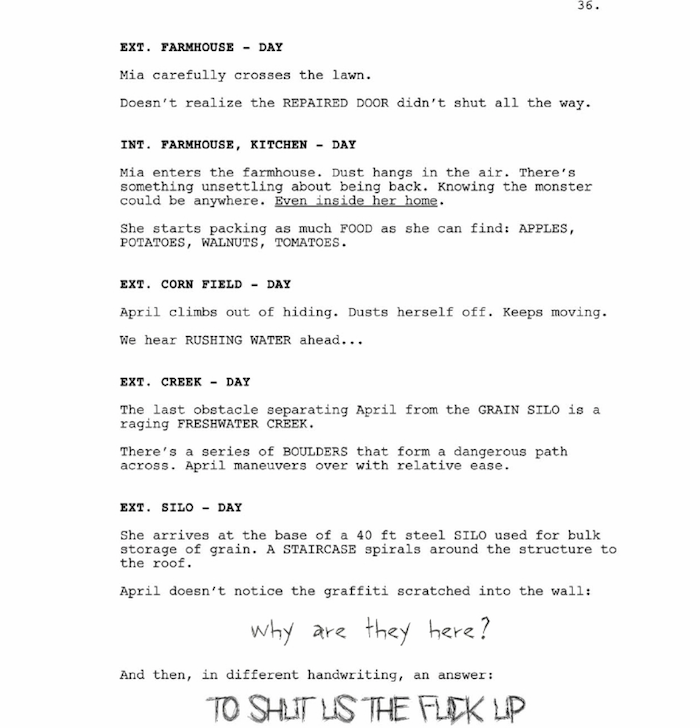
Scott Beck: We were looking at the Walter Hill and David Giler draft of Alien, and Dan Gilroy’s draft of Nightcrawler, and were just really in awe of how they were able to use words and spaces on the page to really just convey a mood, a tone, and a pace as well. That was always super important for us to crib from them.
Scott Myers: Yeah, that ‘haiku style of screenwriting, that’s what Walter Hill calls it.
Scott Beck: Exactly.
Scott Myers: As a response to people reading this script, I thought it was great that you do this because I can’t, in my mind, wrap my head around where this idea of screenwriting rules comes from. There’s no rule book, but people keep popping up. This is why these flame wars happen online on the most stupidest things.
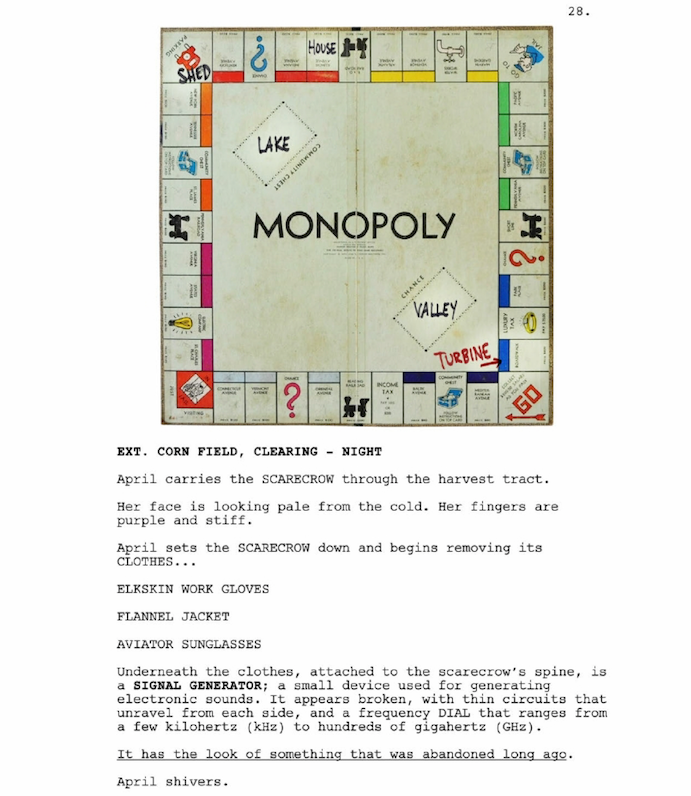
I saw a Reddit thread and one of the commenters said, “I guess my point is, why can’t you be different? Why can’t you try doing your own thing? If a 68‑page spec horror by two relative unknowns, filled with Photoshopped pictures of buildings, buttons and Monopoly boards can get bought by Paramount, then surely anything is possible.” Do you think that’s a good lesson there for writers?
Scott Beck: Yeah, I think it certainly is. I believe the reason that we were able to forge ahead with that notion was because we had a backup plan. We knew if nobody cares about this, the two of us are so passionate about this idea that we’ll go off and make this.
Again, we wrote it for a certain degree of production where it could have been shot for 50 thousand dollars.
Of course, it wouldn’t be the exact same movie and maybe the set pieces would’ve been pulled back a little bit, but we were trying to design things on a page that we could totally foresee how those could be created on the cheap.
Bryan: I would also add to that that we were doing it for a reason. It’s funny because some of the stuff we’re doing on the page is incredibly gimmicky. That we would not be caught dead writing that way in certain other scripts.
It’s not a style that we have used in hardly anything else we’ve done, but it was true to the vision of this particular movie, which is a bizarre silent film that is, we felt, unlike anything people had seen in theaters. We just wanted to make sure that was captured on the page. It’s not necessarily something we’d do for anything.
I think you can break all the rules you want. If you have a darn good reason to do so, why not?
Scott Myers: That’s probably the safe takeaway for people. If it services the story, you can do it. If not, then it’s a gimmick. I’m a teacher and the script goes into my small category of scripts where the writers brazenly break these so‑called rules. Another one, and quite a contrast in tone, is (500) Days of Summer, where Scott Neustadter and Michael Weber said, “Screw it. Let’s go crazy and break every rule.”
In both cases what they did, what you guys did, it serviced the story. Again, as long as you’re doing that and what you write is clear to the reader, I think you can feel free to do anything you want.
Scott Beck: Exactly.
Scott Myers: I have one last question before I move into talking about the movie itself and production and all that. In your version of it, the micro‑budget version you would have in Iowa if you went back and did it, were you planning on having any soundtrack music at all?
Bryan: Not necessarily, although we did love the idea of keeping it sparse and quiet. We always knew that… In the areas where we failed as writers in terms of intent, emotion, backstory, etc., we knew that music and score would be an amazing piece of storytelling. That score can indicate so much more than words sometimes. We knew that would be something we’d have to lean on quite a bit.
Scott Beck: I think we also recognize that a lot of that heavy lifting could be achieved through sound design as well, which was one of the big reasons that we even wanted to write this. As fans of great movies and as filmmakers, sound is one of your greatest tools.
We felt that in a perfect world, A Quiet Place could be an incredible showcase for simply just the sonic atmosphere that accompanies the story.
Scott Myers: Yeah, well the soundtrack is great. That one theme is really [makes eerie sound] .
[laughter]
Scott Myers: It really does highlight the importance of sound even in the theater experience because you’re hearing people with their hands in the popcorn box…
Scott Beck: Yeah, our biggest fear with this film is that somebody’s going to get in a huge fight over chewing popcorn too loudly in the movie theater and annoying everybody.
Scott Myers: I honestly did cast a nasty look at the woman seated next to me who was chomping on popcorn.
[laughter]
Bryan: You’re not alone. You’re not alone. We have many stories of this. This is so funny.
Tomorrow in Part 5, Bryan and Scott provide some background on a horror movie they co-wrote and co-directed Haunt as well as answer some craft questions.
For Part 1, go here.
Part 2, here.
Part 3, here.
Scott and Bryan are repped by ICM Partners and Madhouse Entertainment.
Twitter: @beckandwoods.
For nearly 200 Go Into The Story interviews with screenwriters, filmmakers, and Hollywood insiders, go here.