Interview (Part 4): Samantha Buck and Marie Schlingmann
An in-depth conversation with the co-writers and co-directors of the movie Sister Aimee which premiered at the 2019 Sundance Film Festival.
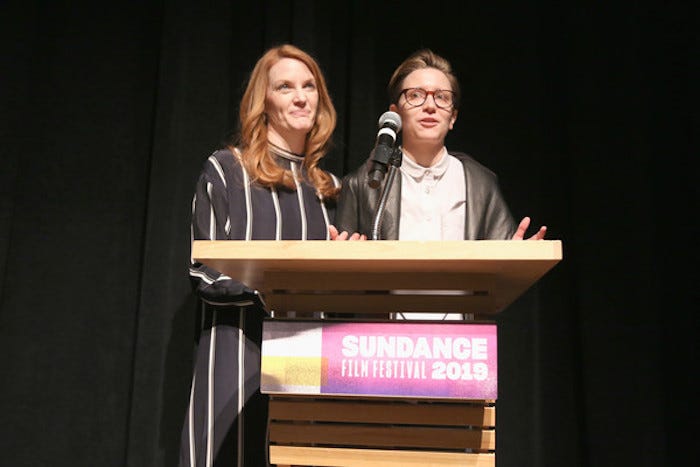
An in-depth conversation with the co-writers and co-directors of the movie Sister Aimee which premiered at the 2019 Sundance Film Festival.
The very first movie I saw at this year’s Sundance Film Festival was Sister Aimee. It was a 9:30AM screening on a Monday morning. I am not a morning person, so the fact I was so taken by this film should tell you something about how entertaining it is.
In watching the post-screening Q&A with the film’s co-writers and co-directors Samantha Buck and Marie Schlingmann, I was so struck by the story behind the story of how this project came to be, I decided I needed to interview the pair. I got in touch with their manager Lee Stobby which led to a 45-minute conversation which I am happy to share over the course of this week.
Today in Part 4, Sam and Marie go into detail about Rey, the third primary character in the story and one of the most interesting.
Scott: I wanted to get to Rey because she is a really terrific character in the movie and has a profound influence on Aimee. They develop a very special connection. Rey is basically going to help them get to Mexico because she is familiar with the area, she speaks Spanish.
Over time, Aimee’s affection shifts from Kenny to Rey. I saw in an interview with you at Sundance where you said, “We thought that it would be an opportunity to fictionalize and talk about female identity.” Could you talk a bit about that and how it plays out with Aimee and her relationship with Rey?
Samantha: Yeah, we’ve always though of these two women as soul mates in their quest. In life, they’re both really good at what they’re doing and they’re very subtle. In a way, they’re both in very male‑dominated worlds. If it’s just thinking, “Where’s a guide?” or “She’s a fighter” and Aimee is an evangelist. They share this identity, but they’re also very definite. There’s also elements of misunderstanding in their relationship.
There is an element of fetishization from Aimee’s part that Rey has to call out. It was this relationship, which is really, at the end of the day, that’s the romantic relationship of the movie and more so than Aimee and Kenny.
It gave us an opportunity to explore where identity can overlap and what the limits of that are, and how important it is to be able to claim an identity. If you can’t, then that is the one thing that becomes overwhelming in your life. You want to claim it or you want to reclaim it.
Scott: Aimee is absolutely dealing with the question of “who am I,” right?
Samantha: Yes, absolutely. Because, in the beginning, she is the image that everybody else has of her. She is this larger than life thing that she created and she’s lost her connection to it.
From the whole movie, it’s her running away from it. Being, quite literally, identity‑less in moments, she is not the person pulling the strings in every part of the movie. She is being put into the back seat of that car and that’s where she has been, pretty much without an identity.
On her way back, she has to go all the way where…There’s this moment in Mexico when she looks into the papers and the papers have been tracking what the people in LA say about her. She’s very angry about what people have been saying.
Then there’s this moment when she’s in Mexico and looks into the newspaper, and she’s nowhere in the newspaper. That is even worse. She has to go all the way away from her identity in order to claim it back and fully. That’s why we put the title in the end of the song.
Marie: They are both creating narratives around themselves or want to. They’re closer than maybe you would think if you’d just look at their lives.
Samantha: Yeah. I think quite the nature of Rey’s life in terms of she should be a larger‑than‑life, famous personality. She’s just not given the privilege of being able to be identified for all of the things that she’s done. She was a great warrior in the Mexican Revolution. She is other things that we can’t say they don’t know it, anyway.
Her life experience is not getting credit for the things that she’s done versus Aimee. She’s fought for her position of power, and for her fame, and her fortune, and her audience, no doubt, but…
Marie: She’s also given that away on her own account.
Samantha: Yeah. She’s able to give something away. At some point, she’s able to get credit for the things that she does versus Rey has never been given credit.
This video provides a sense of how much of a celebrity McPherson was. As she returns to Los Angeles from a nationwide preaching tour, she is greeted at the train station by an adoring crowd and a marching band:
Tomorrow in Part 5, Sam and Marie share details about the movie’s shoot which lasted all of 20 days.
For Part 1 of my interview with Marie and Samantha, go here.
Part 2, here.
Part 3, here.
For more exclusive Go Into The Story interviews with screenwriters and filmmakers, go here.